
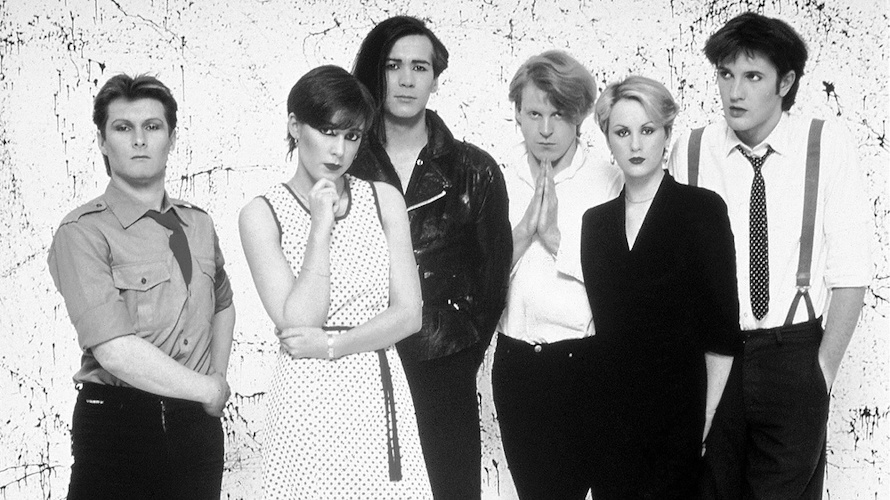
The Human League 1981 (fltr: Jo Callis, Joanne Catherall, Philip Oakey, Philip Adrian Wright, Susan Ann Sulley, Ian Burden)
Introduction
On January 12, 1982, I saw The Human League on television for the first time. In the Dutch Toppop studio, the band mimed to Don’t You Want Me, a classic pop song that was entirely electronic yet sounded completely human. Let’s go back to 1981, the year Dare was released.
The Human League
After experimenting with the names The Dead Daughters and The Future, Philip Oakey joined Ian Craig Marsh and Martyn Ware’s duo in 1977. Oakey may have had little musical knowledge or experience, but “he already looked like a pop star”. In early 1978, the group officially became The Human League. Their demo recordings found their way to an independent record label, and in June 1978, the band released its debut single, Being Boiled. On June 12, 1978, The Human League played its first live show.
Musically, the band showed promise, but its image was a little too stiff and awkward. Enter Philip Adrian Wright, who was brought on board as Director of Visuals. From then on, the live shows featured slides, film projections and lighting effects. It did the trick. The Human League started attracting attention, and their concerts began drawing celebrity guests. One of them was none other than David Bowie, who declared that he “had seen the future of pop music”.
In April 1979, the band released the EP The Dignity Of Labour. Just a month later, The Human League signed with Virgin Records. Their debut album, Reproduction, arrived in August that year, but promptly flopped. The EP Holiday ’80, released in April 1980, fared a little better. A month later, the band followed it up with its second album, Travelogue.
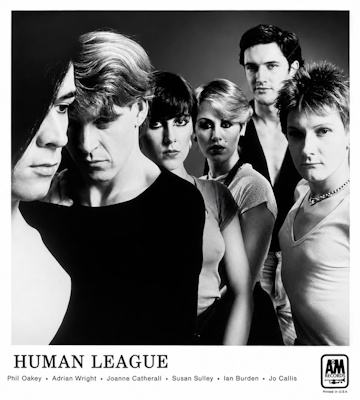
The Human League – Press photo US 1981
It didn’t take long for the band to split into two camps. Marsh and Ware left, handed the band name over to Oakey, and went on to form a new group, Heaven 17. Oakey was left with half a band, a pile of debts and a tour due to kick off within days. Wright gradually shifted his focus towards playing synthesizers, while Ian Burden was brought in to help out on the tour. On a night out, Oakey spotted two 17-year-old students, Joanne Catherall and Susan Ann Sulley, and asked them if they’d like to join the tour as dancers and backing vocalists.
Meanwhile, the musical landscape was changing. Artists such as Gary Numan and Ultravox were riding the wave The Human League had helped create, blending arty electronic music with pop and scoring major hits in the process. Oakey saw what was happening and felt vindicated in his belief that the band’s sound needed a stronger pop element.
After the tour, Oakey offered Catherall and Sulley permanent places in the band. Following a minor hit with the single Boys And Girls, The Human League crossed paths with producer Martin Rushent. Together, they recorded The Sound Of The Crowd, which was released as a single and climbed to No. 12 on the UK chart. With new member Jo Callis on board, the band’s next single, Love Action (I Believe In Love), soared to No. 3.
The Human League had momentum on its side, so the band headed into the studio to record a new album. Their sound was evolving, with less room for experimentation and a much stronger emphasis on pop. The results were immediate: bigger hits followed. Could the album deliver even more? All signs pointed to yes. Just before its release, the single Open Your Heart broke into the UK Top 10.
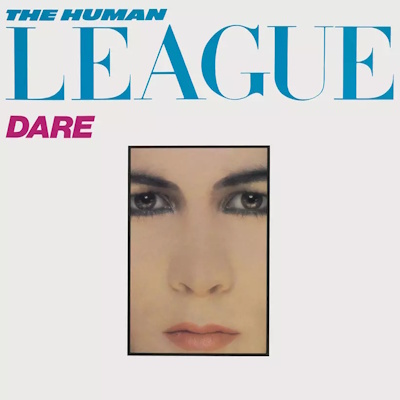
The Human League – Dare
Dare
On October 16, 1981, The Human League released their third album. The first album by the new line-up was titled Dare, although in almost every market it was also released as Dare!. The band currently uses Dare on its social media channels, so that’s the title I’ll stick with throughout this article.
Critics embraced the album, and it ended up in year-end lists around the world. More than four decades later, it continues to feature on all-time best album lists. At the time, Dare was filed under the new wave umbrella, but its legacy would grow far beyond that label. In later years, The Human League, and Dare in particular, became associated with the New Romantic movement, a connection the band itself firmly rejected.
The impact of Dare was immediate, and its influence would prove enormous. Synthesizers were no longer the preserve of experimental musicians and art-school outsiders: they were suddenly front and center, driving irresistibly catchy pop songs straight into the charts. Synth-pop had arrived, and it was about to change the sound of pop music. The Human League showed that electronic music could be sleek, emotional, accessible and hugely commercial without losing its distinctive character. That combination caught on around the world. In the United States, the band helped open the floodgates for the so-called Second British Invasion of the early 1980s, when British acts reshaped the American pop landscape. And then there was the look: bold, polished and unapologetically glamorous. With their striking, almost Vogue-esque image, The Human League helped make glamour fashionable again. Dare wasn’t just a hit album, it was a glimpse of pop’s future.
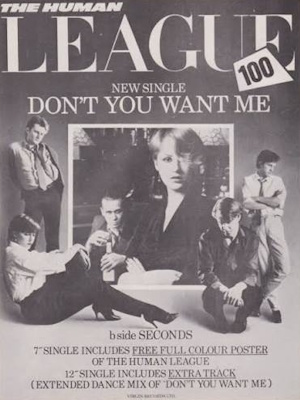
The Human League – Don’t You Want Me – Ad
It soon became clear that Dare was the right album at exactly the right time. It was a huge critical and commercial success, thanks in no small part to a canny choice of singles. The fourth single was Don’t You Want Me, a song Philip Oakey considered little more than filler. He was firmly opposed to releasing it as a single, but Virgin had other ideas and pushed ahead regardless. The result? A global smash hit of monumental proportions. The song topped the UK charts at Christmas 1981, a particularly prestigious achievement in Britain, where the Christmas No. 1 holds a special place in popular culture. The Human League would never score a bigger hit. Don’t You Want Me is even credited with saving the Virgin label, thanks to the enormous revenue it generated, followed by the phenomenal sales of the Dare album.
The Human League’s singles were accompanied by carefully crafted music videos that made the band’s image an integral part of the experience. Glamorous, modern and unmistakably electronic, they nevertheless retained a strong emotional pull. That contrast lay at the heart of Dare itself. The music was often described as ‘cold’, a label frequently applied to electronic music at the time, yet the melodies and vocals were steeped in drama, emotion and outright melodrama. The machines might have sounded cool, but the feelings were anything but.
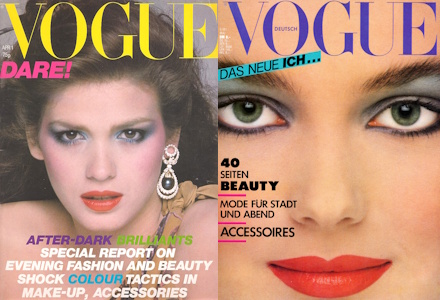
The Human League – Dare – Cover inspiration (Vogue UK April 1979 & Germany May 1981)
Album Artwork
Philip Oakey came up with the album’s visual concept, drawing inspiration from Vogue, particularly the April 1979 UK edition and the May 1981 German edition. He wanted the album to have that same high-fashion aesthetic. Oakey appears on the front cover, Sulley and Catherall on the gatefold, Wright on the back cover, and Callis and Burden on the inner sleeve. The artwork varies between editions, but the overall concept remains the same: close-up portraits of the band members against a white background. In mid-2006, Sulley recalled: “We wanted people to still be able to buy the album in five years, we thought that hair styles would be the first thing to date. We had no idea people would still be buying it 25 years later.”
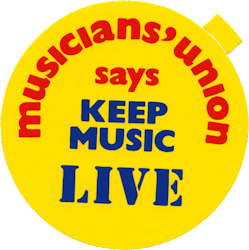
Keep Music Live
When Dare was released, traditional musicians were up in arms about electronic music, convinced that it would mean less work for “real” musicians. Resistance to new developments and the criticism that comes with them are nothing new, but the hostility was almost palpable. The Human League became a prime example in the Keep Music Live campaign. Using synthesizers was dismissed as nothing short of cheating, and bands such as The Human League, lumped in with the New Romantics, were accused of not “performing live” when they took to the stage. The same tired arguments are still trotted out today against musical genres such as rap, hip-hop, dance and house.
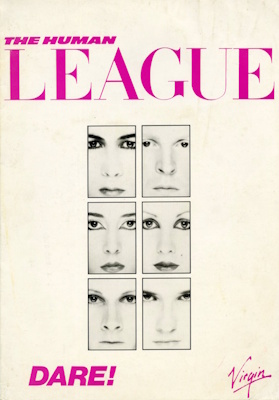
The Human League – Dare – Ad
Review
On January 12, 1982, an appearance by The Human League on Toppop was broadcast, marking the band’s first appearance on Dutch television. The lead singer had a half-long, half-short black hairstyle, wore high heels and sported plenty of makeup. The female singers and dancers were heavily made up, and the music was fresh and innovative yet undeniably catchy. Two months after its initial release, Don’t You Want Me had finally made its way to the Netherlands. I was 15 at the time and (again) making the transition to Japan and David Sylvian. The 2-Tone ska revival was already behind me, and this new electronic sound hit the spot.
I didn’t buy the album at the time, but The Human League stayed with me, especially through later singles such as (Keep Feeling) Fascination and The Lebanon. The combination of electronics, vocals and genuine emotion was something special, something uniquely their own. They weren’t the most technically accomplished musicians, but that hardly mattered. The old saying that “the whole is greater than the sum of its parts” could have been written specifically for The Human League.
That is certainly true of Dare. Only the instrumental Get Carter adds little to the album, while all the other tracks range from good to excellent. A song like Seconds, which LCD Soundsystem also covered on their Electric Lady Sessions album, shows that The Human League had their hearts in the right place. The same was already evident on the early single Being Boiled and, as mentioned earlier, on The Lebanon.
A lot of music from the early 1980s sounds dated today, but despite its instrumentation and the relatively primitive drum machines and synthesizers of the time, Dare still sounds great. The humanity in the vocals and melodies gives the album a timeless quality. Highly recommended!

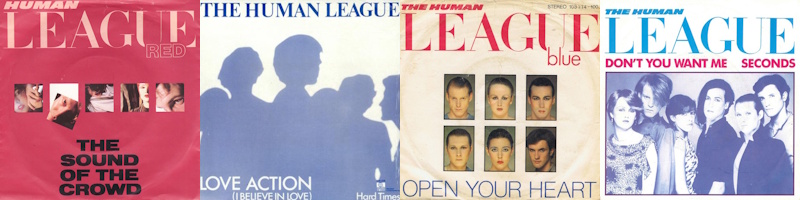
The Human League – Dare – Singles
Singles
Four singles were culled from the Dare album.
- The Sound Of The Crowd
(released on April 24, 1981) - Love Action (I Believe In Love)
(released on July 31, 1981) - Open Your Heart
(released on October 2, 1981) - Don’t You Want Me
(released on November 27, 1981)
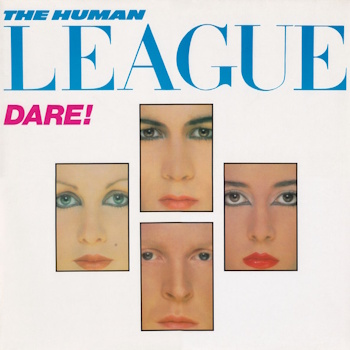
The Human League – Dare – Alternate cover
Songs
Composers between brackets.
- The Things That Dreams Are Made Of (Philip Oakey, Philip Adrian Wright)
- Open Your Heart (Jo Callis, Philip Oakey)
- The Sound Of The Crowd (Ian Burden, Philip Oakey)
- Darkness (Jo Callis, Philip Adrian Wright)
- Do Or Die (Ian Burden, Philip Oakey)
- Get Carter (Roy Budd)
- I Am The Law (Philip Oakey, Philip Adrian Wright)
- Seconds (Jo Callis, Philip Oakey, Philip Adrian Wright)
- Love Action (I Believe In Love) (Ian Burden, Philip Oakey)
- Don’t You Want Me (Jo Callis, Philip Oakey, Philip Adrian Wright)
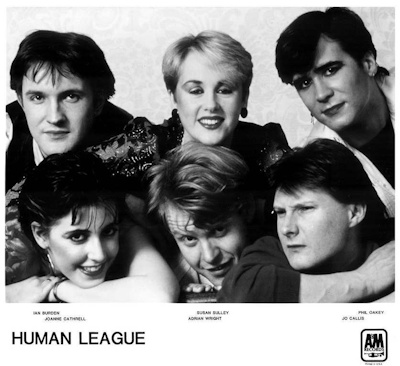
The Human League – Press photo US 1981
Musicians
- Philip Oakey – vocals, synthesizers
- Joanne Catherall – vocals
- Susan Ann Sulley – vocals
- Ian Burden – synthesizers
- Jo Callis – synthesizers
- Philip Adrian Wright – slides, synthesizers
Helped by
- Martin Rushent, Dave Allen – programming
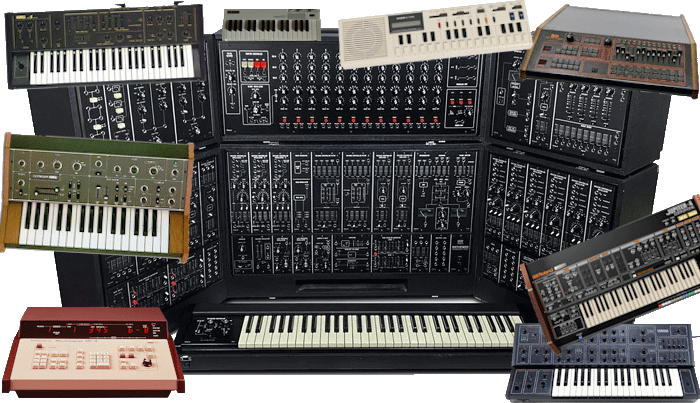
The Human League – Dare – Equipment
Equipment
All the equipment used on the album was first documented in an article titled Taking the All-Synthesizer Sound to the Top Ten, published in the December 1982 issue of Keyboard magazine.
- Casio M10
- Casio VL-1
- Korg 770
- Korg Delta
- Linn LM-1
- Roland Jupiter-4
- Roland MC-8
- Roland System 700
- Yamaha CS-15
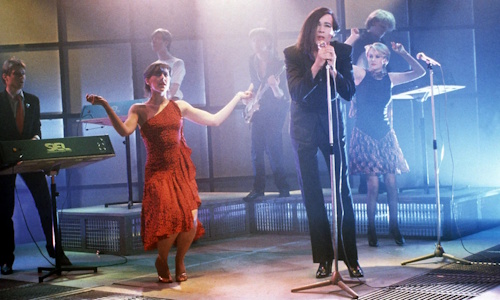
The Human League – Toppop 01/12/1982
After Dare
In 1982, The Human League released a remix album of Dare under the pseudonym The League Unlimited Orchestra. Titled Love And Dancing, it reached No. 3 on the UK charts. The singles Mirror Man and the fantastic (Keep Feeling) Fascination kept the band firmly in the spotlight. However, recording a follow-up to Dare proved a struggle. In the US, the EP Fascination! was released to tide fans over. In May 1984, the magnificent The Lebanon arrived, a guitar-driven single with a political edge, quickly followed by the album Hysteria. Later that year, Philip Oakey teamed up with Giorgio Moroder for the single Together In Electric Dreams, followed by an album.
The Human League soon ran into trouble. Callis left the band, which relocated to Minneapolis to record its next album with production duo Jimmy Jam & Terry Lewis. Released in 1986, Crash featured the global hit Human, but the band was unhappy with the result. The music sounded like a typical Jam & Lewis production rather than The Human League. The band began to fall apart, and with a different line-up, the band recorded Romantic?, released in September 1990. The album flopped, and Virgin subsequently dropped the band.
The band went on to release three more albums: Octopus (1995), Secrets (2001) and Credo (2011), none of which made much of an impact. The Human League continued to tour regularly and remains a popular live act to this day. Ultimately, the success of Dare proved impossible to replicate, something the band was all too aware of. They even embarked on tours celebrating the album, including the Dare! 2007 tour and the Dare 40 tour in 2021.
In closing
What do you think of The Human League, and Dare in particular? Let me know!

Video/Spotify
This story contains an accompanying video. Click on the following link to see it: Video: The Human League and the influential Dare. The A Pop Life playlist on Spotify has been updated as well.

