
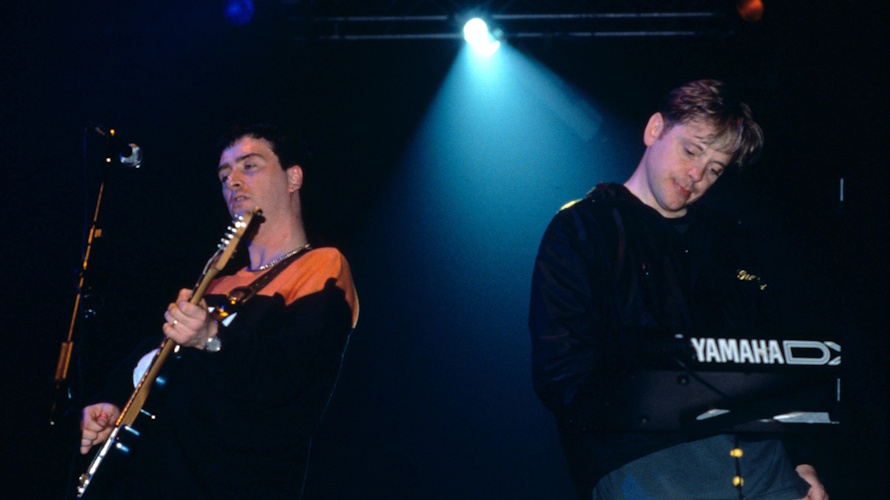
Electronic -Live 12/12/1991 London
Introduction
In 1991, Electronic’s debut album was released, a collaboration between New Order frontman Bernard Sumner and former The Smiths guitarist Johnny Marr. The mix of dance, electronics, guitars, and alternative rock created a strong fusion.
Electronic
In 1984, Bernard Sumner and Johnny Marr met for the first time. At the time, both were still heavily involved with their own bands, New Order and The Smiths. Sumner produced a track for the British-Dutch group Quando Quango, to which Marr contributed. In 1988, Sumner wanted to release a solo album because he was unable to fit all his ideas into New Order. However, he did not enjoy working alone, so he asked Marr for help. They both determined the direction: the project would be electronic, with an emphasis on dance music, which both musicians loved.
The first result of the collaboration was the single Getting Away With It, released on December 4, 1989, using the moniker Electronic. The single was successful, selling over 350,000 copies. It still is the band’s most popular song. The combination of dance and new wave/pop structures worked perfectly, although Marr’s contribution to this track is barely audible. In August, Electronic joined Depeche Mode on tour. After that, work on the debut album began.
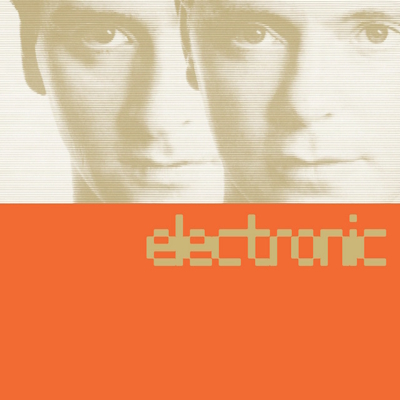
Electronic – Electronic
Electronic
On May 28, 1991, Electronic’s debut album, Electronic, was released. It had been eagerly anticipated as the single had already generated a great deal of goodwill. Besides, how could the combined history of Joy Division, New Order and The Smiths not lead to something magnificent?
In contrast to the single that preceded the album, the album is clearly a meeting of two worlds. Marr’s guitar playing adds value to almost every track on Electronic. The album is characterized by synthpop with a touch of new wave.
There is no overarching theme to be found in the songs on the album, but for the musicians there certainly was one: independence.
The main concept behind the album was independence – a sense of freedom away from groups, sessions and preconceived notions. The album wasn’t actually demoed – we kept everything on computer as long as possible to enable arrangements and keys to be altered when the vocals were written. On parts that were performed live, there was no rehearsal. Once the words were written they were recorded immediately to tape.
© Sound On Sound, Bernard Sumner, October 1991
Electronic was both an artistic and commercial success, selling over 1 million copies worldwide. Both Marr and Sumner were enthusiastic.
It might sound naïve, but the initial idea was to shell out a couple of thousand white labels. That was it. But I think things changed when I realised that Electronic was good. We impressed ourselves much more than we expected. I was really surprised at the way it took off. We weren’t intending on having a really high profile – I suppose it was a bit daft to think we could sneak an album out the back door, as it were!
© i-D magazine, Johnny Marr, 1991
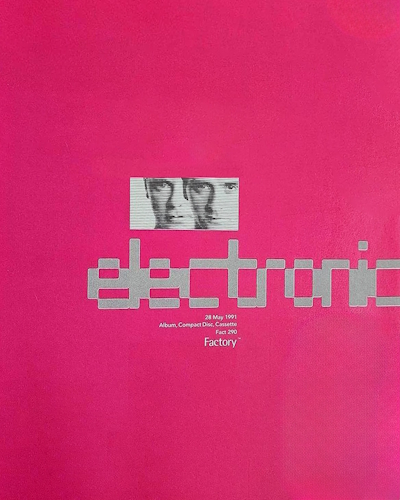
Electronic – Electronic – Ad
Album cover
The album cover consists of two separate photographs that were later combined and displayed on a low-resolution screen. The font used is inspired by New Alphabet by Dutch typographer Wim Crouwel.
Review
So, does Electronic live up to the name “British supergroup”? In name, certainly, but musically less so. Electronic is a very enjoyable album, but the dreamed-of fusion of Joy Division, New Order and The Smiths does not quite materialize.
As is the case on some New Order albums, Electronic lacks a certain level of real energy and excitement. Nevertheless, the album features several highlights, such as Idiot Country, Tighten Up, Gangster, Get The Message and Feel The Beat, where the combination of dance, new wave and pop comes together perfectly.

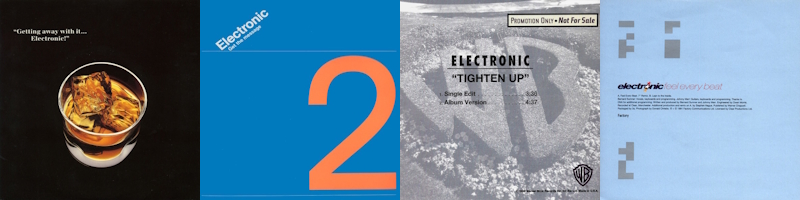
Electronic – Electronic -Singles
Singles
- Getting Away With It
(released on December 4, 1989) - Get The Message
(released on April 15, 1991) - Tighten Up (promo)
(released in July 1991) - Feel Every Beat
(released on September 9, 1991)
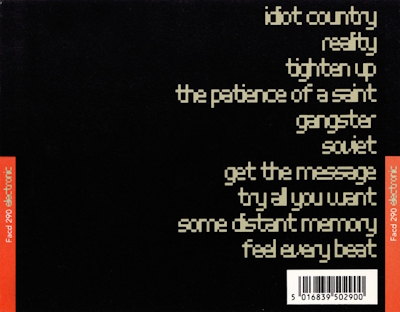
Electronic – Electronic – CD back cover
Songs
All songs written by Bernard Sumner and Johnny Marr, except The Patience Of A Saint, written by Bernard Sumner, Johnny Marr, Neil Tennant and Chris Lowe, Getting Away with It, written by Bernard Sumner, Johnny Marr and Neil Tennant.
- Idiot Country
- Reality
- Tighten Up
- The Patience Of A Saint
- Getting Away With It
- Gangster
- Soviet
- Get The Message
- Try All You Want
- Some Distant Memory
- Feel Every Beat
Getting Away With It was not included on the original UK version.
Musicians
- Bernard Sumner – vocals, keyboards, programming
- Johnny Marr – guitar, keyboards, programming
Guest musicians
- Neil Tennant – vocals on The Patience Of A Saint, backing vocals on Getting Away With It
- Chris Lowe – keyboards on The Patience Of A Saint, synth bass on Getting Away With It
- Donald Johnson – drums, percussion on Tighten Up, Feel Every Beat
- David Palmer – drums on Feel Every Beat, Getting Away With It
- Denise Johnson – vocals on Get The Message
- Helen Powell – oboe on Some Distant Memory
- Andrew Robinson – additional programming
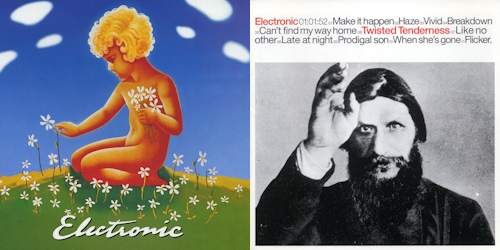
Electronic – Raise The Pressure & Twisted Tenderness
After Electronic
Electronic extensively promoted the debut album and performed a number of shows in England and France. A tour of the United States was canceled. Marr joined The The, and Sumner recorded the album Republic with New Order. In 1992, Electronic briefly reunited with Neil Tennant to record the single Disappointed, which would become their biggest success.
At the end of 1994, work began on the second Electronic album. Marr and Sumner were joined by former Kraftwerk percussionist and composer Karl Bartos. It was not until July 8, 1996 that Raise The Pressure was released. The album was less well received than the debut, both by the press and the public.
Again, the band did not go on tour. The idea was to quickly record a new album with the addition of a bassist and drummer. On April 12, 1999, the result, Twisted Tenderness, was released. It was well received by the press but was not a commercial success.
Since then, no new material has been released by the band. Neither Marr nor Sumner has ever officially announced that Electronic no longer exists. In the March 2023 issue of Undercover, Marr was asked the following question: “Did Electronic come to a natural conclusion?”
Yeah. It did. I am really proud that we still got a friendship that is really strong. […] I think with Electronic we did as much as we were ever going to do. My only regret is that Electronic didn’t put out more records. We were together every single day, more than anyone else I have ever been involved with. I think this idea that we were a project and would get together every couple of years and make a project is false. In fact we were together every single day. When we took a break from working and being in the studio and writing these beats and these melodies, we would get on a boat and go sailing together. I have never been closer to anyone than I was with Bernard. I’m glad that we called it a day in a cool way.
© Undercover magazine, 03/23/2008
Marr and Sumner performed together again in January 2006 and July 2013, but Electronic has never reunited.
In closing
What do you think of Electronic as a band and Electronic as an album? Let us know!

Video/Spotify
This story contains an accompanying video. Click on the following link to see it: Video: The story of Electronic. The A Pop Life playlist on Spotify has been updated as well.

