
|
|
This article belongs to the story Eno and Byrne create history: My Life In The Bush Of Ghosts. |
Introduction
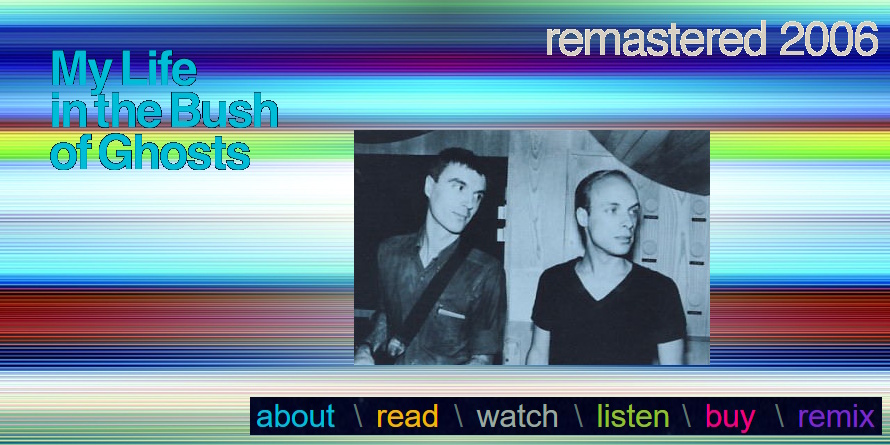
In 2006 My Life In The Bush Of Ghosts was remastered and re-released. The release coincided with the lauch of a website: www.bush-of-ghosts.com, which is not operational anymore. A part of the information that was made available is recreated in this sub article. The majority of the texts can be recreated/found in some form or antoher. Much of the image-, video- and sound-material has unfortunately been lost or isn’t available in the way it was presented in 2006.
Copyrights and intellectual property courtesy of Brian Eno and David Byrne.
Reading guide
The information that was published on the website and in the booklet (that was part of the remastered release) is rather extenseive, so an index may not be an inconvenience.
- Home page
- Press kit
- Credits
- Essay David Byrne
- Essay David Toop
- Essay Paul Morley
- David Byrne’s book selections
- Press 1981 – Los Angeles Times
- Press 1981 – Rolling Stone
- Press 1981 – Musician
- Press 1981 – Trouser Press
- Press 1981 – Village Voice
- Press 2006 – Pitchfork
- Watch page
- Studio pictures
- Polaroids
- Alternate covers ’81
- Manipulated covers ’05
- Mea Culpa video
- My Life In The Bush Of Ghosts original sequence
- Quotes

www.bush-of-ghosts.com – menu
Home page
The www.bush-of-ghosts.com website’s home page gave access to a number of sub pages, about, read, watch, listen, buy and remix. The last 4 pages have more or less disappeared, but I was able to reconstruct most of the first 2 pages. Part of the information offered in this article can also be found/read in (the booklet accompanying) the 2006 remaster of My Life In The Bush Of Ghosts, which was the motive behind the website.
intro
My Life In The Bush Of Ghosts came out in 1981. Over the last decades, hundreds of artists in genres ranging from DJs to alternative to electronic have all borrowed from its ideas and claimed its influence. It is now being re-issued in a beautiful new package, with extensive liner notes and photos, and featuring 7 previously unreleased tracks from the original album and a film by influential artist Bruce Conner.
download/remix/share
This is the first time complete and total access to original tracks with remix and sampling possibilities have been officially offered on line. In keeping with the spirit of the original album, Brian and David are offering for download all the multitracks on two of the songs. Through signing up to the user license, and in line with Creative Commons licenses, you are free to edit, remix, sample and mutilate these tracks however you like. Add them to your own song or create a new one.
Visitors are welcome to post their mixes or songs that incorporate these audio files on the site for others to hear and rate. To launch the Remix site click here[link unavailable]!
watch
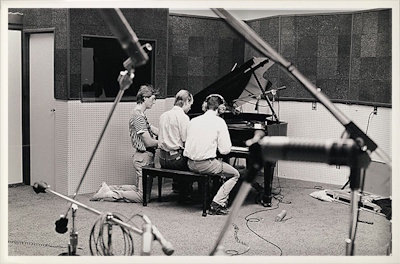
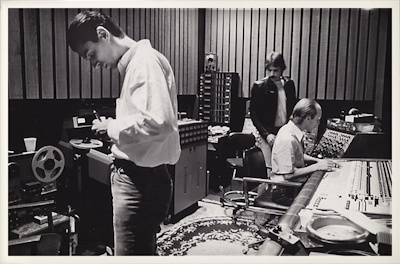
Images of all types. Brian and I took pictures off a video monitor for possible covers, skewing the color of the TV and using the same process to do some Polaroid self portraits. Re-release CD designer Peter Buchanan-Smith skewed the original cover to make the new cover- alt versions are here too. Hugh Brown came by the studio while we were in LA and took some pix which he recently discovered. There is a hi rez streaming version of the film that artist and filmmaker Bruce Conner did for the song Mea Culpa, never before seen, except maybe in some galleries and museum retrospectives. Lastly, there are images of the vinyl covers of the records on which we found some of these sounds.
read
There was surprisingly little press on this record when it came out for all the people who say it affected them. Reading some I see that Jon Pareles, now of the NY Times, was the one who accused us of cultural imperialism. We’re right there alongside McDonalds, Coke and the World Bank. Since then Jon has become an avid proselytizer for “world” music, so we’ll cut him some slack.
There are some recent essays here from writers David Toop and Paul Morley. I wrote one about the making of the record, and some excerpts from the wonderful Amos Tutuola book that gave the record its name.
about
In this section you can read official press info and album credits, and visit websites for more info about those involved in this project.
For promotional use, hi-res photos and press docs are available for direct download; to gain access to this password-protected site, email [link unavailable].
www.bush-of-ghosts.com – watch
Press kit
The press kit was part of the about page on the www.bush-of-ghosts.com website. The same page contained a download link for third parties. The link and its content are no longer avilabale.
BRIAN ENO / DAVID BYRNE
‘My Life In The Bush Of Ghosts’Remastered + bonus tracks | Release Date: 11 April 2006
Nonesuch Records & EMI are proud to announce the release on April 11 of seminal collaborative album ‘My Life In The Bush Of Ghosts’ by Brian Eno and David Byrne. Originally released in 1981, and recorded 25 years ago, this critically lauded album was the first mainstream release to heavily incorporate ‘found sounds’ and ethnic beats.
This new version has been remastered by Greg Calbi at Sterling Sound (Interpol / Kings Of Leon) and features eight bonus tracks. These extra tracks are outtakes and ideas from the album’s sessions from throughout 1979 and 1980 and have been specifically chosen by David and Brian.
The packaging will differ from all previous Eno reissues – a jewel case within a slipcase, plus very special added extras. The slipcase and artwork have been designed by Peter Buchanan Smith (Wilco’s ‘A Ghost Is Born’), and 24 pages of sleevenotes have been provided by David Toop and David Byrne.
David Byrne has personally overseen the tracklisting and remastering.
Please read Paul Morley’s specially commissioned notes on ‘My Life In The Bush Of Ghosts’.
www.bush-of-ghosts.com – watch
Credits
The credits were part of the about page on the www.bush-of-ghosts.com website. They were also contained in the booklet of the My Life In The Bush Of Ghosts 2006 re-release.
BRIAN ENO / DAVID BYRNE
‘My Life In The Bush Of Ghosts’Album Credits | Website Credits
All songs written by Brian Eno + David Byrne, except #s1 (Arranged by Brian Eno, David Byrne, Bill Laswell, Tim Wright, and David van Tieghem) and 3 (Written by Brian Eno/David Byrne/Busta Jones, Arranged by Brian Eno, David Byrne, Busta Jones, Chris Frantz, and Robert Fripp.) All songs published by E.G. Music, Ltd. (BMI)-Index Music/Bleu Disque Music Co., Inc. (ASCAP)
Brian Eno and David Byrne : guitars, basses, synthesizers, drums, percussions, found objects John Cooksey : drums, track 4 Chris Frantz : drums, track 3 Dennis Keeley: bodhran, track 2 Mingo Lewis : bata, sticks, track 5,8 Prairie Prince : can, bass drum, track 5,8 Jose Rossy : congas, agong-gong, track 7 Steve Scales : congas, metals, track 4 David van Tieghem: drums, percussion, track 1,3 Busta Jones: bass, track 3 Bill Laswell : bass, track 1 Tim Wright : click bass, track 1 Rookson 4 courtesy April Potts, Eglingham Hall.
Produced By Brian Eno and David Byrne
STUDIOS:
RPM, New York, NY, August 4 & 16, 1979
Engineer: Neal Teeman
Assistant Engineer: Hugh DwyerBlue Rock, New York, NY, September 5, 1979
Engineer: Eddie Korvin
Assistant Engineer: Michael EwaskoEldorado, Los Angeles, CA, February & March 1980
Engineer: Dave Jerden
Assistant Engineer: George SloaneDifferent Fur, San Francisco, CA, April 1980
Engineer: Stacy Baird
Assistant Engineers: Don Mack, Howard JohnstonSigma, New York, NY, October 1980
Engineer: John Potoker
Mastered by Greg Calbi at Sterling Sound, New York, NY, April 28, 2005DESIGN:
CD Package Design by Peter Buchanan-Smith
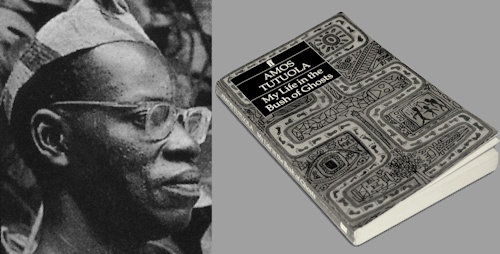
Title from the book My Life in the Bush of Ghosts by Amos Tutuola (Grove Press)
Excerpt copyright © 1954 by Grove Press. Used by permission of Grove/Atlantic, Inc.
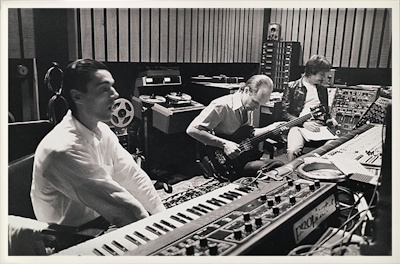
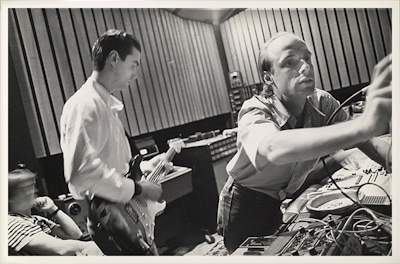
Booklet cover image: Studio photography by Hugh Brown
Original package design by Peter Saville
Special thanks to Dave JerdenThis Website Design and development: FDTdesign
Marco Moretti (CD) / Katherine Hill (PM) / Matt Shultz (PHP) / Manu Reyna, Thiago de Mello Bueno, Caleb
Johnston, Mariana Martin CaprilesRemix Website Design and development: Mook
Nonesuch Records Web Consultant: Larry R. Larson, Larson Associates, NYC
www.bush-of-ghosts.com – watch
Essay David Byrne
The David Byrne essay was part of the read page on the www.bush-of-ghosts.com website. It’s also contained in the booklet of the My Life In The Bush Of Ghosts 2006 re-release.
The Making Of My Life In The Bush of Ghosts
By David Byrne with Brian Eno, April 2005
1979 – Talking Heads had just completed what for us was a long world wide tour after our Fear Of Music record came out. I then took some time to collapse and recuperate in NY. During this time Brian and Jon Hassel and I began to spend some time together enthusiastically exchanging cassettes and vinyl that we had each found. I seem to remember Jon playing some Milton Nasciamento, which I didn’t get at the time. I myself had a new fascination with African pop music, although aside from Fela there was little information available about any of the artists. There was no World Music guides at this point and no internet. We passed around various records, many on the excellent Ocora label- these were often recordings of material previously found on field recordings, but this French label was treating them as if they were “classical” music- the quality of the performances and of the recordings were amazing. I had grown up on the Nonesuch and Folkways field recordings but the production values on these were on a whole other level.
Maybe inspired by these records Brain, Jon and I fantasized about making a series of recordings based on an imaginary culture. We’d make the record and try to pass it off anonymously as the genuine article. This appealed for a number of reasons- it had a lovely Borges like quality, like one of his stories in which an encyclopedia is discovered that describes a hitherto unknown land. It also appealed, I suspect, partly because it would make us as “authors” more or less invisible. In our imaginings we’d release a record with detailed liner notes explaining the way music functioned in that culture and how it was produced- the kind of extensive notes common on those kinds of records.
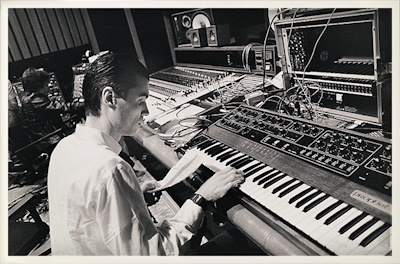
Brian had previously begun work on some recordings that incorporated found voices, and he brought these to the table – one of these pieces became Mea Culpa- it already had layers of vocal loops. There were some instrumental tracking recordings made in NY at this point which I was part of- and these were really Brian’s instigations. It was maybe around about this point that the imaginary culture idea resurfaced. We knocked around the idea of isolating ourselves in the California desert and emerging after a while with a finished record, which we would say wasn’t ours. We did go out to California, but only to LA, which is where the project began in earnest- I believe it was there that we both realized that the “found vocal” idea would be the thread that would pull the record together. We also abandoned the imaginary cultural artifact idea too- at least explicitly, though I suspect this fantasy continued to guide us in a subconscious way. I suspect the found vocal idea also appealed to us as it eliminated any conflict or competition between us as singers (at this point Jon was no longer involved). Neither of us would be singing on our own record of songs.
At one point in LA we were hanging out a bit with Toni Basil, whom we both admired as a innovative choreographer and street dance facilitator – her appearances on Soul Train with the Lockers were unforgettable and the group she was working with and organizing at that time- The Electric Boogaloos, were making some of the most amazing and innovative dance Brian and I had ever seen. They all put the arty avant guard dance world to shame- they were funky and robotic at the same time, a combination that somehow seemed apt for those times.
At one point Toni had an offer to do a TV special featuring these dancers- and for a short while we imagined our record would be the score/soundtrack. This TV project fell apart, but like the imaginary culture idea, this also acted as a kind of subtext for our recordings- we truly imagined we were making a dance record. A new kind of psychedelic dance music that would get played in dance clubs.
We saw that some of the most innovative mixing and arranging was happening in the dance music world, more so than in the rock world, which was becoming increasingly conservative and entrenched. The influence of dub and what were then called “extended mixes” on music outside those worlds was just beginning. In the studio, since neither of us saw ourselves as virtuoso musicians, ( we probably prided ourselves that we weren’t) we tried to turn that into an advantage. We used cardboard boxes as kick drums, bass guitars as rhythm instruments and basically anything that was lying around as a sound source. This had the advantage of making everything sound a little “off”- a kick drum made out of cardboard box did the job but also sounded slightly unfamiliar, fresher.
After a spell in LA we moved up to San Francisco to continue work, as much to enjoy these (for us) exotic California locales as for any other reason.
At that time there were no samplers, so the found vocals were often flown in (this consisted of two tape machines playing simultaneously, one containing the track and the other the vocal) and, if the Gods willed, there would be a serendipity and the vocal and the track would at least seem to feel like they belonged together and it would be a “take”. It was all “played” and very seat of your pants- there was none of the incremental tweaking and time correcting that is possible with modern samplers and computers, throwing the vocals against the tracks was in our case almost a performance. Sometimes we’d record radio sermons after-hours on our cassette players that were built in to our late 70’s boom boxes. The quality was sometimes dubious (on “Come With Us” we had to make the hiss part of the dark ambience)… but overall we came to realize that hi fidelity was vastly overrated- and sometimes the harsh megaphone like quality of these vocals was actually more immediate sounding. Like transmissions from a desperate planet. Other times the vocals often came from those records we’d been listing to over the previous year.
The amazing thing was how easy it was. (well, relatively) And how much the vocals seemed to feel like they had been performed with the “band”. Part of this effect was, of course, in the ear of the beholder- a phenomenon we noticed early on- that the mind found congruencies and links where none really existed. Intention had nothing to do with effect, in this case- a disconnect that was a big problem for pop music critics, but more on that later. More than just a way of tricking the mind, we also felt that when successful this effect also “tricked” the emotions. Some of the tracks at least generated genuine (to us) emotional reactions- it felt like the “singer” was genuinely playing off the music and vice versa, in a way that sometimes generated powerful feelings- uplift, ecstasy, dread or sexy playfulness. Maybe “tricked” the emotions isn’t quite accurate- maybe these passionate voices and rhythms triggered emotional responses because our emotions have “receptors” awaiting this combination of elements, and we were merely providing the materials.
In searching for “vocalists” we gravitated towards the passionate- which we found in pretty disparate places- angry radio talk show hosts, Arabic singers, preachers and radio evangelists. This made it seem that the natural cadences and metric of the impassioned vocal is innately musical – it’s easy to hear this in the sermon of a gospel preacher where the line between singing and speaking is fuzzy, but it is there in talk show hosts and, well, maybe, all speech.
I think some people found all this disturbing. In the West anyway the causal link between the author and performer is strong. For instance, it is assumed that I write lyrics (and the accompanying music) for songs because I have something I need to “express”. And that as a performer it is assumed that everything one utters is naturally autobiographical. I find that more often, on the contrary, it is the music and the lyric that triggers the emotion within me rather than the other way around. By making music we are pushing our own buttons, in effect, and the surprising thing is that vocals that we didn’t write or even sing can make us feel a gamut of emotions just as much as ones that we wrote. In a way making music is constructing machines that, when successful, dredge up emotions- in us and in the listener. For some, this fact is, it seems, repulsive, a trick, a betrayal and deception. Many prefer to see music as an “expression” of emotion rather than a generator of it. This queasiness is connected with the idea of authenticity as well- for example, that musicians who “appear” down-home must be more real. It’s disillusioning to find out that rock and roll is an act and no regular folk in Nashville really wear hats.
All this as a contentious issue was resolved years later by electronic and hip hop artists, whose music in many cases was either not played by them (in the case of hip hop artists)…. or, like us, remained more or less faceless- others were the voices of most electronic artists’ songs.
After finishing an initial version of this record in 1980 (yes?) we set about the task of “clearing” the vocals. This is a common practice nowadays, but back then no one knew what the hell we were up to. The record sat on the shelf while the phone calls and faxes went back and forth. Most of the vocals were cleared, but with a couple of songs we were denied rights. In the intervening time we had returned to NY, and began work on the next Talking Heads record, which would become Remain In Light. We were wildly enthused by all that we’d learnt and experienced on the Bush of Ghosts sessions, so we opted to begin that record as we had with Bush Of Ghosts, with a blank slate.
Eventually the vocals on the initial version of Bush of Ghosts were cleared, but as some time had passed we felt that since we had to re-do the vocals on the legally denied tracks we might as well see if we could improve the others as well. So some additional recording was done and the record was pronounced done. It therefore came out after the Talking Heads record, which lead to some confusion. A lot more people would be dealing with clearances in the future, paying for rights, delaying their releases, though we didn’t know it then.
During the recording both Brian and I had begun reading John Chernoff’s “African Rhythm and African Sensibility” and Robert Farris Thompson’s “African Art In Motion” – two incredibly poetic books that were respectively about music and art, but also seemed to be about a whole lot more. At some point in this African obsession we became aware of Amos Tutuola’s books- and the title of one- “My Life In The Bush of Ghosts”- seemed to encapsulate what this record was about. We hadn’t yet read this particular book (his The Palm Wine Drunkard was more easily available) but the title was perfect, so that became the name of the record.
Some of the bonus tracks included here were on the original version of the record, and some in slightly different forms or mixes. We felt our revised and new material superceded these, but hearing them now they hold up pretty well…if it weren’t for the time limitations of vinyl we would have probably included them all.
– David Byrne (2005)
www.bush-of-ghosts.com – watch
Essay David Toop
The David Toop essay was part of the read page on the www.bush-of-ghosts.com website. It’s also contained in the booklet of the My Life In The Bush Of Ghosts 2006 re-release.
My Life in the Bush of Ghosts
By David Toop, Jan. 22, 2005
…hear our flash-eyed mother who is snoring like strong wind…
Amos Tutuola’s novel, My Life in the Bush of Ghosts, was published in London in 1952. We start with the book, because the title is central to an appreciation of this record. Some titles are afterthoughts, the identification of a product, or they attempt to capture the mood of a collection of songs, but this is a title that stimulates anticipation and controversy, even before the music begins. Questions arise quickly enough; why are these two urban, urbane, successful, and apparently secular white men, Brian Eno and David Byrne, push-pushing in the bush, haunted by ghosts?
Tutuola’s book is strange, not least in the Nigerian English of his text. He writes, for example, about the “television-handed ghostess”, an image that anticipates the musical Afro-futurism exemplified in the 1960s and ’70s by Sun Ra, Funkadelic, Fela-Anikulapo Kuti, Sly Stone, Lee Perry, and Miles Davis. Dylan Thomas described his writing as “thronged, grisly and bewitching”. The book is a visceral accumulation of disgust, fear, torment and humiliation, but its narrative, the tribulations of a young boy who finds himself in a parallel world of weird, frightening ghosts, contains echoes of such familiar stories as Alice In Wonderland, or The Wizard of Oz.
…my voice was entirely stiffened or dead…
In 1979, unsure of his future direction, Brian Eno took a sabbatical in Thailand. In his luggage he carried a number of tapes. Nigeria’s Fela Anikulapo-Kuti was among them, along with a BBC recording of English dialects. Interviewed at the beginning of 1980 by Richard Williams in the Melody Maker, Brian talked about his love of North African singing, and about the discoveries he had made whilst listening to the dialect record, on which redundant information in speech patterns was used to add variety and colour to conversation. “I started thinking about that,” he told Williams. “Mentally, I’d already given up the idea of writing songs… one of the reasons being that, after hearing those Arabs, I’m less interested in the sound of my own voice. So I started thinking that the dialects are already music, and you could point to that fact by putting them in a musical context.” Eno also played Williams a track from the as-yet unreleased My Life In the Bush of Ghosts. “You heard the thing with the phone-in conversation,” he said, “and I’ve been working mostly in that direction, mostly taking radio voices because they’re easy to get hold of, and putting them to music… It satisfies a lot of interesting ideas for me. One is making the ordinary interesting, which I’ve always been interested in doing. The other is finding music where music wasn’t supposed to have been. And another is finding a pre-delivered message, which you put in a context so that the meaning is changed, or the context amplifies certain aspects of the meaning.”
…dancing the ghosts’ dance…
In the early 1970s, radical innovation in black music was rewarded largely with indifference or hostility. As musicologist Jason King has said, “the larger chronological history of African and African-diasporic minimalism hasn’t been written yet.” From the rock (and jazz) perspective, Miles Davis records like On The Corner were barely understood, and the intense trance/funk of James Brown’s “Super Bad”, Sly Stone’s “Africa Talks To You” and Fela Anikulapo-Kuti’s “Gentleman” was dismissed as repetitive, sybaritic, and reactionary. Yet there were signs that dub aesthetics and funk beats were subverting whitebread fantasies of musical sophistication. Punk’s embrace of roots reggae and dub, and the punk-funk of James Chance, heard on the Eno produced No New York album of 1978, were two indications of growing inclusiveness.
…noises as if one hundred winches are working together…
In 1975, released on Eno’s Obscure label, Jesus Blood Never Failed Me Yet, by Gavin Bryars, sampled and looped singing by an old man, homeless yet radiant with faith, orchestrated to the point where sentiment overwhelms cynicism; also in 1975, released on Obscure, American Standard, by John Adams, including extra material taped from an evangelical radio talk show.
In 1948, at the Paris radio station RTF, Pierre Schaeffer invented musique concrète, using machines that could record environmental sounds onto disc, then play them back. “A particular technique devised by Schaeffer was the sillon ferme or closed groove,” wrote Hugh Davies in A History of Sampling (published in Experimental Musical Instruments, 1989), “in which – similar to the later tape loop – a short sound was recorded in a groove that formed a complete circle rather than spiralling inwards. Schaeffer’s diary for 1948 documents the various stages . . . they included the idea of an organ based on gramophone turntables (April 1948), even imagining himself, Hollywood style, surrounded by ‘twelve dozen’ turntables.”
“Composer, who no longer arranges sound in a piece, simply facilitates an enterprise. Using a telephone, he locates materials, services, raises money to pay for them.” (John Cage: Art and Technology, 1969).
In 1951, John Cage composed Imaginary Landscape No. 4, a piece for 12 radios, each with 2 players who controlled parameters. The New York premiere was quiet, because of the late hour and the fact that most radio stations had ceased broadcasting. “Picking up snatches of music and speech,” said one of the performers, Harold Norse, “with lengthy silences in between, it had a disturbing effect.”
This was an idea he had tried before: in his 1960s art student days, looping the speech of an English actress, then “R.A.F.”, his collaboration with Snatch, released as the b-side to “King’s Lead Hat” in 1978, experimenting with German voices laid over and under choppy reggae/funk beats; in the same period he mixed Kurt Schwitters’ 1920s sound poem – “Ur Sonata”, or sonata for primitive sounds – into “Kurt’s Rejoinder”.
1960: For Amazing Grace, Richard Maxfield samples and cuts-up the voice of revivalist preacher James G. Brodie.
1961: For Collage #1 (“Blue Suede”), James Tenney samples the voice of Elvis Presley singing “Blue Suede Shoes”, edits the tape, then composes the fragments with an IBM punch card system.
1965: For It’s Gonna Rain, Steve Reich samples the voice of a black Pentecostal preacher in San Francisco; 1966: For Come Out, Steve Reich samples the voice of Daniel Hamm, a young man arrested and beaten by police during the Harlem riots of 1964. Each phrase – “It’s gonna rain”, and “Come out to show them” – is looped and played simultaneously on two Wollensack tape recorders. “I thought the economy of them was so stunning,” Brian Eno has said. “The complexity of the piece appears from nowhere.”
1966: For Telemusik, karlheinz Stockhousen samples indigenous music from Africa, the Amazon, Humgary, Cina, Spain, Vietnam, Bali, and Japan. “I wanted to come closer to an old, an ever-recurring dream,” he said, “to go a step forward towards writing, not ‘my’ music, but a music of the whole world, of all lands and races.”
…through the noises of these heads…
Bored with New Wave, hungry ears were turning to Nigeria, and the surreal, techno-retro music of Fela, King Sunny Ade, Sir Shina Adewale. Convergences all around: David Byrne contributing post-punk disco guitar to late 1970s tracks by Arthur Russell; Talking Heads’ Fear of Music album, produced by Brian Eno, and featuring a new African influence on “I Zimbra”.
In 1980, Fourth World Vol. 1: Possible Musics, was released as a collaboration between trumpeter/composer Jon Hassell, and Brian Eno. Fourth World was Hassell’s magic realist concept of a ‘coffee coloured’ classical music of the future.
…staggering here and there in the bush…
In 1976, Music In the World Of Islam is released, a 6-LP box set of recordings by Jean Jenkins and Poul Rovsing Olsen. Jean Jenkins, Appalachian banjo player, ethnomusicologist, and curator at the Horniman Museum, London, wrote this in her sleeve note: “The human voice is the foundation of all music within the Islamic world. Indeed, in some areas it is the only type of music which exists.” Her recording of “Abu Zeluf”, sung by Dunya Yunis, a girl from a northern mountain village in Lebanon, is sampled for two tracks on My Life In the Bush of Ghosts.
…as if ten persons are beating drums to my cry…
Drummer Prairie Prince, from The Tubes, remembers his part in the sessions at Eldorado Studios on Hollywood and Vine, alongside percussionist Mingo Lewis, who had played on Santana’s Caravanserai. A drum kit in the studio, painted battleship grey, belonging to The Screamers. “We’re just going to use it as a banging board,” says Brian. A Linn Drum machine was brought in. “First time I ever saw one.” Playing along with loop tracks, plastic garbage cans, taped them all together. “My credit was cans and bass drum, but I played a lot of different things. All three of us played piano. He had thrown some coins into the piano and it made this clanky sound. It was one of the most wonderful recordings I’ve ever done.”
Years later, the influences ripple outwards: The Bomb Squad productions for Public Enemy, Kruder and Dorfmeister, Goldie, 808 State. Few genres of music are left untouched by this experiment.
…if a bush is too quiet there would be fear without seeing a fearful creature…
– David Toop (22 januari 2005)
www.bush-of-ghosts.com – watch
Essay Paul Morley
The Paul Morley essay was part of the read page on the www.bush-of-ghosts.com website.
What if Brian Eno and David Byrne Made an Album that took its Title from a 1954 Book by the Nigerian Writer Amos Tutuola
notes by Paul Morley
As time, funnily enough, goes on, as we slip self-consciously from one century to another, from vinyl to CD to MP3, from our younger days to our older days, patterns start to emerge. We can see more clearly where we have been, and what kind of history we are leaving behind us. We can see what is important, what will last, what we will carry with us into the future to remind us of where we were before time, oddly enough, moved us somewhere else, before it moves us once and for all out of the way.
It is interesting to watch as a kind of rock canon is created, a list of albums that seem to have some kind of worth, that were influenced in such a way that they themselves then became influential. A list of a few hundred albums that we might describe as great, or the greatest, can easily be rattled off, and as the 1900’s drift behind us, and the vinyl age remorselessly trickles backwards to antique status, we often find ourselves in a position where we want to compile such a list. Gradually, a kind of truth starts to emerge, about what these great albums are, about how will ultimately survive what is, after all, truly the test of time. There are some albums that quickly come to mind when it comes to considering some of the favourites to make that journey, albums that seem to have altered the course of rock music, or been very visible on the map as the changes occurred that turned one kind of music in the middle of the century into many others kinds of music by the end of the century. Many other kinds of music, but music that ultimately, however strange, intense, experimental, unexpected, wild or eclectic can be safely said to be the type of music that can be, if it’s possible here to use an old vinyl age expression, filed under pop.
MY LIFE IN THE BUSH OF GHOSTS has elements that are wild, unexpected, strange, intense, experimental and it is definitely, definitively eclectic, but it is absolutely a record that can be filed under pop. Whatever else is going on inside the music, however far some of the sounds have travelled to take their place within the music, however obscure or distant the world was where some of the sounds began their life before they were imported into this bush, however intellectual some of the decisions that were taken about what sound fitted where and with what and for what purpose, if any, other than the basically pleasurable, the essential atmosphere of the record is pop. It is broken up into certain sizes, it is pieced together from pieces as if there is a chorus and a verse, it is repetitive and ever changing. It lasts a certain amount of time, about the length of a pop record, and it organises and manufactures rhythms that instantly familiarise the listener into believing all is well with the world even as other noises and voices imply that something a little fishy, if not downright sinister, is going on.
You file it under pop even if as such it was not a popular success. You file it under pop because, even as agitated and harrowing as it can get, even as potentially middle eastern and African as it can become through the finding, borrowing and stealing that’s going on, the singing and the chanting, it sounds like there is a world, maybe one close to us, or one that’s getting closer all the time, where you can imagine music like this being in the charts. You file it under pop because even though at the time it’s combination of studio invention, avant-garde instinct, rhythmical ingenuity and conceptual smartness seemed to place it a long way from the everyday world of pop, since it’s release, music very much like it, and produced in ways that resemble the techniques of cutting, pasting, taping and layering in operation in the bush, often finds a place in the pop charts. Juxtaposition like this is now nothing new – it wasn’t as such when Eno and Byrne broadcast flat out American craziness from the thundering depths of a make believe African jungle, but it was a lot newer than it is now, and there weren’t many who had the wit, imagination and technical capability to conjure up a world where the Middle East was at the centre of civilisation and the West was a strange freak show in the eerie, fading distance.
The music produced by Eno and Byrne with their like-minded collaborators has become more and more familiar to mainstream ears since they first decided to relieve certain creative urges they were having by dreaming up a new kind of hybrid. They followed the path that others had made – Can with their Ethnological Forgery Series, Jon Hassell with his imaginary electro-acoustic landscapes, and the Residents with their extravagantly detailed Eskimo fantasy – they were beating from the underground into the undergrowth, chasing phantoms, clearing the way so that Eno and Byrne could begin to see a way forward. They wondered what it would be like if pop music had not been so American, or so European, or so disconnected from the rhythms and textures that first inspired the music that first inspired pop. They imagined a future, or even a present, where pop music might sound like this – might in fact sound like it was music that was the pop music of an imaginary society. Their imagining of an imaginary society that was familiar with music like this has helped actually create that world – it’s one of those things that makes certain records have lasting stature, that, by taking forward the ideas and thoughts of others, and shaping them into a new identity and image, they actually do make a difference to the sound, and often the appearance, of the world. The Bush music has drummed its way into the centre of the city. It’s moved in from out there, into the centre, and then into history, which is where the component parts actually began, the loop feeding back on itself, looping from John Cage to Sly Stone, from Sun Ra to the Bush Tetras, from an invisible world to a mass market.
It’s a pop record. It is also one of those albums that come to mind when you consider great rock albums, albums that fit naturally onto greatest lists, because of the story they tell, and the way they tell it. If I was thinking of say 30 albums from between 1950 and 2000 that I would like to transfer forward in time as the best examples of the incredible changes that took place in sound and recording at the end of the 20th century, as the world of sound literally collapsed into grooves, melted down into sonic signals of greater and greater sensualised complexity, as information about ourselves got filtered through the pop song in more and more ingenious ways, then My Life In The Bush Of Ghosts would certainly be one them. Actually, six or seven of the other examples would also feature the involvement of Brian Eno, sometimes when he was part of a double act with a fidgety, thinking city spirit like Byrne – often when he was forging a partnership as if he was trying to find a replacement for Bryan Ferry, his first real straight man. Unless it was Eno that was keeping a straight face. For a while he was his own other half, making solo records with himself that were half sensible, half insensible, and which were the act of a composer making new maps that could join one sort of music with another sort of music and bring experimental dislocation into pop discipline.
Imagine, then, that after the first two Roxy Music albums, the other records Eno was part of, including My Life in The Bush of Ghosts, were still Roxy albums – a continuation of the exploration of sensation begun when the double act was Eno and Ferry.
It is also a Talking Heads album, in the way that the group, whoever it really was, and certainly Bryne and Eno were quickly learning their lines as new double act, had been fascinated with the spirit of African rhythms, and deviant funk, and folding that fascination inside a more conventionally Western – New York – idea of multi-media playfulness.
So it is a Talking Heads album, and it is a Roxy Music album, but nothing of the sort, and it is an album produced by Brian Eno and David Byrne, and it certainly sounds exactly like you would imagine a combination of those things to sound like, in that with Eno’s pop, and his ambience, and with Byrne’s funk, and his hipster paranoia, they’d been creeping, and seeping, and banging, and dreaming towards this kind of destination, this devilish hallucination of Africa, this fretful vision of an ancient history yet to happen catapulted through a fuzzy post-modern filter, for, between them, literally years and years. It may, though, only sound in hindsight exactly like an album the pair of them would make. It may only sound exactly like the album they would make because this is the album they ended up making and it’s not pushing the boat too far out into the bush to say that at times it does sound like Roxy Music meets Talking Heads as fed through the imagination of an Eno and a Byrne wearing hats that they found whilst cruising down the Nile working out just how close they wanted to get to the heart of darkness before stopping off for an iced drink.
So it is the third part of a Talking Heads trilogy – Fear of Music, Remain in Light and My Life in the Bush of Ghosts.
It is the third part of a Roxy Music trilogy – Roxy Music, For Your Pleasure, My Life in The Bush of Ghosts, and although the leap from Pleasure to Bush seems longer and loonier than the Byrne trip from one thing to another, it’s not if you see, say, the philosophical Devo potboilers, the Jon Hassell Possible Musics and the moving still life ambient records that Eno had made or help make as stepping stones. Everything Eno has made, leading up to when he led Byrne onto his garden path, and then up it, has seemed not altogether completely Western, even when it was staggeringly white, or profoundly unAfrican, or mildly European, or particularly academic, or delicately English, or faintly neurotic. There was a lot of the world, and indeed other worlds, in Eno’s music long before Bush, so it’s not a total surprise that he takes this interest in this particular what if, the what if there was a world where ancient folklore and religious realities simultaneously existed with Western Christian and scientific realties and you put a rhythm to that, what if American was just a small, bizarre part of Africa, an electric jungle cut off from civilisation, what if ghosts, sorcerers and magic continued their existence in the modern world of clocks, televisions and telephones.
There were many other what ifs as part of this novel mix of race and mix. What if we made an album and eventually people say we paved the way for ambience, sampling, electronica, world beat, trip hop, trance ? What if we spliced together our interest in movement through suspended movement with our very white, but what can we do about that, interest in how and why the body moves in response to music? What if the percussion seems to flicker between the spirit and the physical world? What if we achieve some kind of fevered, foaming sound that is somehow the opposite of the banalisation of the exotic?
What if we made something completely authentic based on a totally fake premise? What if we got very technical about something very primitive? What if we pretended to make an acoustical landscape painting of a world that doesn’t exist and never could and it ends up more lifelike – a reality that actually hints at reality – than we ever imagined it would ? What if we include a possibly blasphemous recording of Muslims chanting the Koran and that actually causes real controversy, and what if legal problems cause the delay of an album that was recorded in time to see off the 70s and in the end appears in time to usher in the 80s?
What if we want to make a funny, funky hybrid of international pop and serious music and we never actually get to the punch line?
What if it actually starts with the punch line?
What if the punch line is Steve Reich?
What if the punch line is Public Enemy, DJ Shadow, Moby, Bjork and being sampled by Goldie and 808State?What if we sample whatever we want from all over the world, edit it all together so that it sounds as if there was a very specific plan to place this with that and drag it through there, what if we add the kind of rhythms people will spend decades trying to think of words for and will make up words using poly, ethnic, tribal, world, beat, multi, what if we feed random American religious white noise into a seething pulse of trance motion, what if we make a documentary about what it would be like to piece together sound and words from around the world into something of an event that is all at the same time coherent, and incoherent, trivialising, and celebratory, apprehensive and liberated.
What if Miles Davis had joined Talking Heads?
What if Miles Davis had joined Roxy Music?
What if Miles Davis had covered Music for Airports?
What if Stockhausen had been African?What if it meant we were eventually asked questions like;
“How do you feel about the criticism that all this taking black music and adding white-boy quasi-intellectual lyrical concepts to it is imperialist, that is, the critics’ implication is that you’re saying the music isn’t intelligent enough until you improve on it, and therefore that what you do is patronising to black culture.”What if we answered like this:
“It’s the kind of criticism that always happens if you transgress any of those boundaries . . . The critics really think that white people ought to play white music and black people ought to play with blacks. In my case it’s not any kind of intellectual decision, it’s a feeling in my own music that I’m moving in a certain direction and realising that here’s a group of people who have moved much further and deciding I’ll learn from them, consciously use some of their devices. It arrives from a kind of humility rather than a kind of arrogance. I regard myself as a student. I’m very humble about my understanding of African music, it’s a vastly more complicated and rich area than I had dreamed of. I’d say that anything I’m doing is simply my misunderstanding of black music.”What if in 1954 a Nigerian author named Amos Tutuola wrote a serial folktale about a bush so dense civilisation couldn’t penetrate it, filled with different towns filled with different ghosts ? A young boy, abandoned by his family during a slave raid, dives through a little hole in a hedge and finds he’s entered an unmapped world filled with strange spirits. He wanders lost for 24 years. He is so sad that he loses music altogether, except for one scene where a ghost gets him blunted. “I forgot all my sorrows and started to sing the earthly songs which sorrow prevented me from singing since I entered the bush.”
What if this underworld odyssey was called My Life in The Bush of Ghosts. What if Eno and Byrne started making the record before they had even read the book, so that the record wasn’t intended to illustrate it, and in fact it doesn’t have anything to do with it at all, except that in a sense it is a series of unrelated wanderings, and the music on the album called My Life in The Bush of Ghosts leaves behind certain music traditions in order to explore strange new worlds filled with unusual sounds, the voices of spirits that move through the air and appear through speakers, and repetitive rummaging that emerges out of nowhere and takes on the intoxicating power of rhythm.
What if Eno and Byrne dived through a little hole in a hedge.
What if My Life In The Bush Of Ghosts was one of those albums that as soon as you hear it’s title you think, that’s the kind of music I love to see filed under pop, that’s one of those albums that has taken it’s proper place as a key part of the story of how rock music ended up taking huge parts of the 20th century with it into the 21st.
By Paul Morley July 2005
www.bush-of-ghosts.com – read
David Byrne book selections
The David Byrne book selection was part of the read page on the www.bush-of-ghosts.com website. De page 29 excerpt is also contained in the booklet of the My Life In The Bush Of Ghosts 2006 re-release.
David Byrne’s selections from:
My Life in the Bush of Ghosts
by Amos Tutuola
First Published in 1954 By Faber and Faber Limited, new and revised edition 1978
Forward by Professor Geoffrey Parrinder, D.D.,Ph.D., formerly of the University of Ibadan, Nigeria
Later we have a Television-handed Ghostess, described by a man who had never seen television.
p.12 (part of forward by Prefessor Geoffrey Parrinder)As every one of them pointed his finger to me to come to him I preferred most to go direct to the copperish ghost from whose room the smell of African’s food was rushing out to me, but when the golden ghost saw my movement which showed that I wanted to go to the copperish-ghost, so at the same time he lighted the golden flood of light all over my body to persuade me not to go to the copperish-ghost, as every one of them wanted me to be his servant. So as he lighted the flood of golden light on my body and when I looked at myself I thought that I became gold as it was shining on my body, so at this time I preferred most to go to him because of his golden light. But as I moved forward a little bit to go to him then the copperish-ghost lighted the flood of his own copperish light on my body too, which persuaded me again to go to the golden-ghost as my body was changing to every colour that copper had, and my body was then so bright so that I was unable to touch it. And again as I preferred this copperish light more than the golden light then I started to go to him, but as this stage I was prevented again to go to him by the silverfish-light which shone on to my body at that moment unexpectedly. This silverfish-light was as bright as snow so that it transparented every part of my body and it was this day I knew the number of the bones of my body. But immediately I started to count them these three ghosts shone the three kinds of their lights on my body at the same time in such a way that I could not move to and fro because of these lights. But as these three old ghosts shone their lights on me at the same time so I began to move round as a wheel at this junction, as I appreciated these lights as the same.
p. 24-25All kinds of snakes, centipedes and flies were living on every part of his body. Bees, wasps and uncountable mosquitoes were also flying round him and it was hard to see him plainly because of these flies and insects. But immediately this dreadful ghost came inside this house from heaven-knows-where his smell and also the smell of his body first drove us to a long distance before we came back after a few minutes, but still the smell did not let every one of the settlers stand still as all his body was full of excreta, urine, and also wet with the rotten blood of all the animals that he was killing for his food. His mouth which was always opening, his nose and eyes were very hard to look at as they were very dirty and smelling. His name is “Smelling-ghost”. But what made me surprised and fear most was that this “smelling-ghost” wore many scorpions on his finger as rings and all were alive, many poisonous snakes were also on his neck as beads and he belted hiis leathern trousers with a very big and long boa constrictor which was still alive.
p. 29Having reached their town, they put me in a very dark room which was under the ground, as such rooms are very common in the “Bush of Ghosts”. After a while they changed me to a blind man and then rubbed my body with their palms which were sharp as sand paper and were slightly scraping me as dulled sand paper. Having left that they were cutting the flesh of my body with their sharp finger-nails which were long at about four inches, so I was crying bitterly for much pain. Again after a little while they left that and then my eyes opened as before, but I saw nobody there with me in this doorless room who was ill-treating me like that. Immediately my eyes opened there I saw about a thousand snakes which almost covered me, although they did not attempt to bite me at all. It was in this doorless room which is in undergrounds I first saw my life that the biggest and longest among these snakes which was acting as a director for the rest vomited a kind of coloured lights from his mouth on to the floor of this room. These lights shone to every part of the room and also to my eyes, and after all of the snakes saw me clearly through the lights then they disappeared at once with the lights and then the room became dark as before.
p.67It was these eyes which were bringing out splashes of fire all the time and were used to bring out fire on the firewood whenever she wanted to cook food and the flash of fire of these eyes was so strong that it would catch the firewood at the same moment like petrol or other inflammable spirit or gunpowder, and also use it at night as a flood of light in lighting the whole town as electricity lights, so by that, they were not using other lights except the flash fire of her eyes. Whenever one or more of the short ghosts who were serving her as their mother offended her both eyes would be flashing out fire on to the body who offends her, and the fire would be burning the body at the same moment as fluffy things or rags. She was using it as a whip to flog any other of her offenders as it could be flashed to a long distance. For this reason she was very fearful to other creatures coming to her town without special reason, even H.M. the King of the Bush of Ghosts could not say-“Who is she?” She was using all kinds of animal skins as clothes which made her more fearful, ugly and dreadful to see or look at. As she was not standing upor moving about so all the short ghosts of this town who were under her flag were killing the bush animals and bringing them to herm although all of them were feeding on these animals as well.
p.99-100I was escorted before her on this day and stood before her as if I had been dissolved into vapour or no more alive and also dreaming of her terrible, dreadful, ugly, dirty appearance without sleeping.
p.100
www.bush-of-ghosts.com – read
Press 1981 – Los Angeles Times
The press selections were available on the read page on the www.bush-of-ghosts.com website.
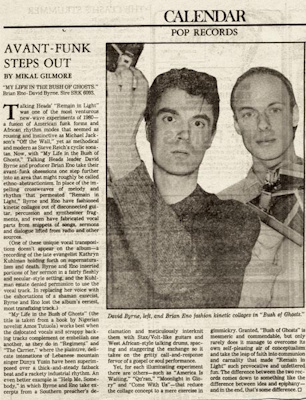
Avant-Funk Steps Out
By Mikal Gilmore
“MY LIFE IN THE BUSH OF GHOSTS”
Talking Heads’ “Remain in Light” was one of the most venturous new-wave experiments of 1980 – a a fusion of American funk forms and African rhythm modes that seemed as rousing and instinctive as Michael Jackson’s “Off the Wall,” yet as methodical and modern as Steve Reich’s cyclic sonatas. Now, with “My Life in the Bush of Ghosts,” Talking Heads leader David Byrne and producer Bran Eno take their avant-funk obsessions one step further into an area that might roughly be called ethno-abstractionism. In place of the impelling crossweaves of melody and rhythm that permeated “Ramain in Light,” Byrne and Eno have fashioned kinetic collages out of disconnected guitar, percussion and synthesizer fragments, and even have fabricated vocal parts from snippets of songs, sermons and dialogue lifted from radio and other sources.
(One of these unique vocal transpositions doesn’t appear on the album – a recording of the late evangelist Kathryn Kuhlman holding forth on supernaturalism and death. Byrne and Eno inserted portions of her sermon in a fairly fleshly secular-style setting, and the Kuhlman estate denied permission to use the vocal track. In replacing her voice with exhortations of a shaman exorcist, Byrne and Eno lost the album’s eeriest, most transfixing track.)
“My Life in the Bush of Ghosts” (the title is taken from a book by Nigerian novelist Amos Tutuola) works best when the dislocated vocals and srappy backing tracks complement or embellish one another, as they do in “Regiment” and “The Carrier,” where the plaintive, delicate intonations of Lebanese mountain singer Dunya Yusin have been superimposed over a thick-and-steady fatback beat and a rackety industrial rhythm. An even better example is “Help Me, Somebody,” in which Byrne and Eno take excerpts from a Southern preacher’s declamation and meticulously interknit them with Stax/Volt-like guitars and West African-style talking drums, spacing and staggering the exchange so it takes on the gritty call-and-response fervor of a gospel or soul performance.
Yet, for each illuminating experiment there are others – “America Is Waiting,” “Qu’ran,” “moonlight in Glory” and “Come With Us” – that reduce the colalge concept to a mere exercise in gimmickry. Granted, “Bush of Ghosts” is mesmeric and commendable, but only rarely does it manage to overcome its own self-pleasing air of conceptualism and taek the leap of faith into communion and carnality that made “Remain in Light” such provocative and unfettered fun. The difference between the two records comes down to something like the difference between the idea and epiphany – and in the end, that’s some difference.
Los Angeles Times, 03-1981
www.bush-of-ghosts.com – read
Press 1981 – Rolling Stone
The press selections were available on the read page on the www.bush-of-ghosts.com website.
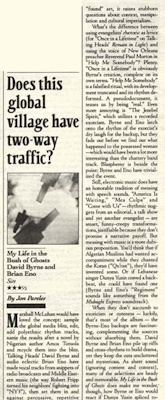
Does this global village have two-way traffic?
By Jon Pareles
My Life in the Bush of Ghosts
David Byrne and Brian Eno***1/2
Marshall McLuhan would have loved the concept: sample the global media blitz, edit, add polyethnic rhythm tracks, name the results after a novel by Nigerian author Amos Tutuola and recycle them into the blitz. Talking Heads’ David Byrne and audio eclectic Brian Eno have made vocal tracks from snippets of radio broadcasts and Middle Eastern music (the way Robert Fripp turned his neighbors’ fighting into “NY3”), then set them in and against percussive, repetitive mind-funk designed more for listening than dancing. My Life in the Bush of Ghosts is an undeniably awesome feat of tape editing and rhythmic ingenuity. But, like most “found” art, it raises stubborn questions about context, manipulation and cultural imperialism.
What’s the difference between using evangelists’ rhetoric as lyrics (for “Once in a Lifetime” on Talking Heads’ Remain in Light) and using the voice of New Orleans preacher Reverend Paul Morton in “Help Me Somebody”? Plenty. “Once in a Lifetime” is obviously Byrne’s creation, complete on its own terms. “Help Me Somebody” is a falsified ritual, with its development truncated and its rhythm deformed. A psuedodocument, it teases us by being “real.” Even more annoying is “The Jezebel Spirit,” which utilizes a recorded exorcism. Byrne and Eno latch onto the rhythm of the exorcist’s dry laugh for the backup, but they fade out before we find out what happened to the possessed woman-which would have been a lot more interesting than the chattery band track. Blasphemy is beside the point: Byrne and Eno have trivialized the event.
Still, electronic music does have an honorable tradition of messing with speech sounds. “America Is Waiting,” “Mea Culpa,” and “Come with Us”-rhythmic nuggets from an editorial, a talk show, and yet another evangelist-are smart, funny-creepy transformations, justifiable because they don’t promise a narrative payoff. But messing with music is a more dubious proposition. You’d think that if Algerian Muslims had wanted accompaniment while they changed the Koran (“Qu’ran”), they’d have invented some. Or if Lebanese singer Dunya Yusin craved a backbeat, she could have found one (Byrne and Eno’s “Regiment” sounds like something from the Midnight Express soundtrack).
When they don’t succumb to exoticism or cuteness-luckily, that’s most of the album-the Byrne-Eno backups are fascinating, complementing the sources without absorbing them. David Byrne and Brian Eno pile up riffs and cross-rhythms to build drama, yet they keep the cuts uncluttered and mysterious. As sheer sound (ignoring content and context), many of the selections are heady and memorable. My Life in the Bush of Ghosts does make me wonder, though, how Byrne or Eno would react if Dunya Yusin spliced together a little of “Animals” and a bit of “The Paw Paw Negro Blowtorch,” then added her idea of a suitable backup. Does this global village have two-way traffic?
Rolling Stone, 02-04-1981
www.bush-of-ghosts.com – read
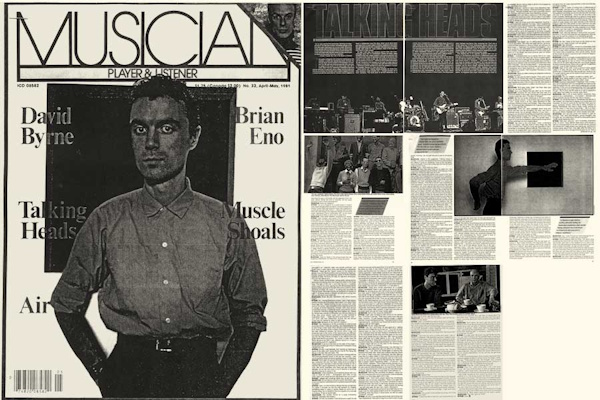
Press 1981 – Musician
The press selections were available on the read page on the www.bush-of-ghosts.com website.
“As he was carrying the wood away, dancing and staggering on, he met over a million ‘homeless-ghosts’ of his kind who were listening to my cry as a radio. Whenever these ghosts met him and listened to my cry which was a lofty music for a few minutes, if they could not bear the music and stand still then the whole of them would start to dance at the same time as a madman.”
–Amost Tutuola, My Life in the Bush of GhostsThe author is Nigerian, the context is mythological, the narrator a small boy wandering warily through the African bush, but the subject of the passage, our subject, is a 28-year-old American pop star who, just now, is coiled in the corner of his near-empty new loft in SoHo, New York City, watching a videotape of genuine African dancers in a genuine native village moving to genuine African drumming. Our Scottish-born subject happens to have a record out with the same title as Tutuola’s novel, happen to have a collaborator (see Eno story when you’re done here) just back from a music safari in Ghana, happens to have seen the light beaconed by the civilization that sprung up at Oldavi Gorge, right under Dr. Louis Leakey’s nose in that neat film they show in high school.
Or see it this way: the sensitive psycho-killer with Care-package eyes and no compassion leaves the West, takes himself to the river, drops himself in and swims upstream into the heart of the heart of darkness and finds, at its source, the rhythm of the rhythm of light, life. He wishes to remain there, yet he wishes to move on-within an arm’s reach from where he sits, thoughtful and angular on the sofa, is a tape labeled “Music of Indonesia,” a penciled note with (the Indian violinist) L. Shankar’s phone number on it, and The Jackson’s Triumph on cassette. Remain In Light, but move on…
David Byrne will. Talking heads probably will. Brian Eno, their producer, most certainly will-though perhaps not in their company. The focal point of all this movement is, of course, their movable Afro-funk-psychedelic feast, Remain In Light. Easily the m ost exciting popular effort of 1980, it was also the best dance disc since Parliament’s Funkentelechy vs. The Placebo Syndrome and one of those rare pop records that jazz and modern classical listeners don’t turn up their noses at. Most importantly, Remain in Light signaled a musical, emotional, and philosophical change within Talking Heads-most notably within the head Head, David Byrne.
One, two, three. From the first three beats of the African drum that literally and symbolically announces the record, we know everything will change its shape: the impetus will become polyrhythmic, not straight Beat; the vocals will be chanted, preached and talked, layered and woven in circular patterns, not whooped and shieked in solitary confinement; the tone will be affirmative and spiritual, not sardonic and paranoid; the parts will be interlocked and communal, not autonomous and individualistic. In time, the music would explode the familiar quarter of Christ Frantz, Tina Weymouth, Jerry Harrison and Byrne (hey, remember the 70s?) into a nonet featuring P-Funk freeboardist Bernie Worrell and ex-Bowie, ex-Zappa guitarist Adrian Belew. And don’t mistake that red-splotched cover of Remain in Light for just another groovy graphic: those Heads are wearing face paint, those Heads are wearing techno-tribal masks.
The missing link in our pilgrim’s progress from Fear of Music to Afrunkidelica was Byrne’s collaborative work with Eno, My Life In the Bush of Ghosts. It was to precede Remain in Light into the market-place-Eno calls it a “laboratory” for that record, Byrne a “blueprint”-but events conspired to hold back its release until this March. On it we can hear the rising tide of pan-ethic stylings, a growing concern for what idealists call the World Village: Algerian Muslims chant the Qu’ran, American evangelists testify, Georgia’s Sea Island singers spin a folk tale, a Lebanese mountain singer calls from the hills, an exorcist goes after Jezebel on a New York radio station, an Egyptian pop singer slithers through a maze of percussion, an “inflamed caller and smooth politician” are stolen from a radio call-in show and reduced to electronic gibberish. These are the “found” voices on the record, the ghosts, if you will; Byrne and Eno, and a small army of percussionists, supply the accompanying rushes of rhythm and the washes of color. It’s funny, it’s arty, it’s high-tech ethno-pop. And you can dance to it.
Talking Heads, talking bodies, talking spirits, talking drums: David Byrne is talking about the things that matter to him these days. The light of this one-and only this one-is slowly pulled away by the clock, leaving his unlit loft darkened. Byrne speaks slowly, pausing for thought after every question, ever sentence at times. His voice-so jolting and wounded on Talking Heads’ first three records, so messianic on Remain In Light-is barely above a whisper. He talks as a young man with an old man’s soul might talk.
MUSICIAN: When did your fascination with ethnic musics begin?
BYRNE: Oh, I started listening to it when I was in high school, getting records out of the library. But it wasn’t until about three years ago that I started looking for pop records from other parts of the world. I was interested if there might be some sort of merger of forms happening. Perhaps there were groups somewhere playing in traditional styles using electric guitars or whatever. And sure enough that does happen. So I looked for African pop records and Brazilian pop records, that sort of thing. Also, some Islamic music, and I’ve also listened to Indonesian music-which has some good rhythmic stuff-and some real nice Vietnamese records. But the African music was the easiest to relate to right away.
MUSICIAN: Because of the rhythmic impetus?
BYRNE: Yes, because of all the similarities to what is now American music. It was very exciting, very fascinating for me to hear things in that music which are also a part of American funk music and other kinds of black American music. I think the main difference between the African ethnic music and American funk is that some of the textures are real different; the overall textures and the combinations of instruments they use, the way they build an orchestra, is very different than just guitar-bass-drums-percussion. So overall, it might have the same structure but still a very different sound to it. It was a good starting point for inspiration.
MUSICIAN: In terms of the funk on this side of the ocean, I would assume George Clinton’s Parliament-Funkadelic thang caught your ear.
BYRNE: Uh-huh, most definitely. But I started out listening to some of the older stuff: James Brown, Kool & The Gang, Sly Stone in the late ’60s and early ’70s.
MUSICIAN: I don’t suppose your exploration will stop with the Afro-funk-psychedelic fusion of the last two records. I hear you’re going to check out some Gamelan music in Indonesia.
BYRNE: That’s right. I’m going to Bali after our tour of Japan. A guy contacted me who had been doing some recording in Hong Kong and had been to Bali and had contacts for me. It seemed like a good opportunity to check the situation out, to work with some musicians over there and see what might develop. It’s not like that music is my #1 favorite of anything, but it’s a chance to check it out.
MUSICIAN: In the meantime, you’re plowing ahead with your work in visual art forms-photography and vieo. At one point, wasn’t your visual art more developed than your music?
BYRNE: I always felt I could go either way, at any time.
MUSICIAN: Do you feel you bring the same rationalistic rigor to your art that the mathematician or systems analyst brings to his work?
BYRNE: Yeah, I do tend to look at things that way sometimes. It’s useful, it amuses me. But the final decision on whether something stays or goes is usually based on some sort of intuitive thing, not on whether it fits into a system or a concept or a theory. It has to sound right.
MUSICIAN: Our society insists on a large dichotomy between rationality and intuition…
BYRNE: Uh-huh, but it doesn’t have to be such a split. It’s not so hard to use both at the same time, or to use either one when the other fails. If one doesn’t seem to be leading anywhere, use the other one. For instance, if I go into a studio with nothing planned, I could piddle around on my instrument to see what happens intuitively. Now there’s a chance I might get something, but it seems like there’d be more chance if there was some sort of process I was using to construct the piece. If I formulate a structure, then I have to be intuitive within my restrictions-and that can be more productive. A lot of people who compose or dance or whatever go through this process in their heads; they just don’t externalize it, or talk about it.
MUSICIAN: Using strict formal parameters for a project doesn’t necessarily mean it can’t open up as you go along?
BYRNE: No, as long as you don’t let it block you from keeping your ears open to what’s happening as the project develops. Sometimes things can happen in the opposite way: you can start with a very loose concept or notion or a direction and then you just improvise off of that. Then you go back and look or listen to the improvisations and pick out the interesting bits and formalize those. You might find an interesting pattern, then pick it out and learn it. I just did a videotape out on the west coast that involved me dancing in it, and that’s the way I did the rehearsals: improvising within a general framework in front of a little port-a-pack video camera. I’d look back and pick out the good parts and just do those moves again.
MUSICIAN: Sort of like visual bio-feedback?
BYRNE: Yeah, only I’d have to walk around to the monitor later. I’d review it and say, “That was a good move, that one really connects. It’s just abstract looking enough, it doesn’t look like I’m just miming something.” That was the kind of thing I was looking for. I would pick out moves that would fit into that category and do them again.
MUSICIAN: Do you enjoy dancing?
BYRNE: Yes, but I don’t think I’m very good at it. I started dancing a lot on stage during the last tour. The music we were playing made me want to dance more and the fact we had more musicians freed me from having to concentrate and be at the microphone all the time. And that gave me the confidence to go ahead and do it. But now I feel I have to buckle down and work at it; there seems to be a big difference between dancing for enjoyment, to express yourself, not caring what it looks like, and dancing because you want it to have a certain visual look to it. In this case, on the videotape, I’m dancing to “Once In A Lifetime.”
MUSICIAN: It’s a curious phenomenon, how dancing to a given piece really affects the way one listens to it, or hears it.
BYRNE: Yes, I can show you some tapes of dancing that illustrate that pretty well. I have one of African dancing, where the music is pretty fast rhythmically, but their dancing looks like it’s in slow-motion. In fact, you’d be convinced it was in slow-motion until you see somebody walk by in the background at normal speed. And so that dancing can make you hear a slower rhythm. Likewise, I have a tape of some dancers in L.A. called the Electric Boogaloos, who do a lot of ticks, little jerks for just a second. [Demonstrates by moving shoulder and arm in minute robot-like fashion.] This makes you hear other beats, off-beats, that you might not have paid much attention to.
MUSICIAN: Dancing also activates the listener, makes him less of a consumer and more of a participant, more completely involved in a mind-body-spirit sort of way.
BYRNE: Yeah, I think when people dance they immediately eliminate that mind-body separation. There is an open flow between them. And in a way, it’s not even necessary to dance sometimes when the music is real funky, because you hear it almost as much with your body-even if you’re not moving-as with your ears. So your own rhythm interprets it.
MUSICIAN: The participating listener also might help turn the music from the more passive realm of art-for-consumption to something more like ritual or social event, as with so-called “primitive” cultures?
BYRNE: Uh-huh. If you call the kind of music we’re doing now “non-hierarchical” then performing it for a community in a way describes the way a community can be organized, that it can work without having that kind of hierarchy. So the music becomes a sort of aural demonstration.
MUSICIAN: Music as a metaphor?
BYRNE: Yes, as a metaphor for a social system. It doesn’t even require thought when you hear it. It communicates more directly. People might hear a piece of music that’s organized in a particular way and really enjoy it-because that’s the way they’d like other things to be organized. Maybe it’s the kind of social organization they’re comfortable with, so the music really connects to them on some sort of deep level.
MUSICIAN: That’s rather idealistic, considering our society.
BYRNE: Yeah. [Laughs, long pause.] Yeah, it does sound pretty idealistic. Yet most art shoots for the same sort of thing: it comes to work as a metaphor for something else-a way of organizing people socially or a way of looking at the world. I guess if you look at it this way it’s not so idealistic; most times, music and art aren’t necessarily trying to change the world so much as just demonstrate a structure that can exist, and does exist, that people might be able to relate to.
MUSICIAN: Given the direction of your music and the emphasis on community, how does the Talking Heads community function? I don’t supposed you could call it a non-hierarchical or democratic one, since you and Eno have been most responsible for the direction of the music.
BYRNE: The problem is that people tend to confuse “non-hierarchical” with “democratic.” They equate the two. So it’s one thing or the other: there’s either a dictator and a bunch of people being bounced around, or, everybody’s equal. But there’s other ways of working things that work quite well. Like in Japan, there’s a definite hierarchy, but no one feels put-upon. The people at the lower end of the hierarchy feel that’s their place. The general attitude is: that’s where they belong and they are to be respected for it, respected for their ability to fit into their niche.
MUSICIAN: Yeah but David, in the wrong society that has dangerous implications. Or even in the wrong pop group.
BYRNE: Well, it works in Japanese society because of their respect system-a person is respected to the extent he fits into his proper place. I think other things can work this way. Different people are good at doing different things-so they’re definitely not equal, but they may be mutually respected by one another for doing whatever job it is they do. The tricky part is being mutually respected. It’s difficult to make it work, but I think it’s possible.
MUSICIAN: Hell, if you’re patterning your music from the spirit and sensibilities of African music, maybe you’re patterning the T. Heads after African society? As I understand them, African tribal societies are not exactly “democracies” in the western sense.
BYRNE: If one kind of decision has to be made in the trive or cult, then there is a small society within it that makes that particular kind of decision. If the crops fail, the farmers might consult the people who deal with spirits. And so on and so on. There are different people who decide different things in the community. Now there may be a head governing body…
MUSICIAN: But if you bring all that back to this side of the Atlantic for a second, it somehow ends up as a “Talking Heads in Trouble” headline in Rolling Stone…
BYRNE: And I feel that that kind of thing is a shame, because it takes attention away from the music and things that I think are much more exciting than the difficulties of keeping a band together. It’s a real shame, it brings them down to the level of gossip. Anything I say can get reduced to grist for the gossip mills.
MUSICIAN: Implicit in the judgment, “Talking Heads in Trouble,” is a notion that interpersonal friction is detrimental to the making of good art. Nonsense. Thin of that first Mahavishnu Orchestra. Friction can create heat and heat ain’t such a bad thing for music…
BYRNE: Yeah, I know what you mean.
MUSICIAN: Now what about what you’ve called the “rock musicians’ capitalistic way of thinking” in the way your music works now. Could you flesh that out a bit?
BYRNE: A guy named Max Weber wrote a book in the ’20s I think called The Protestant Ethic and the Spirit of Capitalism. He was attempting to explain how a peoples’ spiritual foundations lead them to a particular economic way of life, how their religious and moral upbringing leads them to a social and economic attitude. I think this is true for rock musicians as much as anyone. They’ve grown up in a society that values competition, the whole dog-eat-dog beat-out-the-other-guy kind of thing. So they’re bound to play music in the same way: trying to out-solo the other guy, trying to play louder than the other guy, et cetera. All that’s very different than the kind of music we’re playing, where you have to leave a lot of holes in what you’re playing in order for the other parts to be heard, where the whole thing doesn’t take off unless you can hear lots of different people’s parts popping in here and there. This is not to say we negate ourselves as individuals, but that we get something by restricting our individual freedoms that we couldn’t get otherwise. The whole feeling this music generates for me-the whole community of interlocking parts-is totally different than what rock does. Presently, I don’t’ feel I have any connection to rock and roll. In a lot of rock music people tend to play all the time, or at least as much as they can get away with.
MUSICIAN: Didn’t you go through a phase of basic American ego-laden individualism, that sort of playing?
BYRNE: Sure, and that works: you get a kind of music that fits that whole way of thinking. But I just happen to be real excited by other kinds of things.
MUSICIAN: Is your current music an arrival or a direction or perhaps only a stage? How do you think about it?
BYRNE: [Puzzled.] I don’t know. I don’t’ know what we’re gonna do next. I guess it’s a direction.
MUSICIAN: Do you have any fear that you might find yourself either duplicating or regressing from Remain in Light?
BYRNE: Not really. I’m ambivalent about all the pressure to come up with something new.
MUSICIAN: NEW AND IMPROVED…
BYRNE: Yeah, and I put the pressure on myself, it’s not like it’s put upon me by the record company or the critics. I put it on myself that I’m supposed to come up with something new and improved each time. And ti think it’s probably not necessary. It seems perfectly reasonable to be able to enjoy music without having to be startled and shocked every time you put on somebody’s record. [Laughs.]
MUSICIAN: Seems reason enough to explore other media.
BYRNE: Well, I have been doing work in video. I did a project with Toni Basil of the Locker Dancers, and I helped out Bruce Conner with a couple of films to music from Bush of Ghosts, and one I did myself. All this occupied me for a good while and I spent a lot of money on these things. And I’ve been doing these photos [points to huge, warm-toned prints lying on the floor] for the past few years that I’ve only just had blown up.
MUSICIAN: What kind of parallels do you draw between your music and your visual art?
BYRNE: The method, the working process can be real similar. I don’t really know what the visual arts give me that music doesn’t, or visa versa. I have noticed that they tend to feed back to each other, one into the other.
MUSICIAN: I know you used to do copier art with Xerox machines or whatever while at Rhode Island School of Design, and I wonder whether there’s any connection between that activity and incorporating the “found” vocals in Bush of Ghosts or your musical posture in general?
BYRNE: I did copier art because I wanted my work to be easily accessible and not available only to the few people who could afford it. I also didn’t want it to have that “aura” that fine art in galleries has-you know, don’t touch ’cause this is precious stuff. Yes, a lot of that attitude carried over to the way I approach music. I didn’t try to make it incredibly commercial either, just not precious. As far as using the found vocals as “copies” of something, I’ve never made that connection myself [laughs] but maybe that’s true though.
I’ve always felt there’s more to something than exists on the surface. Even something like a landscape painting, the way in which it’s done might make it about a lot more than just a landscape. Might be a whole way of looking at the world. Or take an ordinary, literal set of lyrics about a subject everybody knows. Real mundane, like a love song. But there are a whole lotta ways those lyrics can be dealt with: phrasing, the choice of an odd word here or there, the texture of the music, the rhythm make it something much more than just two lovers.
MUSICIAN: Speaking of phrasing, you get a lot of mileage out of unusual phrasing and insistently rhythmic phrasing on Remain in Light. One thing that comes to mind is the ungrammatical, almost pathetic, line in “Houses in Motion”: ‘She has closed her eyes, she has give up hope.’
BYRNE: I got that right off the radio. That’s exactly what the guy said, so I didn’t change it. It sounded too nice the way it was. It sounded much sadder that way.
MUSICIAN: I know the incessant “And the heat goes on” chorus in “Born Under Punches (The Heat Goes On)” was lifted from a New York Post headline. And the four verses of “Once In A Lifetime” were taken right out of the mouths of preachers you’d heard. How much do you use found materials in developing your ideas and lyrics?
BYRNE: On and off a fair amount. Not all the time. Many times found materials are just a jumping off point or a way of getting some inspiration. They may put me in a frame of mind I wouldn’t otherwise be in, and once I’m there I can write the rest of the lyrics myself.
MUSICIAN: Hey, I mean Picasso put news clippings into his African-influenced aft, no reason why you shouldn’t.
BYRNE: [Great laughter] Well the thing I like about using something like that is that the listener doesn’t need to know that phrase came from a Post headline for it to work in the song. If you start working on songs where the listener has to be privy to inside information, you get yourself in trouble. A lot of modern writing refers to other works for instance, and if you don’t know them, then you’re really left out in the cold. But I still think you can have stuff that refers to other things and comes from other sources, as long as it works by itself-as is-first. The other stuff is just icing on the cake.
MUSICIAN: Nor does it seem necessary to explain to your listeners that Remain in Light is based on African rhythms and sensibilities, yet you wrote a letter to all the critics explaining this very thing. How come?
BYRNE: Because I wanted to have more interesting interviews. It was my way of saying, “these are the things I want to talk about.” I thought the letter was a way to push the critics in that direction, that they’d write more interesting reviews.
MUSICIAN: Don’t you think a helluva lot of the critics might have taken the record as a plain, old funk album if you hadn’t indicated where all this stuff was coming from, including which books on African art?
BYRNE: I can’t tell if that would have happened. Could be. I wouldn’t have been surprised. As it was, I wasn’t surprised by the favorable press it got because when I finished it I thought, “Gee, this is a good record…I think.” But I always felt wary, I thought maybe they’re all gonna jump on us for this-for doing something we’re not supposed to be doing. [Laughs] now if they hated it, I guess I might think twice about it.
MUSICIAN: Alright, David, how about the White Man’s Burden?
BYRNE: Hmmm, how what is that exactly? Is that where the white man’s burden is to go among the heathens and convert them to Christianity?
MUSICIAN: Yes indeed, but I’m talking about the modern musical equivalent. The white man goes into the “Primitive” culture of Afro-America or African or Brazil and extracts the black music-“improves” it to continue the metaphor-for a white audience that won’t listen to it or go hear it played by black people. Or as Hugh Masekela put it, African music won’t catch on in the States until some producer gets four British boys to learn Swahili.
BYRNE: I understand what you’re saying. Now in our case, the band is currently half-black. But I know the same audiences wouldn’t come if it was just Bernie, Busta, Colette, Steven and Nona. We tried to be a little more sensible about all that. A big difference between what we’re doing and what many have done in the past-as you’ve described it-be it African or the Funkadelics or whoever. That’s important. The issue you raise is a difficult one…
MUSICIAN: Have you been drawing an integrated audience to your concerts?
BYRNE: It’s real slow for that to happen. There were a lot of Latin kids at our Central Park show. It’s happening a little bit, but a lot less than we would like. I’ll be disappointed if it doesn’t begin happening more. A lot of it has to do with airplay; it would help if we got played on a station like WBLS [a N.Y. soul station].
MUSICIAN: ‘BLS plays white “trash” like Peter Allen and Devo, but no room for Afro-funk?
BYRNE: Sure, sure. Maybe they just didn’t go for the stuff.
MUSICIAN: Certainly the new record has even less of a chance for airplay. In any case, how did you run across Amos Tutuola’s novel, My Life In The Bush Of Ghosts?
BYRNE: We had run across references to the book in other books on African culture-a lot of which were very scholarly-and I finally found it at City lights Bookstore in San Francisco. Previous to that, I just though, “Gee, what a great title.” And the book didn’t disappoint me, it was all you’d expect from a book with that title.
MUSICIAN: There are many passages about song and dance and fear and joy throughout the story, and one in particular struck me as strongly reflective of your story-going as you have from the anxiety and dread that characterized Talking Heads through Fear of Music to the much more affirmative attitude of Remain in Light. The narrator says, “I forgot all my sorrow and started to sing the earthy songs which sorrow prevented me from singing about.”
BYRNE: Yes, that’s a very nice quote. I think I understand what that means. I feel less afraid of many things now, feel more confident. And I think the music was important in that it demanded a completely different attitude. The anxiety of my lyrics and my singing didn’t seem appropriate for this kind of music; this music is more positive, though a little mysterious at the same time. So it was important that I wrote lyrics that also had these qualities.
BYRNE : It was a matter of writing from a different part of my personality, one that didn’t come out much in our earlier stuff. Peoples’ personalities have more than one facet. Gee, the audience must be fair and let the artist deal with more than one side of his personality. I know this can be tricky in the music business; people get used to a person’s songs being from one point of view and then they identify him as such. They tend to identify the actor with the part he’s playing. I mean: the villains of soap operas have been attacked on the street for being so rotten. But most people do have more than one side.
MUSICIAN: Sometimes the problem for listeners is deciphering whether the personality the artist presents is truly himself or herself, and how much is unadulterated affectation. Take the U.S. version of punkdom, for instance.
BYRNE: Yeah, only now perhaps in some of the “surf punk” bands in L.A. do you find punks who are really punks: Mean as Hell, and not just the creators of an interesting persona.
MUSICIAN: Do you think of the voices on Bush Of Ghosts as ghosts?
BYRNE: No. But I think of the music on the record as very spiritual, so you might connect that with ghosts.
MUSICIAN: How spiritual?
BYRNE: It’s difficult to explain. I think it’s a combination of the rhythms and the more mysterious textures and sounds. Like Remain In Light, there’s a positive, affirmative feeling there but then there’s also a mysterious, other-worldly feeling. Almost all the vocals we put on it have to do with one kind of religious experience or another…
MUSICIAN: Which in a couple of cases intersect with current political experiences, like with the “Unidentified indignant radio host” railing against our lack of nerve in the you-know-what crisis and on the other side of the coin, you include Algerian Muslims chanting Qu’ran. Where did you get the “Unidentified exorcist” vocal to take Kuhlman’s place?
BYRNE: Right off the radio. It was a phone-in show, people called in to have this guy drive off the evil spirits. There’s another guy in California who has you put your hands on the TV screen and he puts out his hands to touch yours and heal you through the TV.
MUSICIAN: Can you imagine yourself in a similar role?
BYRNE: What, telling people to put their hands on the set?
MUSICIAN: C’mon David, you know what I mean…
BYRNE: Helping to heal people? Preaching? Yeah, in a way. I get a lot of inspiration from the evangelists one hears on the radio throughout the U.S. I think they’re dealing with a similar aesthetic; in the more exciting preaching I think they’re going after a thing similar to the music. But I’m not very direct about it though. I like to plant just the seed of an idea in someone’s head rather than telling him exactly what I think.
MUSICIAN: With a lot of those testifyin’ preachers, there seems to be a contradiction-or a tension-between what they’re actually saying and the way they’re saying it.
BYRNE: Yes, sometimes there is. Sometimes their delivery is real ecstatic, but what they’re saying is so conservative and moralistic. It’s hard to reconcile the fact that these guys are going absolutely berserk while they’re telling everyone to behave themselves. And they’re madly raving, jumping all over the place. In that kind of preaching-like in a music piece-as much is said in the delivery and the phrasing as in the words. What’s important isn’t what’s literally being said.
MUSICIAN: Let’s take the words from Remain In Light for example. They were after-thoughts, second thoughts, side thoughts, etc. you jotted down and all the critics gonna spend 10,000 words explaining them…
BYRNE: Well yeah, because I don’t completely understand what I’ve done. I have definite ideas about which phrase is right for a line and which is not, but I couldn’t tell why. Some of my choices don’t make sense in any logical way, I just have an intuitive sense about them. Only later, after the critics have explained it all to me or enough time has gone by, do I have a general idea of what I was trying to say.
MUSICIAN: Did you find that the pieces were writing you instead of visa versa?
BYRNE: Yeah, I find that’s true with a lot of music. It’s generally thought it’s the singer who puts the emotion into the song, but I think most times it’s the other way around-it’s the music which brings the emotion out of the singer. A piece of music, if it’s exciting, demands a certain response from the vocalist, and the music brings out those emotions.
MUSICIAN: Now that some time has gone by, how do you feel about them?
BYRNE: My still think my voice is a little shrill when I talk or preach or whatever. That could be improved; it needs to have a deeper, richer quality, and I need to stop clipping my words and phrases as much as I do. Gosh, what about the words? I know you’re thinking. I still haven’t tried to figure them out. But they work as I intended them to: they have that implied religious, spiritual feeling. Implied, but not stated. I wanted to get a spiritual ambience in the words.
MUSICIAN: Tom Wolfe’s great phrase for the ’70s, “The Me Decade and The Third Great Awakening” somehow got shortened and secularized into just “The Me Decade.” But it seems your new emphasis on spirituality is very much a part of our society’s great awakening.
BYRNE: Yeah. I’m part of the same society so I’m probably part of the same phenomenon. The fact that our music implies a different kind of social order was sort of a way out for me, a way out of all the predicaments our society has gotten itself into. It’s made me optimistic about things, it’s been very rewarding to see how things work out on a musical level-we’ve achieved more by collaborating and cooperating than we could have achieved by everyone asserting their individuality. It’s exciting.
MUSICIAN: Maoist Pop?
BYRNE: Yes, and one of the things that was so exciting was that it wasn’t just the theory that was good or moral, but that everyone shared in the ecstatic experience when it worked. It wasn’t like we all got together to build a house or anything; working together was its own reward. And the reward was spontaneous. The music has helped me, helped make me optimistic, gave me faith in human beings a little bit; whereas, if I was just to read the headlines everyday, I might write really nihilistic songs.
MUSICIAN: You couldn’t write another Buildings and Food record if you tried?
BYRNE: It would be sort of hard. It’s just not something I’m inclined to do anymore. But I get wary of talking about the spirituality thing. There’s all these rock stars who have gone mystic, you know, Bob Dylan has found Jesus and gone soft or whatever…
MUSICIAN: don’t worry, we won’t cast you as the Jerry Falwell of Afro-Funk. But on those first three records, you were writing lyrics from all sorts of different viewpoints, contradictory or otherwise. I mean: there were so many points of view, it was almost like Value Relativism-nothing is better or worse than anything else. In retrospect, wasn’t this a bit of a cul-de-sac for you?
BYRNE: In a way, yeah. Because if you get too far into that, then you start thinking of all the possible ways of looking at something and you’ll never be able to make a decision about it. For instance, let’s say you’re driving down the street and see a billboard, and you try to decide: should that be there or shouldn’t that be there? There’s so many different ways you can look at it: you could say it’s an ugly object obscuring nature, or you can say it’s a beautiful object because it says so much about our society. In the process, you’ll never be able to make a decision. You can reason and reason. Which is fun, but it’s mental masturbation. It’s fun, but you can get stuck after awhile.
I think I’m out of that phase. I think in a way I was driven into it because people tended to identify me by the songs I wrote, and say, “that’s what he’s like.” So I thought, “O.K., I’ll show ’em, I’ll write one from the opposite point of view!” And so on. It was a challenge. But I’ve stopped doing that now.
MUSICIAN: How has it been working with Eno?
BYRNE: Fine, fine. I don’t know what I’ll do in the future though. We have tentative plans to work on another record together. I don’t know what it would be like. We didn’t even know what Bush of Ghosts would end up like when we started. I was pretty excited by that project the whole time I was working on it. The whole record, like Remain in Light, was composed in the studio. That technique eliminates the problem of trying to get a texture, a sound you’ve developed while rehearsing, onto the tape. Instead, by composing in the studio you get the sound first and then decide where and how you can fit it in. once you’ve got it on tape you can never lose it-you don’t have to try recreating it again.
Not that there weren’t days when we tried a bunch of things in the studio and most of them didn’t work, and I’d come back home thinking, “wow, what a waste of time. Lost it I guess.”
MUSICIAN: You had “give up hope?”
BYRNE: Naw.
Musician, 04-1981
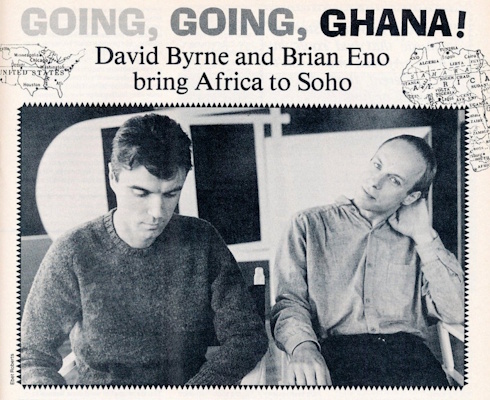
www.bush-of-ghosts.com – read
Press 1981 – Trouser Press
The press selections were available on the read page on the www.bush-of-ghosts.com website.
Going, Going, Ghana!
By Scott Isler
Jealousy. Rage. Tension. You won’t find them here. We suggest you turn to the Elvis Costello feature for those commodities. This article, by contrast, concerns two musicians whose friendship si based on mutual interest in plumbing the meaning of rock music to unusual depths, and on featless experimentation with the music itself.
The square-shaped, peeling loft high above New York’s artist-riddled Soho district is just the place where you’d expect to find Brian Eno – self-confessed amateur musician, maverick record producer and leading rock theoretician. Rows of windows facing north and east offer breathtaking views of the glorious clutter of factory buildings and old tenements that fight for space in lower Manhattan. The concrete umble outside is in striking relief to the loft’s near-absence of furniture. Stranded in the middle of the room, a white sofa faces outside, inviting contemplation. Across from it and under the windows, a divan is loaded down with an eclectic record collection – a boxed Motown Story collection, Actua Voices of Ex-Slaves, Miles Davis, Robert Wyatt, Olatunji – cassette tapes (some labeled “drones,” others in Arabic), and audio and video equiptment; on the side, a video camera on a tripod stares out the dwindow. A small bookcase holds a Polaroid camera and some paperbacks (Music of Africa, Godel, Escher, Bach). Kitchen and bathroom are tucked discreetly out of view, and no bed is visible. Seated at a long table in the corenr, washed by the early afternoon light, Eno finishes an omelette and shares lemon scented tea with David Byrne, singer, writer and guitarist of Talking Head and partner with Eno on the just-released My Life in the Bush of Ghosts.
A Zen-like peacefulness pervades the room, but things aren’t quite as calm as they appear. Eno, just returned from a trip to Ghana, has to yield the loft (a sublet) in a matter of days and doesn’t have another place lined up yet; he’s been scouring the Village Voice apartment classifieds. Byrne, himself in the process of moving (he lives on the les fashionable lower east side), is in New York between visits to Los Angeles, where he’s working on a video. Four weeks later Talking Heads will tour Japan.
Eno’s African sojourn – his first time there – reflects a continuing obsession with that continent’s culture. While in Ghana he even produced some recordings by a local band, whose punchy riffs, bobbing rhythms and chanted vocals are undeniably related to Remain in Light, last year’s Talking Heads album. Byrne has also bitten by the African bug, proven not just by the Heads LP but by the expanded band he introduced with it; the basic quartet was more than doubled with the addition of antother guitarist, bassist, keyboard player, percussionist and vocalist(s).
Suspicious rock journalists assume that Eno, who has produced and played on all Talking Heads albums since the second, is calling the band’s shots. The fear isn’t allayed by seeing Byrne and Eno together. They made an odd couple: Short, slight Eno is relaxed and self-assured; the chooses words carefully but is rarely at a loss for them. Byrne, taller but no less thin, fidgets and looks nervously out the window while talking in a tremulous whisper, pausing to track down fugitive ideas.
Eno, 33 this May, has been in the glare of the rock press spotlight since 1971, when he burst flamboyantly into international consciousness via Roxy Music. (He was an all-purpose electronics man.) Byrne, 28, began to be noticed in 1976, when Talking Heads shared CBGB’s stage with the Ramones and Blondie during New York’s primal new wave rumblings. Shyness can’t conceal Byrne’s intelligence, and despite their different experiences, Byrne and Eno’s is not a one-sided relationship. They’re hardly hot-headed romantics, but their art is no less passionate for being carefully thought out.
So why Africa?
“We both gre up listening to music that had its roots in Africa,” Byrne explains. “The African music we listen to isn’t that different-in spirit, anyway-than a lot of rhythm and blues, or funk, that we’re quite accustomed to and that most of [Talking Heads’] music is based on. It’s not that big a leap.”
“It has melodies you can understand, rhythms you can understand,” Eno says; his accent is barely British. “The other thing about Africa is that both of us, and many other people in the world, are interested in discovering whether there are other moral philosophies-not a word one handles lightly in the contemporary rock press, I must say.” A little sarcasm there, but he elaborates: “The way I see it, during the ’50s and ’60s people were very impressed by Easter philosophies because they seemed to represent another option about how you could think about or organize things, your life being one of them. They also had an important musical connection; there was a whole group of composers, both rock and ‘serious,’ who were very influenced by Eastern ideas. It’s become a rather unpleasant part of the currency of ’70s thinking.
“We were both attracted to the African thing initially for music reasons. We began reading about African music at first but you can’t read about African music without finding out about African society because they’re so closely interwoven. Music stands as a crystallization of cultural standards.”
“There’s a very different kind of spirituality in African than what we grew up with,” Byrne notes. As opposed to our “sober, very serious” approach, “in Africa and a lot of other cultures, probably most of the cultures in the world, things that are considered spiritual-performances, music-are also exciting and fun. People have a good time; it’s not sacred in the sense that you can’t talk while a performance is going on, or have a drink or smoke a cigarette. There isn’t that separation of pleasure and spiritual things.”
Moral philosophies aside, Talking Heads’ tilt towards Africa with Remain in Light shouldn’t have surprised astute Headwatchers. The band’s preceding album, Fear of Music, already featured four-square beats and prominent rhythm section-none dare call it disco-and “I Zimbra,” a nonsense poem set to shifting musical phrases, sounded quite subtropical. Heads bassist Tina Weymouth has claimed that she and drummer/husband Chris Frantz’ interest in African music predated Byrne and Eno’s, and that they even “turned them onto it.”
Eno won’t go that far, but he does admit “all the Talking Heads and myself have been listening to African records. You can’t steer anyone in a direction they’re not already going in; there has to be momentum or it isn’t going to succeed. David and I did articulate a way of working-we said, ‘This is the way we want to work,’ rather than all other possible ways-but it wasn’t an idea that was foreign to everyone. Nobody said, ‘God, what’s this?'”
“It was more a case of everyone going, ‘Oh yeah, exactly,'” Byrne adds. “I think it was something that everyone in the band was interested in to some degree, but Brian and myself were more actively involved in reading books and listening to records.”
Eno points out (while methodically tearing the filter off a Triumph cigarette before lighting it; later he’ll wheeze consumptively and complain he smokes too much) that the current Talking Heads are not interested in senselessly recreating an ethnic music from 5000 miles away. “We weren’t trying to do African music. We were trying to use some of the things we thought we’d learn from that in making a newer version of our own music. I don’t think it’s like putting on a new set of clothes and ‘here we are, it’s al new.’ It’s saying, ‘This might be a clearer version of what we’ve been trying to do anyway’-or a more refined version.” Byrne mentions that the songs on Remain in Light’s second side “don’t immediately sound as African but they were just as influenced” by the same ideas.
Talking Heads’ Afrophilia could be viewed as elitist displeasure with their own pop music culture, and Byrne says the thought has occurred to him. “Then I saw more and more similarities between African music and black American music. I thought yes, it’s discontent with a lot of white music and a lot of the sensibility that white music is about, but [African music] is not as exotic as it initially sounds.”
“Also,” Eno says, “it’s not so much that you go to another culture to discover something entirely new; it’s to discover a different emphasis on things. I think we were interested in finding some way to emphasize different aspects, not suddenly to present us with a whole lot of new ones. Most of the things we ran into as we were reading and listening were not totally exotic but a different balance-a balance that seemed quite attractive to us.
“There’s quite a lot of elements in that music and in that culture that we have a little similarity with,” Byrne says, “But there you get a purer strain of it. It’s a little more intense.”
Remain in Light is not Byrne and Eno’s first foray into tribal music together. That album was preceded by the Headless My Life in the Bush of Ghosts, whose most novel aspect-the use of found vocals, mostly taken from radio-doesn’t completely explain the record’s nine-month holding period.
“There was a legal reason that actually disguised an artistic reason,” Eno says of the delay. The former was an objection from the estate of the late evangelist and faith healer Kathryn Kuhlman to the use of her voice on one of the album tracks.
“The whole thing was ready,” Eno continues. “We knew that if we tried to release it there would be an injunction stopping its sale, so we just had to rework that track. This came up after we’d done Remain in Light, and doing that record gave us quite a lot of new ideas about how we could approach ours as wel. The two records really helped each other along: the Talking Heads record was influenced by early My Life in the Bush of Ghosts, and then, having done Talking Heads, we learned a few things about how we could do our own record better. This Kathryn Kuhlman episode was really the perfect cause to take the record apart and do some things again.”
“It wasn’t that planned out, really,” Byrne says of his first solo project. “We had these mutual interests, and we talked about various things we’d like to do. It wasn’t real formulated; we just started working.”
Didn’t the rest of the band feel left out? “I hope not,” Byrne answers quickly.
Eno fills in some details on the album’s evolution. “Initially I was going to make a record of my own. I was thinking of doing my next solo album, so I started recording with David and other musicians. The first piece I did was ‘Mea Culpa,’ which started off with just synthesizer and a voice off radio. I thought that worked very well, and I was very excited with carrying on with that idea.”
Nevertheless Eno says he then became indecisive-worried about his lack of musical skills-before recruiting Byrne as a partner. On the finished album the pair play the “vast majority” of instruments (according to Byrne), supplemented by bass players and percussionists, including Chris Frantz on one cut. Eno’s pragmatic approach to sonic source material results in percussion “instruments” like tables, tape boxes, Leslie speaker cabinets as bass drums and the recording studio floor as a tom-tom. Eno relied on his famous electronic treatments “to get interesting sound from them.”
Bizarre instrumentation is typical of Eno, but found vocals are a new element in his work. “Neither of us were interested in writing ordinary songs anymore,” he says with no trace of ironic understatement. “We hadn’t yet evolved any new formats that excited us for writing songs. This seemed to be a very good solution for that problem.”
Very well, but what does it mean? “If you want to get into that,” Byrne says in hushed, reverent tones, “It means an awful lot. You can probably talk for a long time about what that implies. The most obvious thing, for me anyway-it’s obvious on some of the tracks-is that the vocal can be quite moving without literally meaning anything. That alone implies a lot: the phonetics and texture of a vocal have their own meaning. I’m sure no one would disagree with that, but most people tend to think that lyrics are most important.”
“I’m interested to see what happens when this album comes out,” Eno says, “Because rock critics always analyze words in a song; they regard that as the apex of meaning. There’s all this other stuff underneath but the meaning is supposedly invested in words.”
“A lot of people don’t realize,” Byrne takes over, “That the sound of a voice, phrasing or phonetic structures are affecting them at least as much as the words. Usually lyrics that are a little bit mysterious, that don’t quite come out and say what they mean, are the most powerful. They deal with things in a metaphysical way.”
BYRNE’S incisive, offhand comments on words and meaning illuminate Talking Heads’ own work as well as My Life in the Bush of Ghosts, but Eno maintains that-for him, anyway-the album was basically a technical exercise in using pre-existing vocals “to see where that takes us.” He discovered it was taking them “somewhere quite interesting”:
“It wasn’t a conscious decision when we started doing the album, but we nearly always found that the vocals that sounded the best came from spiritual or religious sources. It’s one of the only obvious places on radio where people are passionate. On radio, people train themselves to be cool, monotonous-to be in control. The only voices you hear that aren’t like that are voices in a passion about something, and on radio that nearly always means religion. Those were the most interesting voices on radio. Gradually, we started to notice that the album was shaping up to have that identity, so it became a conscious decision to work on it that way, with that spirit running through the album. Interestingly enough, the title-which I think is pretty spiritual-was chosen ages ago, almost before we’d recorded anything.”
(The lyrics to at least one song on Remain in Light, “Once in a Lifetime,” are also drawn from radio preachers, another indication of the two albums’ interdependence.)
Before it was a record, My Life in the Bush of Ghosts was (and remains) a novel by African writer Amos Tutuola; another of his works, The Palm-Wine Drunkard, is on Eno’s bookshelf. Byrne admits, a bit sheepishly, that when they picked the title “we hadn’t even read the book yet.” Eno explains that it concerns someone in touch with the spirit world who journeys through 20 towns, each peopled by a different ghost.
“These, in a sense, were our ghosts,” he says of the record’s disembodied voices, “but we didn’t plan it that way. It sort of locked together.”
Besides radio evangelists, the other source of vocals on My Life in the Bush of Ghosts (the record) were Middle Eastern singers. Byrne considers them equally “spiritual,” but they also fit for the practical reason that Islamic music, like R&B; funk, revolves around a tonic drone.
“Just as we were attracted to African music because it has a very strong emphasis on rhythm,” Eno says, “we were attracted to [Middle Eastern] music because it has an incredibly strong emphasis on melody. They’ve taken melody as far away from our sense of it as the Africans have taken rhythm, so it’s like going on to two extremes.” He likes that idea.
The next move after found vocals would seem to be found music, but Eno considers that a very difficult step. He should know; he experimented with it-unsuccessfully-on Bush of Ghosts.
“We tried putting in a flute solo but it just sounded very normal, like someone dithering around playing flute-jamming away. It didn’t have the impact of a collision of two different things, the friction you get from that.”
“Vocals are a really charged element,” Byrne agrees. “You can’t deal with them lightly.”
“On a lot of these tracks we tried many vocals before we got the one we finally used,” Eno adds. “Mea Culpa”-the first track he worked on, before teaming up with Byrne-is the only piece where music was fit to a specific voice. Eno feels it’s a difficult technique; “people will realize that when they try to copy it. I can see this as a potent feature for a lot of groups. I hear so many whose music is great but whose songs are throwaway. They obviously put words on because they think they ought to sing something. It seems to me that a lot of those people would rather not have to do that. Here’s there answer,” he laughs. “That some of these vocals fit so perfectly”-he offers “Regiment”‘s Arabic singer as an example-“is a testament to the fact that we worked quite hard on it.”
Byrne and Eno are both happy with the way My Life in the Bush of Ghosts turned out, and future collaborations seem a certainly. Ordinarily, when a group’s leader starts flirting with solo projects, it’s time for the band to call it quits. Talking Heads, however, are an exception to many rules, and have enough creativity to funnel through band and solo albums. Last year’s group population explosion, for example, was born of artistic restlessness.
“I was fed up with touring as we had been doing it,” Byrne says-the Heads had been through some grueling schedules-“so we did it differently, and it was fun. This last tour the Talking Heads did, with the big group, was the only time I really felt, ‘This is what touring should be.’ Every night-or at least as many as possible-should be an uplifting, ecstatic experience. You should get something at the same time you’re giving something to the audience. That happened with that tour. Of course, that tour wasn’t very long either.” The critical praise heaped on that band, Byrne adds, “Made me feel I could trust my own instincts.”
A distaste for routine has colored Talking Heads’ actions from the beginning, which accounts for their challenging unpredictability. When asked what he’s written recently, Byrne chuckles, “Oh, I stopped writing things a while ago. But I’ve made tons of notes-of little phrases I like, and of musical approaches that interest me. Sometimes it’s just a vague idea about a way of working or putting different sounds together in the studio. When I’ve got enough ideas I’m real excited about and can’t wait to try out, that’s the time to go ahead. I’ve written songs just about every way you could think a song could be written,” he says with no discernible pride. “I don’t stick to any one process.”
The band’s hook-up with Eno may be confusing to those who wonder just where a producer’s job starts-or stops. “I wouldn’t call myself the fifth Head or any other number Head,” Eno laughs, but he admits there’s no other band he’s linked with so closely. His preference for this group is undoubtedly related to Taking Heads’ loose methods of music making; about the only constant is Byrne’s lyrics.
“The relationships aren’t well-defined and clear-cut,” Byrne tries to explain. “They always change and they’re always a little bit confusing to people who aren’t involved in the process. They’re confusing to us if, in retrospect, we try to figure out what everyone did. We don’t sit at home and bang out a song on the piano…”
“…And take it in to other people who add their things-it doesn’t go like that,” Eno affirms. “For each song you’ll find the roles shifting. One person might be dominant on one song and almost unimportant on another. The songs are written-‘arise’ is a better word-by all sorts of techniques. One of those techniques is to constantly change the roles of people within the group.”
“Often Brian and I might have a very strong feeling about the way a piece should go,” Byrne says, “Or the sensibility behind a piece, but we may not play much on it-or we may play on it and then erase our parts.”
“That often happened in the making of My Life in the Bush of Ghosts.” Eno again. “We would start with four or five instruments playing a fundamental basis, and work on top of that. As we added things they made certain other things obsolete, so those would get erased. They were invisible ladders to what we ended up with. Some of those tracks went through incredible transformations; you wouldn’t recognize them as they started out.”
Outside, shadows are lengthening as a mid-winter afternoon gives way to twilight. Byrne leaves and Eno begins to ruminate on himself and his semi-adopted U.S. He’s still a British citizen, for all his high visibility here-prior to New York he was staying in San Francisco-and avoids vsa problems through international shuttling. He gets up from the sofa periodically to pace around the loft, opening windows to disperse cigarette smoke and staring outside silently. The buildings are now reddish with fading sunlight; the sounds of another rush-hour traffic jam reverberate off their sides.
Eno, like so many others, is seduced by New York’s nonstop hustle and bustle, but he’s not blind to this city’s-and country’s-shortcomings. He was in Ghana when John Lennon was shot, but he finds the murder “symptomatic of America. There are so many things that are symptomatic of America that one tends to overlook-like the fact that people can get handguns so easily. [Mark Chapman] would have had a hard job doing that in England because he wouldn’t have a gun. You can’t get guns very easily there.
“What I dislike most about this country is its lack of a sense of honor. It’s very clear to me the more I live here. People do humiliating things here to get on; they’ll undergo transformations of character if they think it will get them up the ladder. I don’t like this country very much, I must say. In terms of society, it’s got a lot wrong, you know. It’s been able to shield itself by constant expansion of wealth; you can buy your way out of problems.
People here don’t really know much about the rest of the world. I avoided saying this for years but I know it’s true: Americans have a childish attitude, a kind of powerful, thoughtless over expressiveness. Unfortunately, I think the identity of America abroad is a big lout, a big bully.
“Americans are more willing than anyone else to bare their hearts to you-as if you want that, as if that’s a good thing. The idea of exposing yourself too much is something you just don’t have here, particularly in this city. The whole idea of this city is people walk around exposing their neuroses to you-just all this crap coming out at you all the time that you really don’t want to know, on the assumption that this so-called honesty is good for everyone. One of the aspects of a sense of honor is withholding, keeping certain things as your own secret, part of your identity. I’m sure that in parts of America I’ve never been to there’s quite a different sense of those things-rural America I don’t know at all-but not in coastal America.
“This is a country where a lot of the most powerful movements are inward-looking. Gay rights, black power, women’s lib, the Jewish movement-they’re all based on this sense of ‘what about me?’ I don’t trust a movement based on self-pity. That doesn’t mean I don’t sympathize with some of its intentions, but it has a cloying quality to it. It sets very quickly into bitterness.
“These problems aren’t exclusive to America but they’re very pronounced here. Like the [sneers] disgusting greed that typifies Los Angeles. I’ve never seen that anywhere else. I made a vow never to go back to that city, and I never will. I hated that city, and I thought the only positive contribution I could make was by vetoing it-so I could say, ‘I am not involved with that.’ I’ve got a clear conscience about it, at least. If I go there I know I should compromise myself some way or another because the whole situation is set up to induce you to do things you wish you hadn’t done, things that are cruddy and cheap and contentless. I see people there as having very shallow concerns. I’ve got nothing against hedonism but I do have something against this cultural urge to strip everything of its greatness and replace it with a glue that covers the whole thing. Los Angeles is like one of those machines that treat flour: when the wheat comes in it’s full of interesting ingredients; it looks a bit funky. It goes through this machine and what you get out at the end is this perfect white crap.
“San Francisco is a beautiful city-that helps a lot-but I got disenchanted with it. The problem there is a low threshold of criticism. My own standards must be rather high, because I’m always criticizing long after other people have stopped. Whoever I collaborate with, I’m the one who says, ‘No, this could be done better.’ In New York they drop off at this point [indicates a level with his left hand] and I’ll carry on to that point [indicates level several inches higher with his right hand]. In San Francisco they drop off about there [lowers left hand several inches], which makes it even more difficult to carry on the rest of the way. I think it’s a drug problem. If you take drugs your creative threshold drops-simple as that. I’ve smoked and dropped and what have you, but I don’t now. The feeling’s always the same: how wonderful everything is, followed by six hours of ‘Christ, why did I do this? I wish it would go away.’ I can’t stand being in a room full of people who have taken drugs, whoever they are.
“I’m not a very sociable person. I seem to get trapped in semi-conversations with people jabbering incessantly at me, and I’m too polite to say, ‘Fuck off.’ The truth is, most of the things people say to me I don’t want to know. I wish they’d shut up and leave me alone. Most of the things you want to know you won’t find in what they say anyway.”
After half-apologizing for talking so much himself, Eno gets up, walks over to a captain’s bed used as a catch-all and brings back a cheap electric bass. He plays a few runs on the unplugged instrument, which he used on My Life in the Bush of Ghosts. At certain pitches the guitar’s bridge buzzes; Eno says he’s trying to figure out how to prolong the vibration.
“I think I’m going to do some work now,” he announces firmly but not discourteously. “This is my favorite time of day so I make use of it.” He resumes his position on the sofa with the bass-a man and his video camera facing north in the Manhattan afterglow. Later that evening Eno will go out to the movies.
Trouser Press, 04-1981
www.bush-of-ghosts.com – read
Press 1981 – Village Voice
The press selections were available on the read page on the www.bush-of-ghosts.com website.
Possible Arabias
By John Piccarella
John Lydon supposedly gave up his extremist stage persona with the name Rotten, just as Brian Eno did when he left Roxy Music. Disavowing rock and roll as “dead,” as concert/product retrace, Lydon, like Eno, sought a contemporary experimental music created in the sober solipsism of the recording studio. Eno’s mild-mannered elitism can be as obnoxious as Lydon’s sneering arrogance. But his often self-effacing ubiquity makes Eno’s eternal drone of extemporaneous theories far less offensive than the sophomore fuck-youisms to the Public Image Ltd. Eno conceals his snobbery by simply not performing, while PiL deliberately provoke outrage on state, as if, like Werner Erhard, they believe insult is good or you. That PiL think a conceptualized ripoff is like the one at the Ritz last Friday night is an effective challenge to what Robert Fripp dismisses as “The vampiric relationship between audience and performer” clearly delineates the stupid limits of their iconoclasm. Farting around with a pickup drummer behind a giant video screen and then taunting the crowd about its “money’s worth” is like raping somebody to teach her that sex is a power game. But while the distaste with which one watches artists behave like assholes has to shrivel our regard for their vision and intent, that shouldn’t be the standard by which we measure their work, anymore than we should assess Reagan’s budget by his good humor.
Eno’s recent collaboration with David Byrne, My Life in the Bush of Ghosts, and the just released Public Image Ltd. Album, is no translation of the word of Lebanese singer Dunya Yusin or Egyptian Samira Tewfik, their melodic affinity with “Qu’ran” (chanted by Algerian Muslims) reinforces the assumption that this is spiritual music. A striking cross-reference occurs in “Moonlight in Glory,” when the soloist in Georgia’s Moving Star Hall Singers could almost be performing in Arabic.
The Flowers of Romance, which begins with the word Alla, is it’s own bouquet of ghosts, full of claustrophobic settings: tombs, mosques, prisons, dungeons, locked rooms, cadavers escaping out of walls. “Down in the dark/Tell us a story/From the room below” is the opening of “Phenagen,” a horrific supplication that ends “No more, no more/Amen, amen, amen.” Though the music sounds crude and unfinished, built like the Byrne and Eno record on vigorous drum patterns, the relatively brief tracks of The Flowers of Romance are generally more cimplicated than the self-propelled grooves of earlier PiL, whose musical center was the thunderously visceral bass of Jah Wobble. “Phenagen”‘s two-and-a-half minutes, for instance, begin by constructing a rhythm from bongolike cross-rhythms and gamelanlike prepared piano. The middle section finds Lydon chantring the lyrics over a solitary drum beat as unrelenting as the row-or-die pulse of a galleyship. Then the piano returns to liven up the rhythm behind Keith Levene, who double-tracks atonal guitar runs that branch out like lightning bolts seeking a place to touch down and finally strike a vocal reprise.
The Flowers of Romance seem, in part, a product of reactionary rock-sucks aesthetics, staking out similar alternatives to the new-wave dance music these artists once helped invigorate. The critical consensus that dismisses these records as pretentious seems to me like a serves-them-right refusal to hear music that finally makes good on these guys’ past claims to uncompromising experimentalism. The two records do frustrate expectations by abandoning former strengths-Byrne and Eno offer no vocals or lyrics; PiL abandon both their hypnotic dance grooves and their lyrical guitar-noise-but that’s what makes them interesting. Third-world rhythms and melodic influences permeate both albums, roughly according to Eno’s “fourth world” idea: primitivist-ethnic percussion patterns embellished with sophisticated electronic sounds to create futurist-exotic musical geography. PiL, like Eno and now Byrne, discover their music by playing in the studio, on tape, and then refining and releasing what they think works. Byrne and Eno usually settle into a characteristically buoyant lyricism and lambent funk, while Public Image tend toward darker dirge-dub and gritty abrasion. While the new records reflect these signature textural preferences, they arrive at analogous results.
Both the “found’ taped materials that act as vocal tracks for My Life in the Bush of Ghosts and the almost gothic imagism of Lydon’s chants for The Flowers of Romance make repeated spiritual references-citations of prayer, apparitions and spirits, echoes of distant cultures. I don’t think this imagery reflects the artists’ concerns-it inheres in the music itself, like primeval dream images haunting some Jungian anthropological inquiry. In My Life in the Bush of Ghosts, American politicians, announcers, evangelists, exorcists, and gospel singers mingle with Middle Eastern songs in an unlikely alliance. Bongos, congas, and exotic percussives animate funky rhythm guitars and lush synthesizers to resolve musically a clash of Christian and Arab voices. Because there “Track 8” sets first a sing-song vocal and then an intentionally thin and arbitrary guitar solo against an impossible rhythm, a two-beat synthesizer oscillation colliding with a three-beat drum part.
Because Byrne and Eno worked largely without a rhythm section-there are few basslines and kit drummers on only four cuts-the basic tracks are constructed of layers of wooden, metallic, and electronic percussion, decorated with their own bass, guitar, and synthesizer inventions. The most accessible tracks, “Regiment” and “Help Me Somebody,” are the ones in which the taped vocal material is complemented by some kind of conventional guitar. In “Regiment,” what must be a Fripp solo (he’s credited on the label as co-arranger but not listed as a musician on the album jacket) imitates the Arabian modality, spirals, and trills of Dunya Yusin’s vocals. On “Help Me Somebody,” a conventional chord change is sketched out by the guitar, first in between and then together with the evangelist’s phrase “Ahhhh…I know,” which is looped into the album’s one genuine hook.
Similarly, former drummer Martin Atkins lends PiL something of an accessible rock beat on The Flowers of Romance’s three longest tracks: “Four Enclosed Walls,” “Under the House,” and “Banging the Door,” which bounces off a single droning bass note, as does Byrne and Eno’s “Qu’ran.” But the almost total lack of brass parts (rumor has it that Wobble’s lines were erased when he left the band) refocuses PiL into tribalistic amateur drum essays and spare instrumental surprises, with a touch of Ant-rhythm here and there. There are a few but not many other apparent influences-the clipped Eno washes of “Under the House” and “Hymie’s Him,” the sound-effect Arabianism of the violins in the title track.
Eno has said that his newest music is an attempt to create imaginary environments, a combination, I suppose, of his ambient and “fourth world” aesthetics into science-fiction landscaping. Both My Life in the Bush of Ghosts and The Flowers of Romance attempt this kind of reinvention of cultures into theoretical land masses. That the final product is experimentally tentative and not pop-polished is what opens this “possible music” into a metaphorical continent. Without the cosmetic gloss of the cinematic, this montage of snapshots is like a TV travelogue robbing the cradle of civilization. Wholly fictitious, some would say, but the electronic media don’t lie, really. The TV eye just absorbs and projects images of and in a world where every culture is mangled by others.
Village Voice, 20-05-1981

Brian Eno + David Byrne – www.bush-of-ghosts.com – read (7)
Press 2006 – Pitchfork
The press selections were available on the read page on the www.bush-of-ghosts.com website.
Interview: David Byrne
Interview by Chris Dahlen
July 16, 2006
David Byrne’s office/studio occupies a former sweatshop in Soho, up three steep flights of stairs. In the studio side you can check out his current projects, including his chairs; one of them is a file cabinet, and you sit on the opened bottom drawer; another is a kind of bean bag made out of the molecule kits you play with in grade school science, a big mush of interconnected atoms that looks comfy to sit on. In the main office, a large wall is covered with shelves holding vinyl and CDs from across the globe and books– including art books, guide books, literature, and a toppling stack of maps.
Byrne’s office is littered with new projects, but I came to talk to him about a record that’s 25 years old: this spring, Byrne and Brian Eno re-released their 1981 album My Life in the Bush of Ghosts, with extra tracks and a project that allowed fans to submit their own remixes while providing new insight into a work that was both pioneering and controversial: While it’s been praised for its innovative use of sampled voices, others balked at the idea of two white men from the Western world lifting recordings of Lebanese singers and deep South exorcists and putting them to their own uses. As Jon Pareles wrote in Rolling Stone, “Like most ‘found art,’ it raises stubborn questions about context, manipulation and cultural imperialism…Does this global village have two-way traffic?”
But in Byrne’s career, Bush of Ghosts marks one of the first times that he immersed himself in the music of different cultures– a passion that he’s explored in the Talking Heads, as founder of Luaka Bop records, as the frontman for an all-Latin band on 1989’s Rei Momo, and through countless other projects, including most recently, a musical based on the life of Imelda Marcos, with music co-written by Fatboy Slim. It’s also a running theme in the most consistent work that Byrne produces today: his blog, where he chronicles his travels, the concerts and events he attends– from taking a bike ride with Dave Eggers, to talking global warming with the Wired crowd, to reveling in a Sunn0))) concert.
Pitchfork: How did you decide to reissue Bush of Ghosts now? Was it timed to the 25th anniversary?
David Byrne: Uh– there was a reason. [Thinks.] I know Brian’s catalog was starting to come back out [in England]. It might have been the guy over there who oversees re-releases who said, “We’d like to put this out,” and asked, “Do you have extra tracks? Do you have other materials, any ideas,” etc. etc.
[He also asked] “What if we sent out tracks to be remixed?” I went back to him and said, “The remix thing is not a new idea. I don’t know if you’re trying to get it in clubs or what, but if you’re really trying to get your music in clubs, those guys charge money. Do you want to spend that amount of money? Or why not, let’s do something different.”
So then the whole idea of giving away the 24-tracks came up. And I thought there might be a lot of interest from people about, “Well, what are the pieces of this puzzle? How did they do this and how did they put it together? What do the individual tracks actually sound like?” Making them available answers a lot of those questions. You hear us doing stuff where we basically sound like human samplers, playing the same part over and over again for three minutes.
Pitchfork: Of all the remixes submitted through the Bush of Ghosts website, how did you decide on the two you selected?
DB: I think we wanted to have one that was vaguely danceable [“Help Me Somebody”], and then another one [“A Secret Life”] that was a little more moody or atmospheric. And some of the mixes that I’ve heard so far are really good. So Brian and I are thinking maybe we should make more tracks available if we can. It’s a little bit like changing the rules in midstream, to add more stuff, but depending on if there’s enough interest, maybe we’ll do that.
Pitchfork: Have you tried remixing either of the tracks personally?
DB: No, I haven’t. [Laughs] Brian said he might.
Pitchfork: You originally worked with tape loops and assembled this album by hand. How do you think your work methods have changed, now that you have the facility of a laptop?
DB: Um, it hasn’t. It’s changed it to some extent, but it hasn’t changed it that much, at least for writing songs. I still feel like if I can get a song to work with, say, a basic beat, a rhythm, some chord changes, and a melody, a vocal melody– if it works with that, then I feel it’s written and there’s something there. So I intentionally don’t get involved with arranging stuff or fussing over the sounds and the edits and the beats too much, at least not in the beginning, because I feel like then you can fool yourself that you’ve got something there, when you might not. In a certain way, you get some new tools to work with, but I don’t know if it ultimately makes the creative process any easier.
Pitchfork: Were you and Brian in touch regularly about the reissue?
DB: We kept in touch a lot. Luckily, there wasn’t too much that had to be creatively haggled over. It was pretty straightforward– remaster the record and see what other tracks could be found. That was a little bit of detective work, finding where that stuff was.
Pitchfork: “Qu’ran” appeared on early pressings of the original album, but was later replaced by “Very Very Hungry”. It sampled Algerian Muslims chanting passages from the Koran. It’s clear why it’s not on the CD reissue, but it’s interesting that it’s not even mentioned in the liner notes.
DB: Yeah, I sort of didn’t want to go into it. Partly for the reason that I didn’t want to make people feel like something was being withheld, like they were missing something. It also brings up a lot of issues, and I thought, “I don’t know if I can resolve all this stuff.”
Way back when the record first came out, in 1981, it might have been ’82, we got a request from an Islamic organization in London, and they said, “We consider this blasphemy that you put grooves to the chanting of the Holy Book.” And we thought, “Okay, in deference to somebody’s religion, we’ll take it off.” You could probably argue for and against monkeying with something like that. But I think we were certainly feeling very cautious about this whole thing. We made a big effort to try and clear all the voices, and make sure everybody was okay with everything. Because we thought, “We’re going to get accused of all kinds of things, and so we want to cover our asses as best we can.” So I think in that sense we reacted maybe with more caution than we had to. But that’s the way it was.
Pitchfork: I know these things have flared up over the years, but with the recent Danish cartoon incident, it became not just an issue of respecting someone’s religion. It became very combative. People began taking sides. And I think that’s maybe why people look at the omission of “Qu’ran” a little differently now. At the time you could say it’s out of deference to somebody’s request, but in the wake of this recent controversy, people were lining up saying, “No, you have to print that on a billboard in Times Square, just to show them!”
DB: There was an op-ed piece in The New York Times by an evolutionary biologist or somebody– which was a curious place for the opinion to come from– and he said that there’s no such thing as a completely free, uncensored medium, that people censor themselves all the time, in deference to hurting other people’s feelings, or offending other groups, or in their own, not to provoke a fight. He named a whole bunch of examples– the American press, the U.S. press, the European press. There’s tons of things you can think of that they don’t print, that they don’t say, that they tiptoe around very carefully. It is a form of censorship, but that’s also the way people are as animals– that you don’t unnecessarily provoke people unless you really are looking for a fight. And you do self-censor certain things, and it’s not necessarily a bad thing. That’s just the way human social interaction works.
And I thought, that seems kind of reasonable. So my opinion was that somebody certainly has the right to do cartoons that make fun of somebody else’s religion. But to reprint them just to provoke a fight and just to provoke it like thumbing your nose at someone else and going, “What are you gonna do about it? What are you gonna do about it?” Which is kind of what it is. Then it’s kind of like, “Well, if you keep doing that, somebody will do something about it.”
Pitchfork: You’ve played some of these tracks live over the years– for example, “Help Me Somebody”. Specifically, one of the points of the album was to listen to the cadences in the voices, and treat the cadences as the music. Did they stick in your head when you were doing the vocals?
DB: Oh yeah. I would do it with the same cadence and the same phrasing as the voice that’s on the record.
I spoke with Brian about that the other day, about what that was like, and it’s really curious because [on] a lot of the record, it’s not like there’s a lot of chord changes and super-rich harmonic stuff going on. That song does have chord changes, but a lot of them don’t, and a lot of them are about this texture and groove evolving under the voice, rather than a clear-cut chorus and verse and all that kind of stuff.
Sometimes, performing it, it would become this kind of formless musical mush or groove, with me doing the vocal over the top. And other times, when it worked, it did have a shape and a dynamic– it did have that groove and texture, but it also had enough of an arc and a shape that it seemed to work. It sounded kind of like it was reminiscent of one of the tracks off the Miles Davis record On the Corner, which I felt was a good thing. I didn’t know about that record when we were doing Bush of Ghosts, but afterwards, people said, “Ah, have you heard this?” Which was an eye-opener.
Pitchfork: The original idea behind Bush of Ghosts was to create an imaginary culture, or pretend you went out to the California desert and came back and said, “Somehow we obtained this stuff.” I was interested because later with Luaka Bop, you created the idea of Afropea, a virtual continent based on the real world–
DB: You know that word made it into the dictionary?
Pitchfork: No kidding!
DB: [Laughs] It’s now a real word. I was amazed.
Pitchfork: When you compare that original concept of a fictional culture, and the concept of Afropea, in which the ethos and attitudes of Europe are overlaid with African sensibilities– do you think they come from the same impulse?
DB: Hmm, not really. The idea of making music from an imaginary culture was to give ourselves a set of restrictions and parameters within which to work. Otherwise, we might have just gone on all kinds of creative detours, some of which might have been interesting. But better we confine ourselves to something. Which kind of worked. At least it kept us within bounds for a while, [and] by the time we abandoned that whole idea, which was pretty early on, we already had a direction.
With the Afropea stuff, it seemed [there are] musical nodes on the planet where cultures meet and mix, sometimes as a result of unfortunate circumstances, like slavery or something else, in places like New Orleans and Havana and Brazil. And those are places where the European culture and indigenous culture and African culture all met and lived together, and some new kind of culture and especially music came out of that, that had this incredible richness and strength that then just, boom, exploded and went all over the globe. The most common music that you hear anywhere in the world now basically has its roots in that union that happened in the last century, or in the century before that. That kind of music that’s groove or beat oriented just didn’t exist in lots of cultures before that.
Pitchfork: With Luaka Bop, you started out releasing compilations of older music, but with the new artist signings, would it be fair to say that you’ve been drawn to artists that make these strange juxtapositions between styles and cultures, or bring other strange things together?
DB: Do you mean Tom Zé, or people like that?
Pitchfork: Yeah.
DB: I’m drawn to the stuff that’s maybe a little bit on the fringe. Part of that is just practical sometimes. We can’t compete with the major labels for some acts, so you figure, “Okay, what could I introduce to people, or what do I like that is within my means?”
Pitchfork: It also helps that part of the agenda was to make it very contemporary. As wonderful as the Nonesuch Explorer series is, it’s very archival. But you guys always wanted to have contemporary cover art, and say, “This is something that’s relevant to your life.”
DB: Oh exactly, yeah. The whole challenge was to present it as if this was some kind of contemporary music, not something that only somebody who was interested in something far away and “exotic” would be interested in. That sometimes worked. It didn’t always work. Sometimes the European and North American public like some things to be exotic and kept at arm’s length. They don’t want sometimes to know that foreign artists are doing something that’s at least as relevant as what’s being done here. But I think that’s changed a lot in the last 20 years or so.
Pitchfork: In your role as curator with Luaka Bop, I wondered if you’d been following the digital distributors that are bringing catalogs from abroad into stores like iTunes or Rhapsody. In the ’70s or ’80s, you would be introduced to this stuff so slowly, buying used vinyl or sharing it with each other. Do you have any take on what we’re going to do in the digital era, with so many albums suddenly available?
DB: It is amazing how much stuff that you can’t imagine existed and then vanished can be kind of resurrected. I know when Luaka Bop started doing Cuban compilations, [the Cuban record companies] had such a small amount of vinyl to work with that they wouldn’t press that many records. So [the records would] come out, they’d sell out, and there’d be no further pressings. People would pass them around and learn the songs, and then they’d talk about it as if it was part of the musical history, and you’d go, “Oh, can I hear this record? Where can I get a copy?” But no, not even the government music archives had vinyl copies. They had the master tapes, but they didn’t have the vinyl. It was gone.
Same thing with a lot of the Brazilian stuff. When I was first getting really curious about the Tropicalia movement, people would mention this legendary group Os Mutantes. And I would say, “Well, that sounds amazing, a psychedelic band from that period– can I get the record?” “No.” Nobody had ’em, or they had them in their parents’ garage, or something, and you couldn’t find them in the stores. The vinyl was just gone.
Same with some other things. Someone would mention some great songwriter, so I’d go into a record store in Rio or someplace and ask for records by that person, and they’d go, “No, we don’t have any.”
Pitchfork: In your online journal you’ve written a lot about the flow of culture between the West and the “frontier,” and I know too that, starting with Bush of Ghosts, Jon Pareles criticized you in Rolling Stone for using the music of other cultures. With Bush of Ghosts, did you think there might be a problem with two white guys using Arabic music and these other sources?
DB: I thought there might be a little bit, but not that much. As I said, I think we were more concerned with making sure all the rights and clearances were done.
Some of the reaction we got, we should have anticipated, but it was kind of unexpected. And it didn’t have to do with the kind of cultural stuff, I don’t think, so much as it had to do with the fact that the guys whose names were on the record weren’t singing on the record, which has since become supercommon in the dance and electronic music worlds. But at that time it was blasphemy. It was like, “But that’s not you singing!” And I think it was also confusing to people, because to us, when we were lucky, the combination of the rhythm and the music and the voice had a real kind of emotional arc to it, and it felt like an emotional performance. And I think it bothered some people who felt that this emotional feeling was constructed, that it was manufactured. By using somebody’s voice, we were tricking the listener into feeling something that we weren’t necessarily feeling, but that we knew the tricks of the trade and the craft and the skills, and we could make you feel something even though it was just all constructed, and put together in that way.
There’s a pervasive feeling that when somebody sings a song and records a song on a record, that it’s their true feeling.
Pitchfork: Yeah, it’s from the gut.
DB: Yeah, [people feel] it has more value the more it’s from the gut. Which, I would agree with part of that. You hope that there’s some honesty and some intention that they want to communicate. But with a lot of what we take to be true feelings, especially on pop records, we feel them because they’re cleverly crafted. And because the words are written by somebody who knows how to craft words and draw on those things and convey those feelings. That doesn’t mean they’re dishonest. But it also doesn’t mean that it’s all just pure primitive emotion spilling out.
There’s still a feeling that uncensored emotions make a good song. They don’t. Pure emotion is just somebody screaming at you, or crying. It doesn’t communicate anything. It has to be mediated with some skill and craft, in order to communicate it to a second, a third, or a fourth person. That doesn’t make it any less real. And it doesn’t make it any less true. But it does mean that, yeah, it’s the combination that makes it work.
Pitchfork: In the ’80s, you started to perform more styles of music from around the world. For example, with Rei Momo, did it take confidence to get in front of a Latin band, and say, “I can actually do something here?” Were there any issues?
DB: A lot of that worked itself out in the recording. I thought it was working in the recording, and then I thought, “Oh, okay, maybe I can get a lot of the same guys and we can do this live.” By that time, the band took a little while to gel but once it worked, it really was fairly accepted live, for the most part, once we kind of got our chops down.
That was in a period when I was intentionally rejecting everything I’d done previously, as people sometimes do when they make a break from something– a previous band or a relationship or whatever. You kind of deny everything that you ever did before, and you say, “I’m not going to do any of that stuff anymore. Ever. That’s old.” I was going through that, which I think was kind of stupid. I should have tempered it a little bit, at that time. But ah, well, sometimes that’s just the process that you need to go through.
Pitchfork: In the essay you wrote for The New York Times, “I Hate World Music”, you write that when you understand where music comes from, by studying the liner notes and by appreciating that these are other people, then you’re really responding to it on an emotional, creative level. You argued that listening to music from a different culture is valuable because it’s impossible to see the other people as less than you after you’ve heard it.
DB: Yeah. I’m being probably naïve, but I would like to think that once something moves you and you have an emotional involvement with it, and you see some relevance in it to your own life, then it’s a little bit harder, maybe, to look at the people that produced it as being just exotic others that don’t have any connection to you or relevance to you. I think I’m a little bit naïve there, but I would like to think there’s something to that.
Pitchfork: As a musician, do you ever feel like you can spend enough time with another culture’s music– say, Latin music– where you feel like you can “get it,” and work on almost an even plane with the other people? Or do you feel like there’s always a separation?
DB: It depends on who it is. Some things, I feel like no, I never could have the depth of experience of their own music and culture– but sometimes if I’m collaborating with somebody, they’re interested in me bringing my own stuff into their thing, and sometimes that works.
Other times, it’s super, super easy. There’s a band from Argentina, an alternative band [La Portuaria] that has some regional elements. I did a song with them last year, and I’m going down there in a week to do some shows with them, just me joining them on that song. But that was really easy. Their music already had the same kind chord progressions and everything that I’m familiar with.
Pitchfork: Recently you wrote about attending a reading by Chinua Achebe, and you seemed to look forward to the idea of “the empire striking back,” or in this case “the empire writing back”– that the flow of culture could go both ways, between the colonizing powers and the colonized.
DB: Yeah. Well, the same thing happens musically. A lot of people, musically anyway, have realized that they can do it, and there’s an audience for it at least in their own country, and often thought a lot of countries have a diaspora that breaks out all over the place, so they have a pretty wide audience.
Pitchfork: Why does it particularly interest you, that that’s happening?
DB: I’m going to guess that I hear the same kind of process happening there that sparked off a lot of the creative explosions in popular music that I’ve heard or fell in love with over the years, and I see it happening again and again. It doesn’t have as much of a center anymore, at least in pop music. It’s really getting spread out, and sometimes the most exciting development might be somewhere– certainly other than New York.
So, to me it just gives me more stuff to listen to that I like. That’s what it’s about.
Pitchfork: I’ve been reading your journal, and you seem to spend a lot of time writing it, and giving an account of the events you attend and the other stuff you’re seeing. What got you started doing it?
DB: I’d been keeping tour diaries, and especially when I go somewhere where I felt the experience might be interesting, like Eastern Europe or South America or whatever, where the whole perception of what I was doing there and stuff that I was seeing and music I was hearing, I could put all that into a diary. And I would write those as I went. But that was quite a while ago, and there was no such thing as blogging or anything then. So I would just occasionally e-mail them to friends, or send out little portions of them to people who might be interested. And various people occasionally said, “Oh, you should do more of this.” Some people were mainly interested in my musical insights of what a musician thinks about on the road, what are the practicalities of being on the road, and all that kind of stuff.
When it became easy enough to do it online, then I just thought, “Oh, I’ll start doing this. I’ll put the parts online that aren’t going to get me in trouble. I’ll save the rest for myself.” [Laughs]
It became also this kind of self-therapy. I could write about stuff that was bothering me, or personal stuff. And the very personal stuff I could edit out. But it was kind of the catharsis of getting it out and writing about it, that made me think, “Okay, I see why people do this, why they keep these diaries.” So I thought, “Well, let’s see what happens when I post some of it.”
I think sometimes I get carried away, like I’m speaking to an imaginary audience rather than just trying to figure something out for myself. Ideally, I try to balance that– that I’m asking these questions of myself, how does this work, why does this happen, what’s going on here.
Pitchfork: When artists publish their memoirs or whatever, they’re usually very conscious of, “You’re reading this because you want to know why I wrote this song, or why I did this thing.” And with your journal, it’s hard to shake that assumption as a reader– even though a lot of what you’re writing about may not end up in a work product of any kind.
DB: Yeah, there’s an awful lot that I think obviously won’t. It feeds into things I’m interested in, but it has almost no musical relevance, a lot of it.
Pitchfork: It also gives this impression that you lead a very charmed life, as you’re talking about all of the cool events and the cool things you’re checking out –
DB: Yeah, of course you leave out all of the boring stuff that you did. You’re only posting the stuff that actually moves you or interests you or annoys you or whatever, and you leave out the four days in between when you went to see stuff and it wasn’t very good.
Pitchfork: I haven’t asked you about Here Lies Love. I couldn’t really find any materials about it except for some reviews, and some people who were surprised that you didn’t talk about Imelda Marcos’ shoe collection.
DB: It’s still in the development stage. Norman Cook, (Fatboy Slim), and I are [doing] the music production part. The work with him is very close to being finished. So now it’s moving on to meeting theatrical producers and investors, and thinking about the casting and all that kind of stuff. We’ll see how that goes.
Pitchfork: When you did the run in Australia, was it still a work in progress?
DB: Oh, very much. And that was just me and my band, and two Asian women singing the songs, as a concert– with some archival video on some parts. But there was no attempt to make it a theatrical thing.
Pitchfork: What drew you to that subject?
DB: It was a combination of things. First, I read this book by a Polish writer named Ryszard Kapuscinski called The Emperor, about Haile Selassie. He interviewed members of Selassie’s court after the fall of the regime, and it painted this picture of the world inside a dictator’s court, which was a very surreal place. I thought, “Well, this is very theatrical, and artificial, this little universe that gets created inside these places.”
And then more recently I read something about Imelda going to Studio 54, and having a New York townhouse, and it’s like, “Wow, here’s somebody in power that comes with their own soundtrack. This is the soundtrack that they lived by.” So I thought wow, let’s see if there’s a story there.
That music– a lot of it is about getting outside of yourself and losing yourself in the club, and the beats, and all that kind of stuff. And I imagine that’s a similar experience to the heady experience of having all this power. So I thought, “That might be a good way to express what these people are feeling.”
Pitchfork: Do you know when this might come to the States?
DB: I’m going to do another concert version I think, at Carnegie Hall, next February. By then I’m hoping the theatrical version will be starting to get itself worked out as well.
Pitchfork: I just had one last question. A friend of mine played a show in Providence and went to a hot dog stand. They’re in a band, so the hot dog stand guy says, “Oh, David Byrne used to work here. We’ve been here 30 years and he worked at this hot dog stand.” And at this place, when they do the hot dogs, they line them up on their arm and they take the condiments and they go like this [I make a chopping gesture along my arm, as seen in the video for “Once in a Lifetime”]. “That’s where he got that!”
DB: I did work at a hot dog stand, a place called New York System, where you put the hot dogs on your arm like that. But I got that thing from, I saw these Japanese kids dancing in the park in Tokyo, these kind of rockabilly dancers, and then there were these kind of space cadet kids that had a completely different set of movements. I videotaped a bunch of them, and that’s where I got that.
Interview David Byrne, Pitchfork, Chris Dahlen, 16-07-2006
Watch page
The www.bush-of-ghosts.com website contained a watch page, which provided access to a number of images. By and large, those images can not be found anymore, but the accompanying texts are still traceable. The main watch page contained the following text.
Images of all types. Brian and I took pictures off a video monitor for possible covers, skewing the color of the TV and using the same process to do some Polaroid self portraits. Re release CD designer Peter Buchanan-Smith skewed the original cover to make the new cover- alt versions are here too.
The page also contained an index to its 5 sub pages: Studio pictures, Polaroids, Alternate covers ’81, Manipulated covers ’05 en Mea Culpa video. The texts on those pages are collected below.
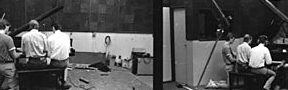
www.bush-of-ghosts.com – watch
Studio pictures
The Studio pictures were part of the watch page on the www.bush-of-ghosts.com website. These were also partially contained in the booklet of the My Life In The Bush Of Ghosts 2006 re-release. I was able to find some of the pictures, as they were also used on the Essay David Byrne page.
fig. 1-4 – Having abandoned the idea or retreating into the Mojave, Brian and I settled into El Dorado studio in LA, where we were told Frank Sinatra had worked sometimes. We stayed on Vermont, in what is now Koreatown, I think. Prairie Prince, of the Tubes, joined us for a few days, playing drums, percussion and odds and ends. Our own percussive efforts made interesting sounds- using cardboard boxes and cases- but sometimes we lacked precise time.
fig. 5-8 – One day, hearing that Brian was in town, a man brought by a prototype Linn Drum machine. (drum machines such as this didn’t exist at this point). We weren’t much interested, possibly because it sounded like it was imitating something else (real drums). Others, like Prince Rodgers Nelson, saw immediately the use for such a machine.
fig. 9-12 – In San Francisco we worked for a while at Different Fur studio. I man named Patrick Gleason lived upstairs- a pioneer in electronic music. Beaver and Krause, two other early pioneers were nearby as well. They lent us a massive Senheisser vocoder that was wonderful sounding, and very expensive.
fig. 12-22 – In NY we wrapped up the record at Sigma studios, where Talking Heads had been working. Though we weren’t quite going for the Philadelphia sound that Sigma was known for, we possibly assumed some of the rhythmic magic and creative expertise might land on us. Doubtful. Though later, hearing Larry Levan include one of the tunes in his set made me think maybe some of it did land on us.

www.bush-of-ghosts.com – watch
Polaroids
The Polaroids were part of the watch page on the www.bush-of-ghosts.com website.
Having tried a few different directions for LP cover art, we decided to incorporate the video monitor as a painting tool, as Brian and others were doing here and there. By pointing the camera at the monitor and generating video feedback a few little cutout humanoid shapes pasted on the screen would be infinitely multiplied. And by fussing with the color setting on the backs of the TV sets one could saturate and skew the color quite a bit. I also took some pictures of just skewed vortexes and whorls of color, and then we did some images where we skewed the color on pictures that had been taken of ourselves and then took polaroids of the results. Somehow, despite it being very techie, these techniques also seemed analogous to what we were doing on the record. It was funky as well as being techie. Extremely lo tech actually, and not what you were supposed to do with a TV set.

www.bush-of-ghosts.com – watch
Alternate covers ’81
The Alternate covers ’81 were part of the watch page on the www.bush-of-ghosts.com website. The text on this page was identical to the text on the Polaroids page.
Having tried a few different directions for LP cover art, we decided to incorporate the video monitor as a painting tool, as Brian and others were doing here and there. By pointing the camera at the monitor and generating video feedback a few little cutout humanoid shapes pasted on the screen would be infinitely multiplied. And by fussing with the color setting on the backs of the TV sets one could saturate and skew the color quite a bit. I also took some pictures of just skewed vortexes and whorls of color, and then we did some images where we skewed the color on pictures that had been taken of ourselves and then took polaroids of the results. Somehow, despite it being very techie, these techniques also seemed analogous to what we were doing on the record. It was funky as well as being techie. Extremely lo tech actually, and not what you were supposed to do with a TV set.

www.bush-of-ghosts.com – watch
Manipulated covers ’05
The Manipulated covers ’05 were part of the watch page on the www.bush-of-ghosts.com website.
I talked to Peter Buchanan-Smith, who designed the re release CD package, about either including or referencing the original album cover rather than coming up with something entirely new. This is the marketing man in me speaking- I imagined that a person who had seen the original cover would have an idea what they were looking for when seeking out a re release, so a completely unrelated image would throw them off the scent. Peter, as a creative type, didn’t feel comfortable simply reproducing Peter Saville’s original layout over Brian’s video photo, so he came up with a way of referencing the original obliquely. He took the original and digitally manipulated it, while retaining all the original colors- he smeared it horizontally (which was used), twisted it into vortexes and made it all radiate from the center. Surprisingly, one still had a kind of vestigial sense of the original cover in all of these versions.
www.bush-of-ghosts.com – watch
Mea Culpa video
The Mea Culpa video page was part of the watch page on the www.bush-of-ghosts.com website.
In the course of recording this album Brian and I crossed paths with artist and filmmaker Bruce Connor, who lives in San Francisco. Bruce’s’ legendary “experimental” films are well known for their pioneering use of found footage, so it was natural that we approach him regarding the possibility of working together- which was more like suggesting he use some of the Bush of Ghosts tracks in a film or two, due to the similarities of our working methods. Connor mainly uses old educational films, science films, government footage and film footage that people throw out and then recuts them to new music, creating dark and sometimes hilarious moods and visual commentaries. His work was sampling before that word existed, as was this record. The films gain an additional level of depth due to the fact that you can often guess what the footage was originally used for, and so you see it as an artifact and as something entirely new, both at the same time.
My Life In The Bush Of Ghosts original sequence
The image below, and its textual content, was not available on the www.bush-of-ghosts.com website. It stems from the booklet of the My Life In The Bush Of Ghosts 2006 re-release.
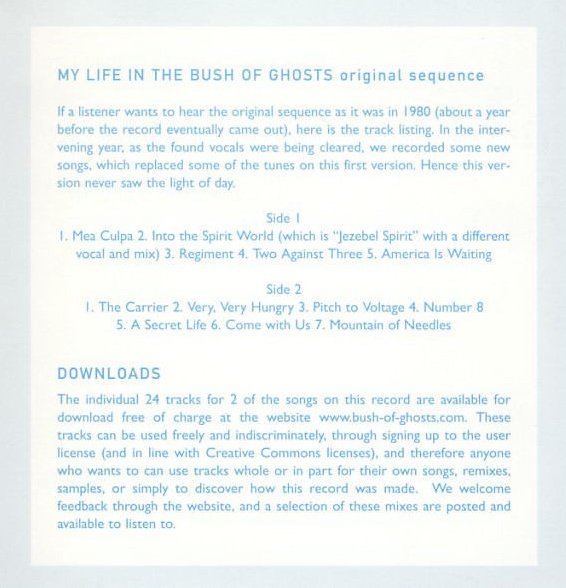
Brian Eno + David Byrne – My Life In The Bush Of Ghosts – 2006 remaster – original sequence
Quotes
The quotes I have been able to retrieve were published on the main and the listen pages on the wwww.bush-of-ghosts.com website.
I grew up as a David Byrne fan. I admired his work with Talking Heads and those records then led me to ‘My Life In The Bush Of Ghosts’ where I discovered Brian Eno’s work. The collaboration between Byrne and Eno inspired me to think outside the box and opened my head up to new musical and most importantly non-musical experiences.
Hank Shocklee – Producer (Public Enemy)
‘bush of ghosts’ was one of my favorite records when i was growing up in the early 80’s. i loved (and continue to love) its remarkable combination of emotional longing and atmosphere and sex and tension. at times it’s a very disquieting record (‘mea culpa’, ‘come with us’), and at times it’s poignant and delicate (‘the carrier’).
moby
In November 1985 Kate Bush remarked that the My Life In The Bush Of Ghosts album “left a very big mark on popular music”. In November 1996 Pink Floyd’s Richard Wright said that the album “knocked me sideways when I first heard it – full of drum loops, samples and soundscapes. Stuff that we really take for granted now, but which was unheard of in all but the most progressive musical circles at the time… The way the sounds were mixed in was so fresh, it was amazing.” The Orb’s Alex said: “That was a definite blueprint for anything I was going to do. It’s an amazing album.”

