
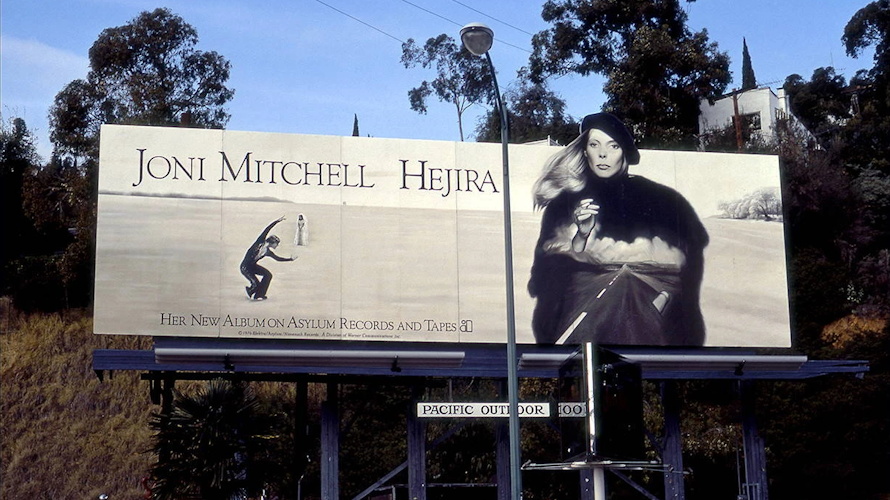
Joni Mitchell – Hejira – Billboard
Introduction
This is the fourth article on this blog dedicated to a Joni Mitchell album. The first focused on the magnificent Blue. That article also takes a closer look at Joni Mitchell’s career. If you’d like to learn more, read Joni Mitchell impresses deeply with Blue. The second article was dedicated to Court And Spark. You can read more about it in Joni Mitchell incorporates jazz into her music for the first time, Court And Spark. The third article focused on The Hissing Of Summer Lawns. Read more in Joni Mitchell experiments on The Hissing Of Summer Lawns.
Joni Mitchell
Late 1975, following the release of The Hissing Of Summer Lawns, Joni Mitchell joined Bob Dylan’s Rolling Thunder Revue for a number of shows. The experience took its toll on Mitchell. She became fatigued and developed a cocaine addiction. Early 1976, Mitchell planned a tour to promote The Hissing Of Summer Lawns. After just a handful of concerts, however, things came to an abrupt halt. In February 1976, while performing in Maryland, Mitchell walked off stage during the very first song and cancelled the remainder of the tour. She was exhausted, struggling with her addiction, and constantly arguing with her fiancé, drummer John Guerin. The tour was over.
Mitchell retreated to Neil Young’s beach house to recover. Friends then invited her to join them on a road trip across America, after which she continued travelling on her own. During these journeys, she wrote the music that would eventually become her next album, Hejira. In 1979, she looked back on how the album came about in an interview with Cameron Crowe.
What were the origins of ‘Hejira’? That album seems to have a sound all of its own…
Well, after the end of my last tour, it was a case of waiting again. I had an idea, I knew I wanted to travel. I was sitting out at the beach at Neil’s {Young} place, and I was thinking, “I want to travel, I don’t know where and I don’t know who with.” Two friends of mine came to the door and said, “We’re driving across country.” I said, “I’ve been waiting for you, I’m gone.” So we drove across country, then we parted ways. It was my car, so I drove back alone. The Hejira album was written mostly while I was traveling in the car. That’s why there were no piano songs, if you remember.
Hejira was an obscure word, but it said exactly what I wanted. Running away, honorably. It dealt with the leaving of a relationship, but without the sense of failure that accompanied the breakup of my previous relationships. I felt that it was not necessarily anybody’s fault. It was a new attitude.
Joni Mitchell interviewed by Cameron Crowe, Rolling Stone #296, July 26, 1979
The trip yielded no less than six songs, alongside two dating from earlier journeys and the Rolling Thunder Revue. On her way back from the final trip, she stopped to visit Chögyam Trungpa, a Buddhist master. Shortly before Easter 1976, she had kicked her cocaine habit.
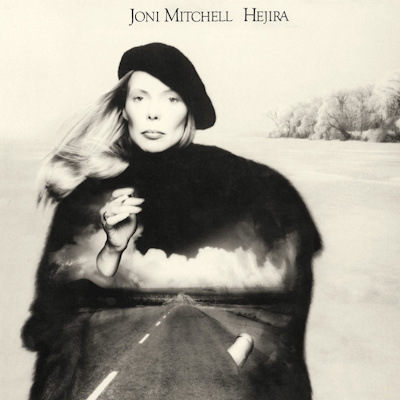
Joni Mitchell – Hejira
Hejira
On November 21, 1976, Joni Mitchell released her eighth studio album, Hejira. Just as The Hissing Of Summer Lawns had continued where its predecessor left off, the same was true of Hejira. Mitchell further developed her experimentation and her gradual move towards increasingly complex instrumentation.
As mentioned in earlier articles, Joni Mitchell was becoming increasingly frustrated with the contributions of rock musicians playing instruments she couldn’t play herself: “There were grace notes and subtleties and things that I thought were getting kind of buried.” Her introduction to other musicians inspired Mitchell to explore different kinds of music and composition.
After most of the recordings for Hejira had been completed, Mitchell met the influential jazz bassist Jaco Pastorius. His innovative bass playing, particularly his use of the fretless bass, took him well beyond the boundaries of conventional jazz. The two shared a deep, intuitive connection. Mitchell’s compositions, original tunings and distinctive musical identity inspired Pastorius, who contributed his playing to four tracks.
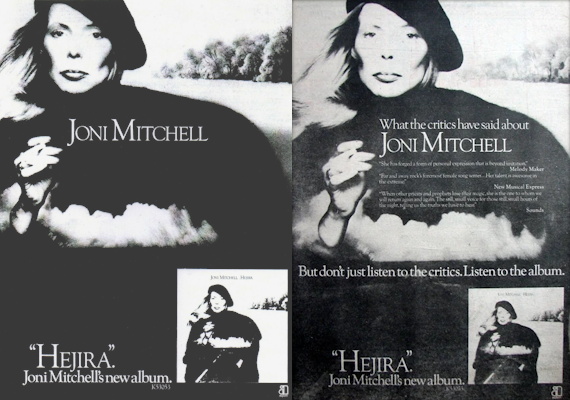
Joni Mitchell – Hejira – Ads
Music and lyrics
The album is largely acoustic in nature, blending folk, jazz and rock into a hybrid sound. Five of its nine tracks contain no drums, yet somehow you hardly notice their absence. Percussion is used sparingly, but a song like Coyote, the album’s only single, sounds thoroughly rhythmic thanks to the clever use of percussion and the effective interplay of rhythm guitar. Mitchell’s singing is beautiful: expressive, warm, narrative-driven and abundant. Hejira feels like the ultimate lyrics album. The lyrics are long, intense and, once again, beautiful. She writes impressively about her own adventures, emotions and personal quest.
The album’s central themes can be summed up as being on the road and travelling. Her journey across America gave her many new perspectives. Her engagement to John Guerin came to an end, and Mitchell embarked on a search for meaning, redefining what success and happiness meant to her as an artist and as a woman.
According to Mitchell, the opening track and the album’s only single, Coyote, was written on November 25, 1975, during the Rolling Thunder Revue. It is about an affair she looks back on without regret: “No regrets Coyote.”
We saw a farmhouse burning down
In the middle of nowhere
In the middle of the night
And we rolled right past that tragedy
Till we turned into some road house lights
Where a local band was playing
Locals were up kicking and shaking on the floor
And the next thing I know
That coyote’s at my door
He pins me in a corner and he won’t take no
He drags me out on the dance floor
And we’re dancing close and slow
Now he’s got a woman at home
He’s got another woman down the hall
He seems to want me anyway
Why’d you have to get so drunk
And lead me on that way
You just picked up a hitcher
A prisoner of the white lines on the freeway© Coyote, Joni Mitchell, 1976
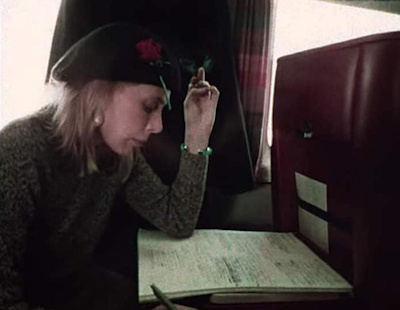
Joni Mitchell works on Coyote on the tourbus, late 1975
The lyrics paint a picture of time and adventure, ultimately portraying Mitchell as the ‘victor’ of the story. The “coyote” has been outsmarted.
Amelia uses the journey and fate of aviator Amelia Earhart as a metaphor for Mitchell’s own desire to travel, explore, be alone and find love: “A ghost of aviation / She was swallowed by the sky / Or by the sea like me she had a dream to fly.”
Furry Sings The Blues recounts her encounter with Furry Lewis, who told Joni, “I don’t like you”. The song depicts Beale Street in Memphis, the official ‘Home of the Blues’, and its decline. On December 10, 1976, Furry Lewis was interviewed by the Memphis Press, in which he stated that he agreed with Mitchell’s lyrics.
Looking up and down old Beale Street
Ghosts of the darktown society
Come right out of the bricks at me
Like it’s a Saturday night
They’re in their finery
Dancing it up and making deals Furry sings the blues© Furry Sings The Blues, Joni Mitchell, 1976
A Strange Boy is about an affair Mitchell had during her travels across America with a young man who was still living with his parents. Despite his immaturity, the relationship nevertheless brought her something meaningful: “We got high on travel / And we got drunk on alcohol / And on love the strongest poison and medicine of all”.
Despite all the beauty we’ve encountered so far, the album’s highlight, the title track Hejira, still comes as a surprise. What a magnificent piece of music, a minor miracle both musically and lyrically. According to Mitchell, it was “probably the toughest tune on the album to write”. The song addresses the end of her relationship with Guerin.
I’m traveling in some vehicle
I’m sitting in some cafe
A defector from the petty wars
That shell shock love away
There’s comfort in melancholy
When there’s no need to explain© Hejira, Joni Mitchell, 1976
The next track, Song For Sharon, draws on the same inspiration: “I can keep my cool at poker / But I’m a fool when love’s at stake / Because I can’t conceal emotion / What I’m feeling’s always written on my face”. Blue Motel Room is also about Guerin, but focuses on the question of what comes next after the end of their relationship: “Will you still love me / When I get back to town”.
After Black Crow, which describes travelling, the album closes with Refuge Of The Roads, a song about Mitchell’s visit to Chögyam Trungpa and her place in the world.
In a highway service station
Over the month of June
Was a photograph of the earth
Taken coming back from the moon
And you couldn’t see a city
On that marbled bowling ball
Or a forest or a highway
Or me here least of all
You couldn’t see these cold water restrooms
Or this baggage overload
Westbound and rolling taking refuge in the roads© Refuge Of The Roads, Joni Mitchell, 1976
Joni Mitchell – Hejira – Gatefold photo
Reception
Hejira was the most experimental album Joni Mitchell had released up to that point. Unlike The Hissing Of Summer Lawns, which had been heavily criticised by the press, Hejira received a much warmer reception, although not always wholeheartedly. The single Coyote failed to make an impact on the charts, but the album was certified gold in the US just three weeks after its release. Today, like much of Joni Mitchell’s other work, it is regarded as a classic and one of the highlights of 1970s music.
Like her other albums, Hejira has become a landmark record and a favourite among many artists, including Björk, Danielle Haim, Weyes Blood and St. Vincent.
Joni Mitchell – Hejira – Original cover photo
Cover art
Joni Mitchell came across the word “Hejira” while searching for a “word to describe running away from something honorably”. The word “Hejira” refers to the migration of the Islamic prophet Muhammad and his followers from Mecca to what is now known as Medina, in the year 622.
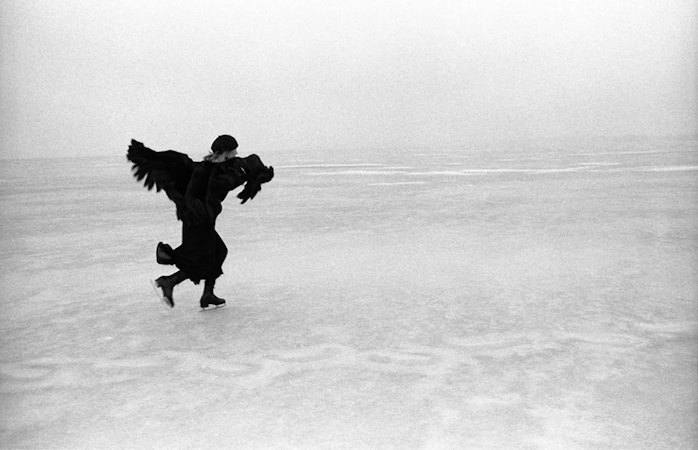
In March 1976, Mitchell was staying in Madison, Wisconsin, with photographer Joel Bernstein. Early one morning, they headed out to a recently frozen lake, where Mitchell went ice-skating. The resulting photographs were beautiful and would eventually be considered for the cover of her next album. However, they weren’t quite what she had in mind.
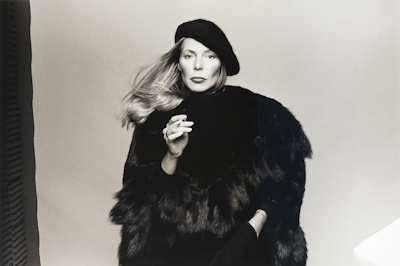
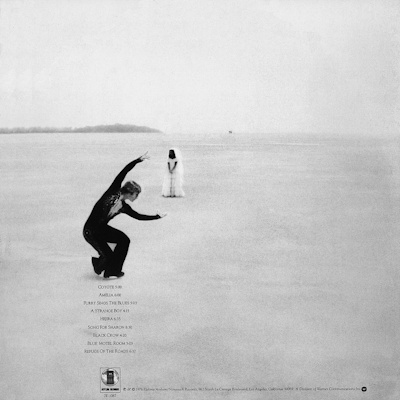
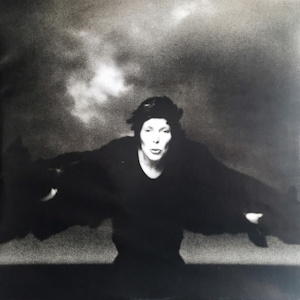
Mitchell contacted Norman Seeff again. A number of portrait photographs were combined with images representing her journey, as well as the pictures taken earlier. In an interview with Rolling Stone, published on December 15, 1994, Mitchell was asked which album cover was her favourite. She replied, “I like Hejira. A lot of work went into that.”
Review
As I mentioned earlier this year when celebrating the 10th anniversary of my blog, Joni Mitchell is one of the artists I’ve come to know better through writing about music. The Joni Mitchell albums I’ve covered and praised have become some of my favourite albums of all time by now. Mitchell has a remarkable ability to transport me to different worlds, moods and places.
The same is true of Hejira. After several listens, it becomes clear that, at times, Joni Mitchell seems otherworldly. Her imagination is captivating, unique, melancholic and intense, yet somehow optimistic. On October 8, 2006, Mitchell told The Ottawa Citizen: “I suppose a lot of people could have written a lot of my other songs, but I feel the songs on Hejira could only have come from me.” Apart from the slight false modesty in the opening words of her statement, she is absolutely right about Hejira. You couldn’t ask for a stronger recommendation.

Joni Mitchell – Hejira – Back cover
Songs
All songs written by Joni Mitchell.
- Coyote
- Amelia
- Furry Sings The Blues
- A Strange Boy
- Hejira
- Song For Sharon
- Black Crow
- Blue Motel Room
- Refuge Of The Roads
Coyote was released as as single in January 1977.
Joni Mitchell – Hejira – Inner sleeve
Musicians
- Joni Mitchell – vocals, guitar
- Larry Carlton – guitar on Coyote, Amelia, A Strange Boy, Black Crow, Blue Motel Room
- Bobbye Hall – percussion on Coyote, A Strange Boy, Hejira
- Jaco Pastorius – fretless bass on Coyote, Hejira, Black Crow, Refuge Of The Roads
- Victor Feldman – vibes on Amelia
- Max Bennett – bass on Furry Sings The Blues, Song For Sharon
- John Guerin – drums on Furry Sings The Blues, Song For Sharon, Blue Motel Room, Refuge Of The Roads
- Neil Young – harmonica on Furry Sings The Blues
- Abe Most – clarinet on Hejira
- Chuck Domanico – bass on Blue Motel Room
- Chuck Findley, Tom Scott – horns on Refuge Of The Roads
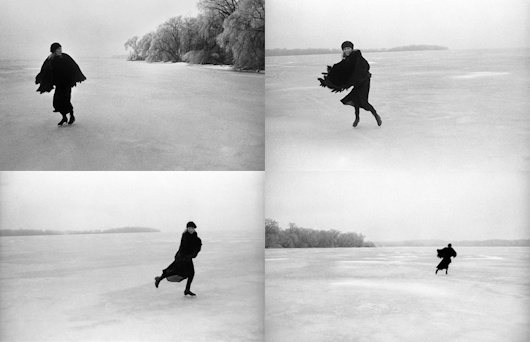
Joni Mitchell – Hejira – Photo outtakes March 1976
After Hejira
In mid-1977, Joni Mitchell began work on her follow-up, the double album Don Juan’s Reckless Daughter, which would lean even further towards jazz and jazz-rock. It would prove to be an extremely controversial release, as Mitchell depicted herself in ‘blackface’ on the cover.
In closing
What’s your take on Hejira? Let me know!

Video/Spotify
This story contains an accompanying video. Click on the following link to see it: Video: Joni Mitchell and the story of Hejira. The A Pop Life playlist on Spotify has been updated as well.

