
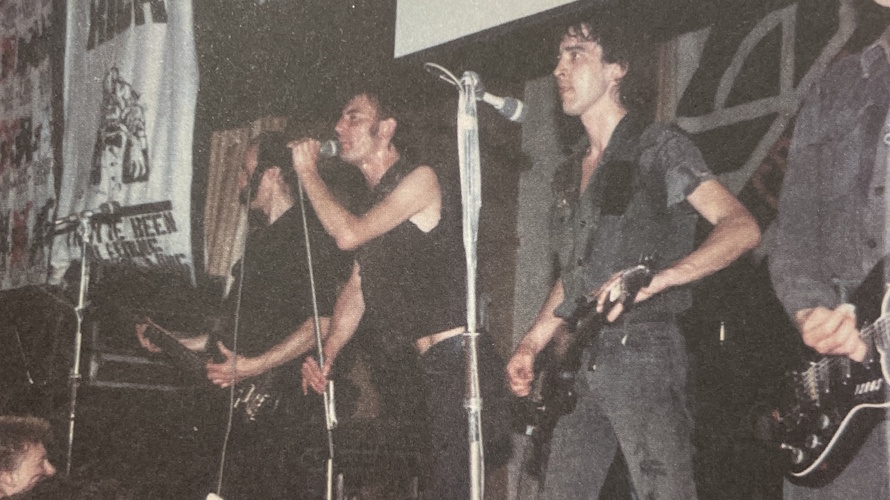
Crass – Abderdare 07/11/1984
Introduction
In 1986, Crass released a compilation album, promoted as the Crass Singles Compilation. An actual Greatest Hits album? From Crass? Yes, it certainly seemed that way. The story of Best Before 1984.
Crass
Following the Yes Sir, I Will release, Crass found themselves at a crossroads. Do we continue or do we stop? Everything has already been said. On July 11, 1984, Crass played a concert in Aberdare. On the way back home, guitarist N.A. Palmer (Andy) announced he was leaving Crass. Palmer bought himself out and left Dial House, the heart of Crass, the farmhouse where all members lived together, shared their lives, loved, and developed their ideas. Palmer turned out to be the first one with the courage to say what others felt and thought.
Steve Ignorant: “I remember when Andy said he wanted to leave the band. I was thinking ‘Thank fuck for that’, cos I’d been dying to say that for ages, but I didn’t know how to – I was too scared.”
Penny Rimbaud: “Also, we were getting frankly bored with each other. The differences were manifesting.”
Eve Libertine: “I did feel towards the end that we’d lost that feeling.”
© 2008 George Berger, The Story Of Crass
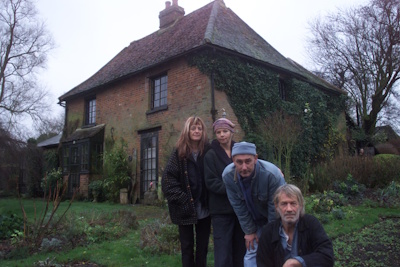
Former Crass members – Dial House 2000 (fltr: Gee Vuacher, Eve Libertine, Steve Ignorant, Penny Rimbaud)
The story goes that Crass had always planned to stop in 1984. The catalogue numbers of Crass releases were structured according to a fixed pattern: X21984/Y, where X represented the number of years between the release year and 1984 (the 21984 part of the catalogue number) and /Y the sequence number within that particular release year. However, in the aforementioned book by George Berger, Phil Free and Steve Ignorant are very clear about the intention to stop in 1984, and that it had always been the intention: “It’s crap”. Others say that the story is indeed true.
Around that time, the group was also taken to court over the lyrics of Bata Motel (off the 1981 album Penis Envy). The court case caused Crass to take a stand on their core convictions, and a lot of money was spent on lawyers.
Perhaps more importantly, after the breakup of Crass, the collective faded into the background, in favor of the individuals that made up Crass. Consequentially, questions arose (Do I actually know you?, Do I even like you?, Who am I?), but also irritations, accusations, disagreements, and opposing visions of the future. On New Year’s Day 1989, things came to a head. Dial House was abandoned by the remaining Crass members.
In 1985, Acts Of Love and Ten Notes On A Summer’s Day were still released under the name Crass, even though the albums were were far removed from previous Crass albums. Basically, both albums are Penny Rimbaud and Friends releases rather than true Crass records.
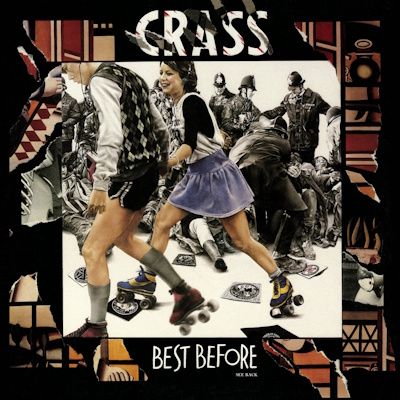
Crass – Best Before 1984
Best Before 1984
And, in 1986, Best Before 1984 was released, a double album featuring a collection of singles, demos, a previously unreleased track, and the final song the band ever played live. The exact release date is not entirely clear. Several sources cite April 27, 1986, as the release date, but dates in June of that year are also mentioned. For this article, I have used April 27.
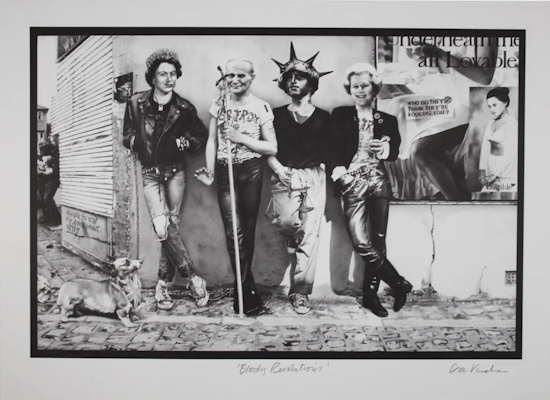
The release differed from earlier ones. The album was given a color sleeve. The gatefold included a color print of the poster that originally accompanied the joint Crass/Poison Girls single Bloody Revolutions/Persons Unknown. It is an adaptation of a famous Sex Pistols photograph, in which their heads have been replaced by Queen Elizabeth (Sid Vicious), Pope John Paul II (Steve Jones), the Statue of Liberty (Paul Cook), and Margaret Thatcher (Johnny Rotten), placed in a street filled with Crass graffiti.
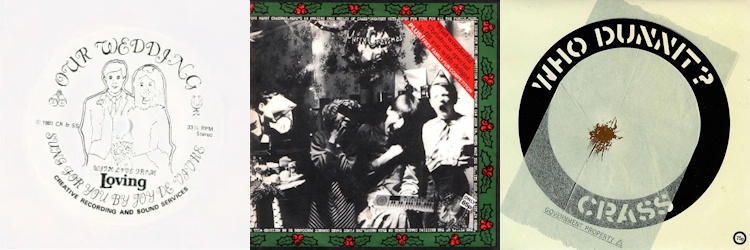
The subtitle does the album partial justice. It contains most of the band’s classic singles, but unfortunately the Our Wedding single (see the story about Penis Envy) and Merry Crassmas are missing. All the other singles are present. The collection is strong and exciting and includes classic Crass tracks such as Shaved Women, Bloody Revolutions, Nagasaki Nightmare, Big A Little A, and How Does It Feel?. Thus, the compilation is a good starting point for entering the world of Crass.
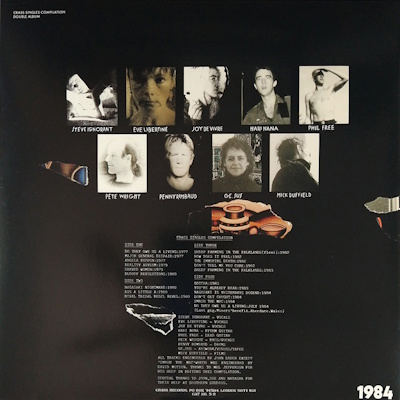
Crass – Best Before 1984 – Back cover
Songs
All songs written by Crass.
- Do They Owe Us A Living? (¥)
- Major General Despair (¥)
- Angela Rippon (¥)
- Reality Asylum (§)
- Shaved Women (§)
- Bloody Revolutions (µ)
- Nagasaki Nightmare (¢)
- Big A Little A (¢)
- Rival Tribal Rebel Revel (±)
- Sheep Farming In The Falklands (#)
- How Does It Feel? (φ)
- The Immortal Death (φ)
- Don’t Tell Me You Care (φ)
- Sheep Farming In The Falklands (2) (†)
- Gotcha (†)
- You’re Already Dead (ψ)
- Nagasaki Is Yesterday’s Dog-End (ψ)
- Don’t Get Caught (ψ)
- Smash The Mac (¤)
- Do They Owe Us A Living? (÷)
N.B.:
¥ recorded on February 27, 1978, the band’s first demos, incorrectly dated as 1977 on the album.
§ taken from the Reality Asylum single, released in 1979 (CRASS1).
µ taken from the Crass/Poison Girls Bloody Revolutions/Persons Unknown single, released in 1980 (421984/1).
¢ taken from the Nagasaki Nightmare/Big A Little A double A-side single, released in 1980 (421984/5).
± taken from the Rival Tribal Rebel Revel flexi-single, later released as a single in 1980 (421984/6).
# taken from an untitled flexi-disc from 1982.
φ taken from the How Does It Feel (To Be The Mother Of A Thousand Dead)? single, released in 1982 (221984/6).
† originally available as a flexi-disc, taken from the Sheep Farming In The Falklands single, released in 1983 (121984/3).
ψ taken from the final single, You’re Already Dead, released in 1984 (1984).
¤ previously unreleased.
÷ recorded live during the final Crass concert in Aberdare, July 11, 1984.
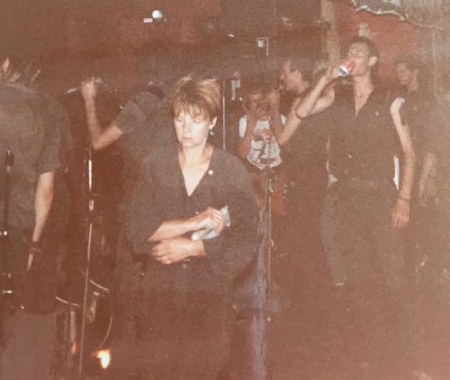
Crass – Abderdare 07/11/1984
Crass
- Steve Ignorant – vocals
- Eve Libertine – vocals
- Joy De Vivre – vocals
- Hari Nana (N.A. Palmer) – guitar
- Phil Free – guitar
- Pete Wright – bass, vocals
- Penny Rimbaud – drums
- Ge.Sus (Gee Vaucher) – artwork, videos, tapes
- Mick Duffield – films
Message
Due to the album being a compilation, there is no single overarching message, as there is on an album like Penis Envy. But the messages are still entirely Crass.
In Major General Despair, the racist National Front is attacked.
Reading evening papers about the National Front / They go out and they do it, they’re such a bunch of cunts
© Major General Despair, Crass
Major General Despair is also part of Christ – The Album, but that version doesn’t resemble the original version on this compilation, both musically and lyrically.

Crass – Reality Asylum – single
Reality Asylum is a slightly different version of Asylum, taken from the debut album The Feeding Of The 5000. The attack on Christianity is relentless.
I am no feeble Christ, not me / “He” hangs in glib delight upon “His” cross, upon “His” cross / Above my body, lowly me / “Christ, forgive!” Forgive? / Holy He, He holy, He holy? / Shit, “He” forgives / Forgive? Forgive? / I? I? Me? I? / I vomit for you, Jesu / Christi-Christus / Puke upon your papal throne
© Reality Asylum, Crass
One of the reasons I found Crass so impressive at the time was their genuine and honest anger. The emotion inspired my admiration. The same applies to Shaved Women, a commentary on how women were ‘pressured’ into shaving themselves to be considered attractive. It is also seen as a condemnation of the shaving of women after the Second World War by the ‘heroes’ who suddenly emerged.
Shaved women collaborators / Shaved women are they traitors? / Dead bodies all around
© Shaved Women, Crass
The lyrics are shouted, the music is militantly minimalistic. After a brief lull, the track returns in full force with a repetitive message that is spat into the microphone.
In all our decadence people die
© Shaved Women, Crass
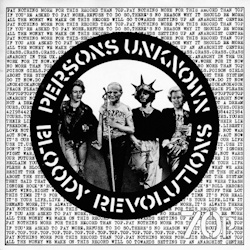
Crass/Poison Girls – Bloody Revolutions/Persons Unknown
The next track, Bloody Revolutions, addresses revolution, violence, and possible solutions. Does left-wing politics really have that much more to offer than right-wing politics? The message is that violence is violence, regardless of its source.
Well, freedom has no value if violence is the price / Don’t want your revolution, I want anarchy and peace
…
You talk of overthrowing power with violence as your tool / You speak of liberation / And when the people rule / Well ain’t it people rule right now? / What difference would there be? / Just another set of bigots / With their rifle-sights on me
…
You say that revolution / Will bring freedom for us all / Well freedom just ain’t freedom when your back’s against the wall
…
Political right, political left, you can keep your politics / Government is government and all government is force / Left or right, or right or left, it takes the same old course / Oppression and restriction, regulation, rule and law
© Bloody Revolutions, Crass
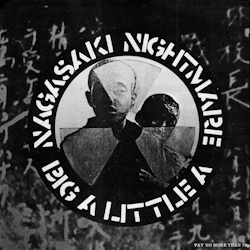
Crass – Nagasaki Nightmare/Big A Little A
Although Nagasaki Nightmare is rooted in the early 1980s belief that “the bomb” would surely fall, which, in hindsight, can be dismissed as irrational, the track remains terrifying.
Manmade power, manmade pain, Nagasaki nightmare / Deadly rain, deadly rain, Nagasaki nightmare / They’ll do it again, shower us in rain / Deadly, deadly, deadly rain / Nagasaki nightmare, Nagasaki Nightmare
© Bloody Revolutions, Crass
And then there’s Big A Little A, perhaps Crass’s ultimate manifesto. In the first part of the track, the institutions that represent oppression are addressed, including religion, monarchy, police, army, and state. That section concludes with:
We’ve got to look for methods to undermine those powers / It’s time to change the tables / The future must be ours
© Big A Little A, Crass
The second part perfectly summarizes Crass’s raison d’être and its mission. It is about personal responsibility, making choices, and the opportunity to shape one’s own life in a way that brings greater fulfillment and meaning. Inspiring to this day.
Be exactly who you want to be, do what you want to do / I am he and she is she but you’re the only you / No one else has got your eyes, can see the things you see / It’s up to you to change your life and my life’s up to me / The problems that you suffer from are problems that you make / The shit we have to climb through is the shit we choose to take / If you don’t like the life you live, change it now it’s yours / Nothing has effects if you don’t recognise the cause / If the programme’s not the one you want, get up, turn off the set / It’s only you that can decide what life you’re gonna get
…
If you don’t like the rules they make, refuse to play their game / If you don’t want to be a number, don’t give them your name / If you don’t want to be caught out, refuse to hear their question /Silence is a virtue, use it for your own protection / They’ll try to make you play their game, refuse to show your face / If you don’t want to be beaten down, refuse to join their race / Be exactly who you want to be, do what you want to do / I am he and she is she but you’re the only you
© Big A Little A, Crass
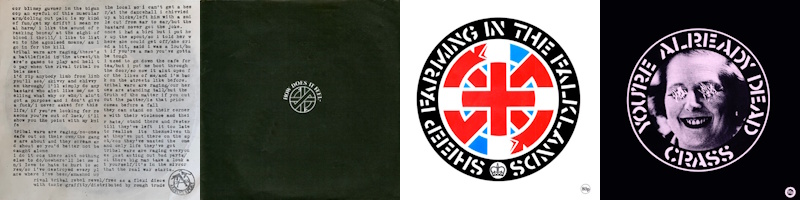
Crass – Rival Tribal Rebel Revel, How Does It Feel (To Be The Mother Of A Thousand Dead)?, Sheep Farming In The Falklands & You’re Already Dead
Rival Tribal Rebel Revel also appears as Pt. 2 on Christ – The Album. From Sheep Farming in The Falklands onwards, the Falklands War and its consequences became the central theme. The band devoted a significant amount of attention to the conflict, which had broken out during the recording of Christ – The Album. Crass wanted to remain relevant and comment on current events. For Crass, missing the Falklands War felt like a defeat. In 2009, Rimbaud said: “Christ had been intended as a celebration of our collective strength, a tangible demonstration of possibilities. However, against the backdrop of Thatcher’s vicious, pointless war, it all seemed depressingly empty. We were too late, too late by far.” The band felt they had something to make up for, and they did so. Much attention was given to the war, and the music reflected that. Disharmonious, harsh, militant, aggressive, atonal. The attack was both lyrical and sonic. See also the story about the How Does It Feel single.
Crass – ….In Which Crass Voluntarily ‘Blow Their Own’
…In Which Crass Voluntarily ‘Blow Their Own’
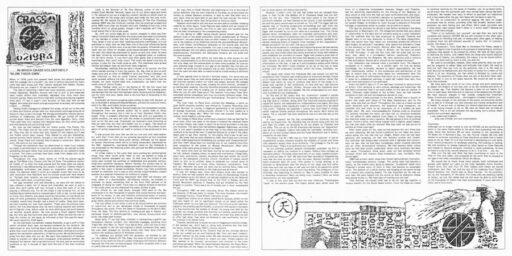
The release of Best Before 1984 was accompanied by an essay titled …In Which Crass Voluntarily ‘Blow Their Own’. The question is what Crass ‘blow’: whistle, top, image, myth, horn? At times it seems to be ‘horn’ (“to blow your own horn” = to boast about your own achievements). A remark such as “It is not grandiose to claim that we have been one of the most influential bands in the history of British rock” strongly supports the ‘horn’ theory. Apart from this statement, the essay portrays a solid image of the original motivations for starting Crass, how it ended, and the doubt that set in after the breakup. Read the full essay in the sub-article …In Which Crass Voluntarily ‘Blow Their Own’.
Crass – Best Before 1984 – The missing singles
Review
Best Before 1984 is essential for Crass fans. The first half of the compilation is truly essential, due to the classic singles, the crystal-clear recordings, and Crass at their peak. The second half is not bad, but portrays a sense of bitterness that limits rather than empowers.
For me, the highlights of the compilation are Shaved Women, Bloody Revolutions, Nagasaki Nightmare, and Big A Little A. Each and every one of them is essential listening for any (anarcho)punk listener. These songs alone warrant the compilation’s purchase, especially for those who, like me, did not own the original singles at the time. The only Crass single I personally bought was How Does It Feel (To Be The Mother Of A Thousand Dead)?.
It is a shame that the singles Our Wedding, Merry Crassmas, and Who Dunnit? are missing, as they would have made the collection complete. Is this the go-to album for those interested in Crass? No, for me personally that title is reserved for the unsurpassed Stations Of The Crass.

Crass – Best Before 1984 – The Crassical Collection
Crassical Collection
All of Crass’s official albums were reissued between 2010 and 2011 as part of the six-part The Crassical Collection. The albums were remastered and featured the complete original artwork, supplemented with new artwork and liner notes by Penny Rimbaud and Steve Ignorant.
Unfortunately, the reissues led to disputes amongst the former band members. Also, the releases were controversial within the punk community, which did not show itself in the best of lights. Complaints about the price (which by today’s standards was low) and a sense of entitlement to free material, because “that was what Crass stood for”. Well then, Do They Owe Us A Living?…

Crass – Best Before 1984 – Free download
Best Before 1984 remained in limbo for a long time. The dispute caused delays, high costs, multiple postponements and contributed to the bankruptcy of the record label Southern. Until in 2019 the announcement finally came: Best Before 1984 would also be released as part of The Crassical Collection, as the seventh installment. From April 1 to April 5, 2019, the album was offered as a free download. Rimbaud:
Crass was then and this now, but the lyrics remain tragically relevant, indeed, Crass were often so prophetic that it’s only now that their warnings might make sense to those who in the day preferred to keep their heads firmly buried in the sand. ‘Global warning? Nah, let’s go down the lido.’ Where the Pistols and The Clash now sit comfortable in the backlit annuls (or is that anus?) of rock’n’roll history, Crass continue to contribute to the ever-growing voice of global dissent.
The physical album would not see the light of day until October 2, 2020. This edition included the Merry Crassmas and Who Dunnit? singles (Our Wedding had already been included in the reissue of Penis Envy). The album also contained so-called Threads between several tracks, which are often referred to as segues on regular (ie not anarcho punk) albums. The downside of this is that they often disrupt the flow of an album. Unfortunately, that was also the case here.
Crass – Bloody Revolutions – Poster (Gee Vaucher)
Gee Vaucher
The story of Crass isn’t complete without mentioning the name of Gee Vaucher. Vaucher was an integral part of the Crass collective. She was responsible for all of Crass’s artwork and was therefore inseparably linked to the band. After the group disbanded, Vaucher continued to produce paintings and collages. Her work has since gained international recognition and is regularly exhibited in renowned galleries and museums. Look up her work, it is original, unsettling, moving, and utterly human.
In closing
This is the last article about Crass on this blog. I have fulfilled a long-held wish: the name Crass must not be forgotten. You are only forgotten when people stop mentioning your name! Beyond whatever their musical impact was, the group represented a unique, coherent statement in which DIY, self-management, independence, self-determination, and self-aware living and decision-making were central. At a young age, this was extremely exciting and inspiring.

Video/Spotify
This story contains an accompanying video. Click on the following link to see it: Video: Greatest Hits? Crass – Best Before 1984. The A Pop Life playlist on Spotify has been updated as well.

More Crass?
- The Feeding Of The 5000
- Stations Of The Crass
- Penis Envy
- Merry Crassmas
- Christ – The Album
- How Does It Feel
- Yes Sir, I Will

