
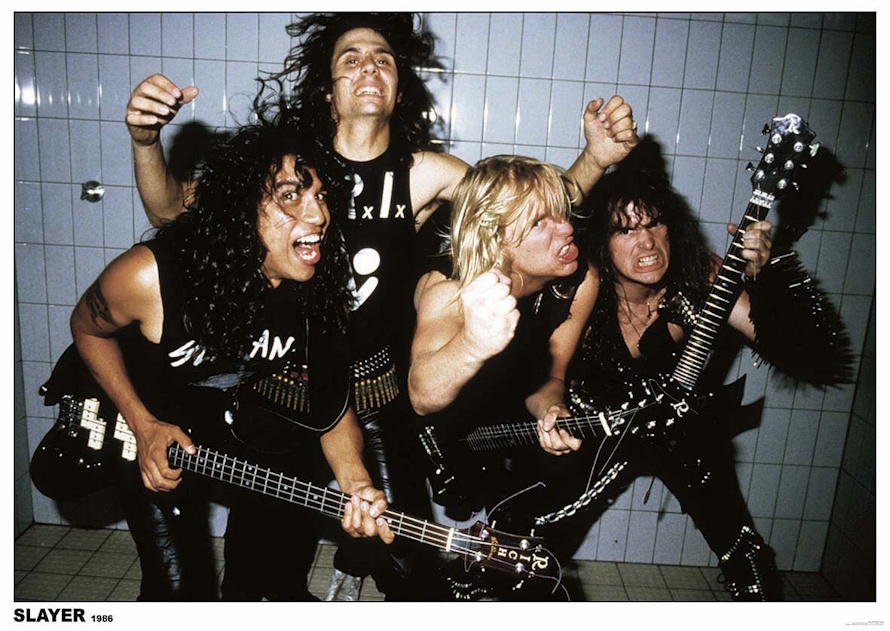
Slayer 1986 poster (vlnr Tom Araya, Dave Lombardo, Jeff Henneman, Kerry King)
Introduction
Generally speaking, I’m not a big fan of thrash metal (also known as speed metal), although there are exceptions. I can listen to three of the genre’s “big four” quite happily. Slayer wasn’t one of them. Has that changed?
Slayer
Slayer was formed in 1981 by Tom Araya (bass and vocals), Jeff Hanneman (guitar), Kerry King (guitar), and Dave Lombardo (drums). In November 1983, the band entered the studio for the first time. Just a month later, the result was released. Show No Mercy sold more than 40,000 copies. Not bad for the genre, especially considering that the album was entirely self-financed and received no major advertising campaign. The EP Haunting The Chapel followed in June 1984. After the live album Live Undead, the band released its second album in April 1985. Hell Awaits summed up Slayer’s sound up to that point quite well: the songs had become longer, while the, in my view, juvenile lyrics focused mainly on hell and Satan.
The Hell Awaits album was a success, and Slayer signed with the hip-hop label Def Jam. Co-founder Rick Rubin took over as producer and recorded Slayer’s next album. Most of the music was written after the band returned home from a European tour. The music moved further towards a cross between metal and hardcore punk, with the sound and intensity of Discharge serving as a major influence.
Rick Rubin cleaned up the sound and stripped away as many effects as possible, resulting in a raw, direct, and energetic sound.
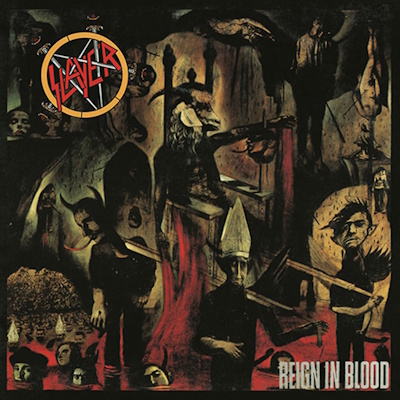
Slayer – Reign In Blood
Reign In Blood
On October 7, 1986, Slayer’s third album, Reign In Blood, was released. The music became faster and faster, averaging at 220 beats per minute, which is one of the reasons the album is only 29 minutes long. The lyrics also took a different direction. After flirting with Satanism, new themes were explored, which Slayer themselves described as being “more on a social level”.
Reign In Blood was soon regarded as the greatest thrash metal album of all time, a title many still believe it holds to this day. The music isn’t just fast, it’s also more complex, packed with tempo changes and infectious riffs.
Slayer was soon grouped together with Metallica, Megadeth, and Anthrax as the “big four” of the thrash metal genre. Reign In Blood was considered the album that firmly put the genre on the map. Even without much promotion, the album made the US album charts and eventually went gold.
The song Angel Of Death, which opens with the lyrics “Auschwitz, the meaning of pain / The way that I want you to die / Slow death, immense decay / Showers that cleanse you of your life”, is about Nazi doctor Josef Mengele and the horrific experiments he carried out at Auschwitz. At times, it seems as if the band revels in all the nauseating details. Nothing could be further from the truth. Composer Hanneman explained in 2004: “When they read the lyrics, there’s nothing I put in the lyrics that says necessarily he was a bad man, because to me – well, isn’t that obvious? I shouldn’t have to tell you that.” The song did cause problems, however, with the band being accused of anti-Semitism and sympathy for Nazism. This led to the album’s release being delayed. Columbia refused to distribute the album, a task that was taken over by Geffen, initially without making the label’s involvement public.
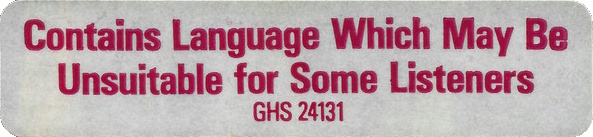
Slayer – Reign In Blood – Warning
Review
Musically, Slayer’s Reign In Blood is a pure shot of adrenaline. Aggression and excitement. The vocals and lyrics, however, leave me cold. The subject matter is certainly less juvenile than on the earlier albums, but still relies heavily on imagery designed to shock, like satanic rituals, and more. The album is also often cited as an inspiration for the emergence of the death metal genre.
The album therefore feels more like aggression for aggression’s sake, whereas bands like Discharge use aggression to express their genuine anger about the world. That emotion comes across as more honest and sincere to me.
But Slayer’s third album sounds absolutely phenomenal and is rightly regarded as a classic of the genre. Of the “Big Four,” Slayer may well have released the most important album, but my preference lies with the other three bands.

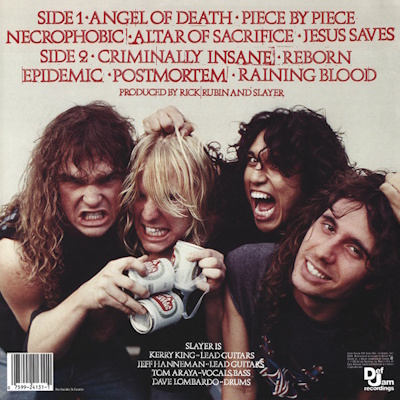
Slayer – Reign In Blood – Back cover
Songs
All songs written by Jeff Hanneman and/or Kerry King.
- Angel Of Death
- Piece By Piece
- Necrophobic
- Altar Of Sacrifice
- Jesus Saves
- Criminally Insane
- Reborn
- Epidemic
- Postmortem
- Raining Blood
Musicians
- Tom Araya – bass, vocals
- Kerry King – guitar
- Jeff Hanneman – guitar
- Dave Lombardo – drums
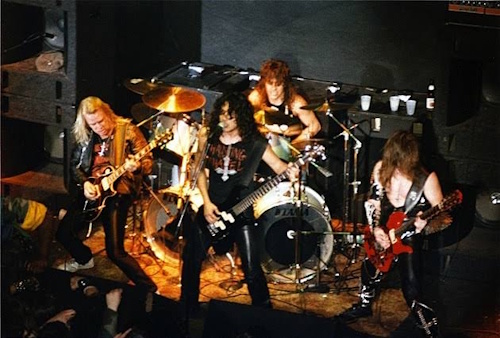
Slayer – Live 1980s
After Reign In Blood
After the album was released, Slayer went on tour. In late 1986, drummer Lombardo left the band. He wasn’t making any money, but a year later Rick Rubin convinced him to rejoin Slayer. This time, he was paid a salary.
Thanks to Reign In Blood, Slayer remained a popular and in-demand live band. They had an excellent reputation as a live act and continued to release albums regularly, but none of them would ever reach the level of Reign In Blood again.
Over the years, the band would release nine more studio albums:
- South Of Heaven (1988)
- Seasons In The Abyss (1990)
- Divine Intervention (1994)
- Undisputed Attitude (1996)
- Diabolus In Musica (1998)
- God Hates Us All (2001)
- Christ Illusion (2006)
- World Painted Blood (2009)
- Repentless (2015)
The original lineup stayed together until 1992, when Lombardo left the band again. He rejoined in late 2001 and remained with Slayer until early 2013. A few months later, Hanneman died. The band continued to tour until 2019, when they officially stopped performing live. In 2024, however, the band reunited for a series of live performances.
Conclusion
What do you think of Slayer and Reign In Blood? Let me know!

Video/Spotify
This story contains an accompanying video. Click on the following link to see it: Video: The story of Slayer’s thrash metal classic Reign In Blood. The A Pop Life playlist on Spotify has been updated as well.

