
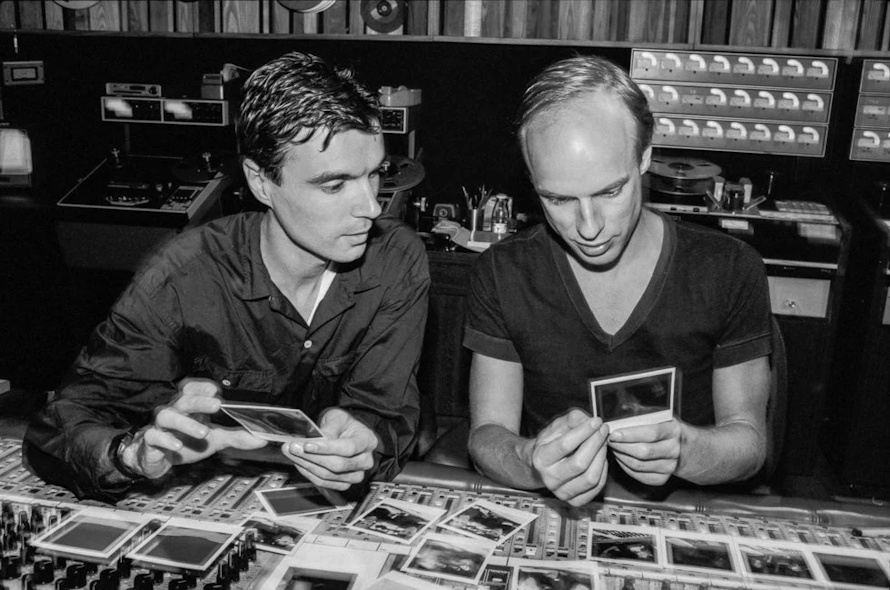
Brian Eno & David Byrne in the studio, 1980
Introduction
My Life In The Bush Of Ghosts was completed before the Talking Heads album Remain In Light, which would ultimately be released three months earlier. The story of an innovative and inventive album with which Brian Eno and David Byrne made history.
Sub-article
This article is linked to a sub-article that focuses on the 2006 reissue of My Life In The Bush Of Ghosts. The edition included liner notes, photographs, essays and more. An official website was also launched: www.bush-of-ghosts.com. The website no longer exists, but many of the texts are available in the sub-article Brian Eno – David Byrne: www.bush-of-ghosts.com. For the reader with enough time.
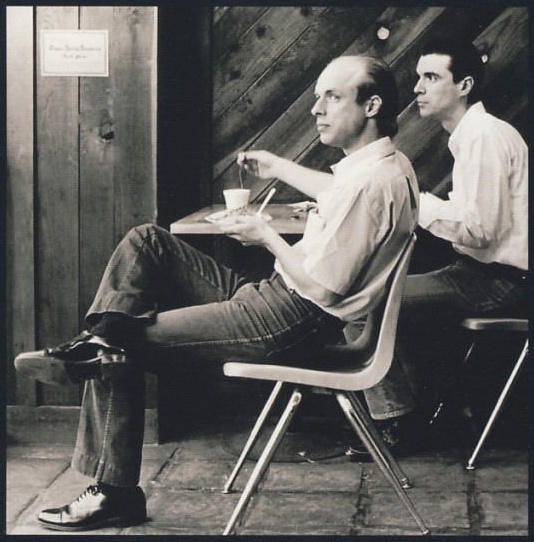
Brian Eno & David Byrne 1980
Brian Eno & David Byrne
In 1977, David Byrne released the debut album by his band Talking Heads: 77, one of my favorite albums. Brian Eno was also impressed. In December 1977, he released his solo album Before And After Science, which included the track King’s Lead Hat. “King’s Lead Hat” is an anagram of “Talking Heads.” Eno and Byrne were therefore destined to work together. Eno produced Talking Heads’ second and third albums, More Songs About Buildings And Food (1978) and Fear Of Music (1979). The band’s music was influenced, partly due to Eno, by (psychedelic) funk (think Parliament and Funkadelic), post-punk and afrobeat (think Fela Kuti).
David Byrne had some time off after the Talking Heads tour for Fear Of Music. Brian Eno had just completed the recordings for Fourth World, Vol. 1: Possible Musics with trumpeter Jon Hassell and also had some time to spend. The idea emerged to record an album together, together with Hassell. The other Talking Heads members viewed this with concern. They felt Byrne was being taken away from them and that Eno increasingly wanted to attach his name more prominently to Byrne’s output, and, by extension, to the band’s. Hassell, too, was critical, especially after he was unable to fly to California, where the recordings began in mid-August 1979.
The next thing was Bush of Ghosts, which came to me as a project that we all (Brian, David and I) were going to do together. … They were going to go out to the desert somewhere in California, get an 8-track and send for me. … I got a tape back a month or so later and it was some North African vocal over a bass and drum loop.
I was outraged. This was clearly a not-too-subtle appropriation of what I was doing over rock drum and bass I thought it was a very unethical thing to do and the fact that I was never credited – even for being an inspiration – is a testament to the testosterone in the room at that time.
Jon Hassell interview, Perfect Sound Forever, July, 1997
Later, the friendship between Eno and Hassell was restored, but Hassell called My Life In The Bush Of Ghosts too “commercial.” Hassell was particularly offended by the way Eno applied his newly acquired knowledge to his collaboration with Byrne.
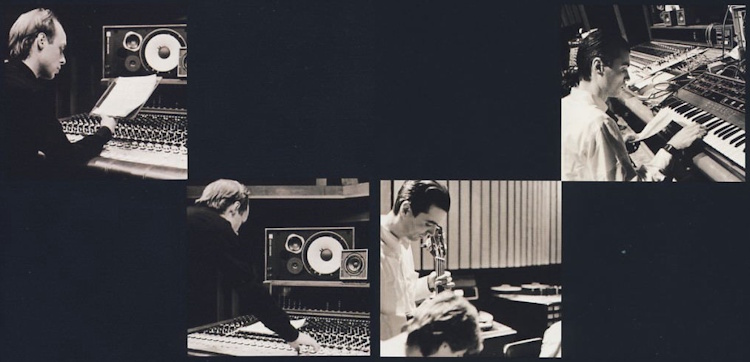
Brian Eno-David Byrne – Recording My Life In The Bush Of Ghosts
Recording
In any case, Eno already had some material prepared for the collaboration with Byrne: Mea Culpa, with the idea of adding voices to it. They agreed that neither of them would sing on their music and eventually settled in Los Angeles. In the studios, they increasingly experimented with rhythmic patterns. Everything was used as a percussion instrument: boxes, metal objects. Guests (including Talking Heads drummer Chris Frantz) were invited to contribute to the music.
In San Francisco, the music was combined with taped voices, conversations, (Eastern) chants and more. Samplers did not yet exist, so all the tapes were manually interwoven. An impressive feat of technical ingenuity, patience and innovation. The final result was entirely unique and groundbreaking.
After the album was completed, countless phone calls, faxes and letters followed in order to obtain the rights to use the voices, conversations, (Eastern) chants and more. This proved time-consuming, extremely time-consuming. Meanwhile, Talking Heads had begun recording their forthcoming masterpiece Remain In Light. Eno had no intention of producing another Talking Heads album, but he still traveled to the Bahamas, where the recordings were taking place. He was so enthusiastic that he decided to participate after all. The My Life In The Bush Of Ghosts sessions proved influential on the music for the next Talking Heads album, which was released on October 8, 1980.
Remain In Light appeared earlier than My Life In The Bush Of Ghosts. Securing the rights dragged on and on. In some cases, this meant starting over with the selected voices, conversations and (Eastern) chants, such as on The Jezebel Spirit, where permission was not granted to use recordings of evangelist Kathryn Kuhlman. After the release of Remain In Light, work continued on what would ultimately become My Life In The Bush Of Ghosts.
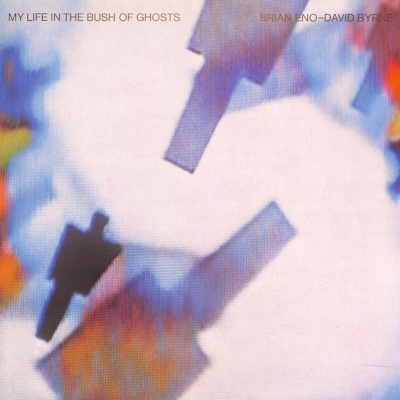
Brian Eno-David Byrne – My Life In The Bush Of Ghosts
My Life In The Bush Of Ghosts
At the beginning of 1981, the time had come: the recordings were ready for release. On February 25, 1981, My Life In The Bush Of Ghosts finally saw the light of day. The combination of African and Middle Eastern rhythms, electronic influences and a ‘dance’ feel was entirely unique. Combined with the samples woven into the music, the album was highly innovative. The juxtaposition is alienating, particularly on tracks where religious expressions are paired with funky, highly danceable rhythms. The prime example is The Jezebel Spirit, featuring an exorcism set to music that makes it impossible for the listener to sit still, but it works equally well on the wonderful Help Me Somebody.
Although there appears to be some debate about the album’s actual influence, it undoubtedly impacted artists and producers. The quote from The Bomb Squad member Hank Shocklee (responsible for the early Public Enemy productions) speaks volumes to me.
I grew up as a David Byrne fan. I admired his work with Talking Heads and those records then led me to ‘My Life In The Bush Of Ghosts’ where I discovered Brian Eno’s work. The collaboration between Byrne and Eno inspired me to think outside the box and opened my head up to new musical and most importantly non-musical experiences.
Hank Shocklee – Producer (Public Enemy)
The above quote (and more) is included in the sub-article Brian Eno – David Byrne: www.bush-of-ghosts.com.
Cover
The original cover was designed by Peter Saville. The image was created using cut-out paper human figures that were placed on a monitor and then filmed by a camera, resulting in a recursive image.
In the liner notes for the 2006 edition of My Life In The Bush Of Ghosts, David Byrne stated:
Somehow, despite it being very techie, these techniques also seemed analogous to what we were doing on the record. It was funky as well as being techie. Extremely lo-tech, actually, and not what you were supposed to do with a TV set.
David Byrne, 2005
The album was named after the 1954 novel My Life in the Bush of Ghosts, written by Amos Tutuola. In those very same liner notes for the 2006 edition of My Life In The Bush Of Ghosts David Byrne said that both he and Eno hadn’t read the novel.
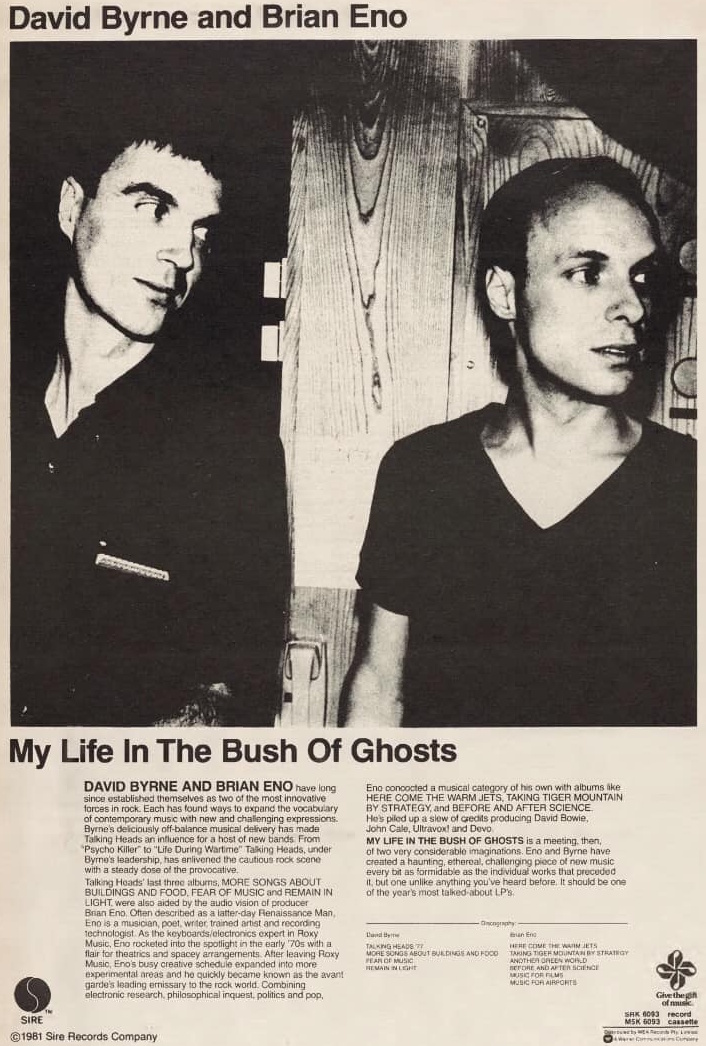
Brian Eno-David Byrne – My Life In The Bush Of Ghosts – Ad
Review
On March 7, 1981, Brian Eno described My Life In The Bush Of Ghosts as a “vision of a psychedelic Africa.” Not only did he do the album a disservice, he also opened the door to labels such as “cultural appropriation,” of which Rolling Stone magazine in particular accused the album. Given the effort that went into tracking down the rightful owners of the sound fragments used, that criticism is somewhat exaggerated. When the request came to remove Qu’ran from the album, that request was honored. Even so, David Byrne stated in the liner notes for the 2006 edition of My Life In The Bush Of Ghosts: “So I think in that sense we reacted maybe with more caution than we had to.”
Setting that discussion aside, what remains is an innovative and inventive album that sounds remarkably current. The rhythms are just as infectious as they were at the time, and the music is still funky, compelling and at times unsettling. Highly recommended!

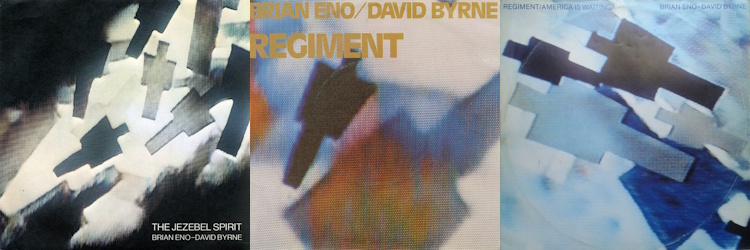
Brian Eno-David Byrne – My Life In The Bush Of Ghosts – Singles
Singles
The album spawned three singles, all released in 1981.
- The Jezebel Spirit / Regiment
- Regiment / America Is Waiting
- The Jezebel Spirit / Regiment / Very, Very, Hungry (Dutch 12-inch edition)
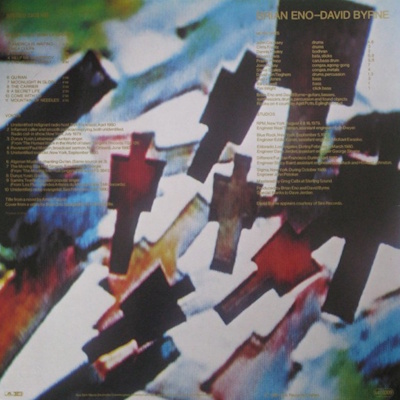
Brian Eno-David Byrne – My Life In The Bush Of Ghosts – Back cover
Songs
All songs written by Brian Eno and David Byrne, except Regiment, written by Brian Eno, David Byrne and Busta Jones.
- America Is Waiting
- Mea Culpa
- Regiment
- Help Me Somebody
- The Jezebel Spirit
- Qu’ran => Very, Very Hungry *
- Moonlight In Glory
- The Carrier
- A Secret Life
- Come With Us
- Mountain Of Needles
* Qu’ran was only available on the first pressing of the album. At the request of the Islamic Council of Great Britain, Qu’ran was removed from the album and replaced by Very, Very Hungry (which had previously only been available on the Dutch 12-inch edition of The Jezebel Spirit).
Samples
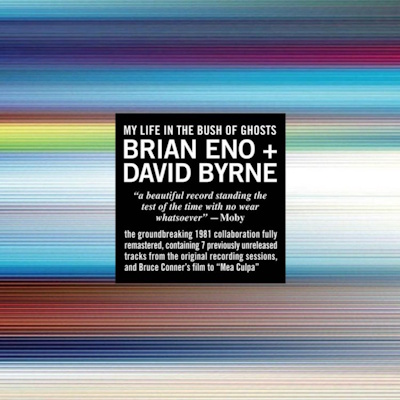
Brian Eno+David Byrne – My Life In The Bush Of Ghosts (2006 reissue)
Musicians
- David Byrne, Brian Eno – guitar, bass, synthesizer, drums, percussion, found objects
- David Van Tieghem – drums, percussion on America Is Waiting, Regiment
- John Cooksey – drums on Help Me Somebody, Qu’ran
- Mingo Lewis – batá, sticks on The Jezebel Spirit, The Carrier
- Prairie Prince – can, bass drum on The Jezebel Spirit, The Carrier
- Tim Wright – click bass on America Is Waiting
- Bill Laswell – bass on America Is Waiting
- Dennis Keeley – bodhrán on America Is Waiting
- Chris Frantz – drums on Regiment
- Busta Jones – bass on Regiment
- Steve Scales – congas, metal on Help Me Somebody
- José Rossy – congas, agong-gong on Moonlight In Glory
- Rooks on Help Me Somebody courtesy of April Potts, recorded at Eglingham Hall
- Robert Fripp – Frippertronics on Regiment (source: dgmlive.com)

David Byrne-Brian Eno – Other releases
After My Life In The Bush Of Ghosts
The Remain In Light album proved to be the last Talking Heads album in which Brian Eno was involved. On August 18, 2008, David Byrne and Brian Eno released their second collaborative album, the beautiful Everything That Happens Will Happen Today. Following its release, David Byrne went on tour: The Songs of David Byrne and Brian Eno Tour. The setlists drew on both collaboration albums, supplemented with Talking Heads material originally produced by Eno. The tour resulted in an EP, Everything That Happens Will Happen on This Tour – David Byrne on Tour: Songs of David Byrne and Brian Eno, released on May 11, 2009, and a film, Ride, Rise, Roar, released on March 15, 2010. On November 18, 2025, David Byrne released the single T Shirt, co-written by Brian Eno.
In closing
My Life In The Bush Of Ghosts is a legendary album that more than lives up to its reputation. What do you think of Brian Eno, David Byrne and My Life In The Bush Of Ghosts? Let me know!

Video/Spotify
This story contains an accompanying video. Click on the following link to see it: Video: Eno and Byrne create history: My Life In The Bush Of Ghosts. The A Pop Life playlist on Spotify has been updated as well.

